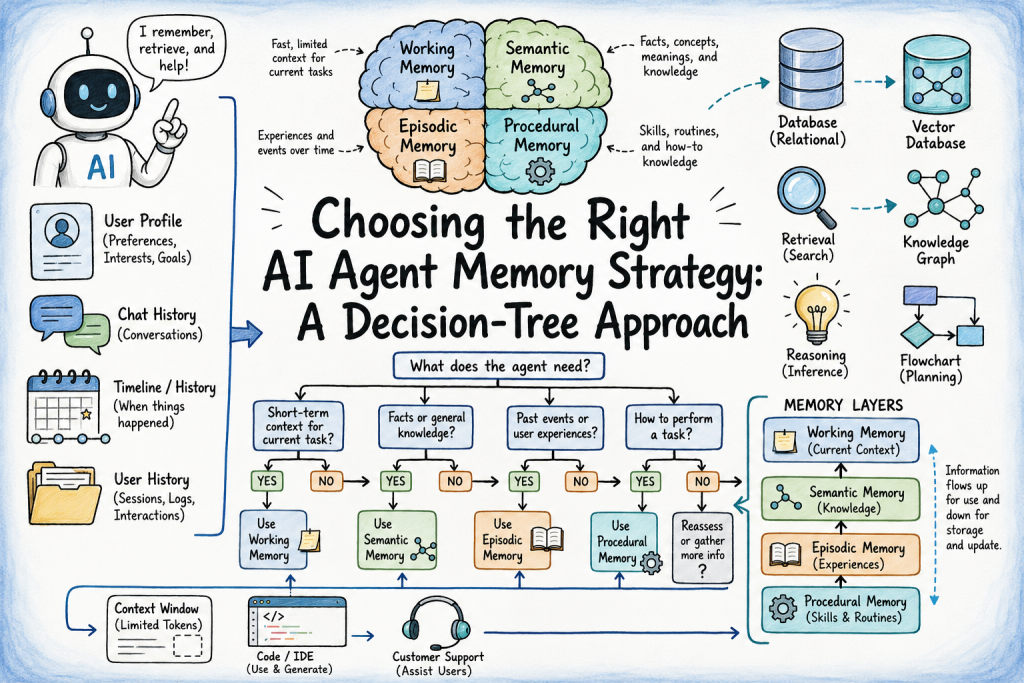
Understanding AI Agent Memory
AI agents, especially those designed for complex tasks, require memory to retain context, learn from interactions, and make informed decisions. The type and strategy of memory employed significantly impact an agent's performance, efficiency, and scalability. Without effective memory, agents would be stateless, repeatedly performing the same actions or failing to build upon previous experiences. Choosing the right memory strategy is not a one-size-fits-all problem; it depends on the agent's purpose, the complexity of its tasks, and the computational resources available.
The core challenge lies in balancing the need for comprehensive information recall with the constraints of processing power and storage. Agents might need to remember a vast history of conversations, specific factual details, or learned behaviors. Different memory architectures serve these diverse needs. For instance, a simple chatbot might only need short-term memory for the current conversation, while a long-term research assistant AI would require a robust system to store and retrieve vast amounts of information.
The Decision-Tree Framework
To navigate this complexity, a structured decision-tree approach offers a pragmatic path. This framework guides developers and researchers by posing a series of questions about the agent's requirements and constraints, leading to a recommended memory strategy. Think of this decision tree less like a rigid set of rules and more like a helpful navigator, pointing you toward the most promising routes based on your specific terrain.
Step 1: Task Complexity and Duration
The first critical question is: How complex and long-running are the tasks the agent will perform?
- Simple, Short-Term Tasks: If the agent performs discrete, short-lived tasks with minimal context carry-over (e.g., answering a single question, performing a basic calculation), a short-term memory or working memory strategy is likely sufficient. This could involve storing recent conversation turns or intermediate results.
- Complex, Long-Term Tasks: For agents engaged in multi-step processes, ongoing projects, or continuous learning (e.g., a personal assistant managing schedules, a research agent synthesizing information over weeks), a more sophisticated memory system is required. This often necessitates long-term memory capabilities.
Step 2: Information Granularity and Volatility
Next, consider what kind of information needs to be remembered and how often does it change?
- Factual, Stable Information: If the agent primarily needs to recall established facts, user preferences, or configuration settings that rarely change, a knowledge base or database-backed memory is suitable. This provides structured, persistent storage.
- Dynamic, Episodic Information: For agents that need to remember specific events, past interactions, user sentiments, or evolving states of the world, episodic memory or contextual memory is crucial. This type of memory is designed to store sequences of events and their associated details.
- Procedural Knowledge: If the agent needs to remember how to perform certain actions or sequences of operations, procedural memory is key. This is often learned through reinforcement or explicit programming.
Step 3: Computational and Storage Constraints
The third crucial consideration is what are the available computational resources and storage limitations?
- Resource-Constrained Environments: In environments with limited CPU, RAM, or storage (e.g., edge devices, embedded systems), simpler, more efficient memory mechanisms are necessary. Techniques like sliding window memory or summarization techniques can reduce the memory footprint.
- Abundant Resources: With ample computational power and storage, agents can afford to maintain larger, more detailed memory stores. This allows for richer context, more extensive history, and potentially more complex reasoning. Techniques like vector databases for semantic search or large-scale knowledge graphs become viable.
Step 4: Retrieval and Reasoning Needs
Finally, evaluate how does the agent need to retrieve and use its memory?
- Direct Lookup: If memory recall is primarily about retrieving specific, pre-defined pieces of information (e.g., a user's name, a specific setting), a simple key-value store or direct database query suffices.
- Semantic Search and Inference: When agents need to find information based on meaning rather than exact keywords, or infer relationships between stored memories, more advanced retrieval mechanisms are needed. This is where vector embeddings and semantic search capabilities within memory systems shine.
- Contextual Reasoning: For agents that need to understand nuanced situations by considering multiple past events or pieces of information simultaneously, a memory structure that supports complex contextual reasoning is vital.
Common AI Agent Memory Strategies
Based on the answers to these questions, several common memory strategies emerge:
- Short-Term/Working Memory: Ideal for immediate context within a single interaction or task. Often implemented as a simple buffer or queue. Low computational cost.
- Long-Term Memory (LTM): Stores information over extended periods. Can be structured (databases, knowledge graphs) or unstructured (text logs, embeddings). Essential for agents that need to learn and adapt over time. Higher computational and storage cost.
- Episodic Memory: Stores specific events or experiences chronologically. Useful for recalling past interactions, understanding sequences, and building a narrative. Often implemented using time-series databases or specialized storage formats.
- Semantic Memory: Stores general knowledge, facts, and concepts independent of specific events. Enables reasoning about the world. Often leverages knowledge graphs or large language model embeddings.
- Procedural Memory: Stores skills, habits, and how-to knowledge. Crucial for agents that need to perform learned tasks or sequences of actions. Can be represented by rule sets, decision trees, or learned policies.
- Vector Databases: A modern approach for storing and retrieving information based on semantic similarity using embeddings. Excellent for large unstructured datasets and finding conceptually related information.
Putting It Together: Example Scenarios
Consider a customer service chatbot. For a single query, it uses short-term memory. If it needs to recall past purchases or support tickets for that user, it accesses a long-term, structured memory (like a CRM database). If the agent is a creative writing assistant, it might use episodic memory to recall plot points and character developments, semantic memory for world-building details, and working memory for the current sentence being drafted.
What is less clear yet, is how to effectively combine these distinct memory types for truly emergent, human-like cognitive capabilities. Current approaches often treat them as separate modules, but true intelligence might require a more integrated, fluid interaction between short-term, long-term, episodic, and semantic memory systems.