The Evaluation Debt You Don't Know You Have
You've meticulously crafted and tested your AI agent. Its performance on your curated test suite is stellar. You deploy with confidence. Then, just weeks later, users start encountering failure modes you never anticipated. This common scenario is the result of what's being called 'evaluation debt,' a problem that 38% of AI teams identify as their primary blocker. The core issue is a fundamental mismatch: your offline evaluation suite measures performance against a known set of tasks, essentially evaluating the past. Production, however, constantly presents a dynamic, evolving landscape—the future. These two worlds rarely align perfectly.
This isn't a minor bug or a limitation of specific frameworks. It's a structural problem inherent in how we currently evaluate AI agents. Existing frameworks like LangSmith, Braintrust, Phoenix, DeepEval, and Arize, while valuable tools for assessing specific aspects of agent performance, are often applied in a way that doesn't bridge the gap between controlled testing and unpredictable real-world deployment. They provide snapshots of performance under ideal or simulated conditions, but fail to capture the continuous, emergent behaviors and edge cases that arise when an agent interacts with the full spectrum of user inputs and environmental variables.
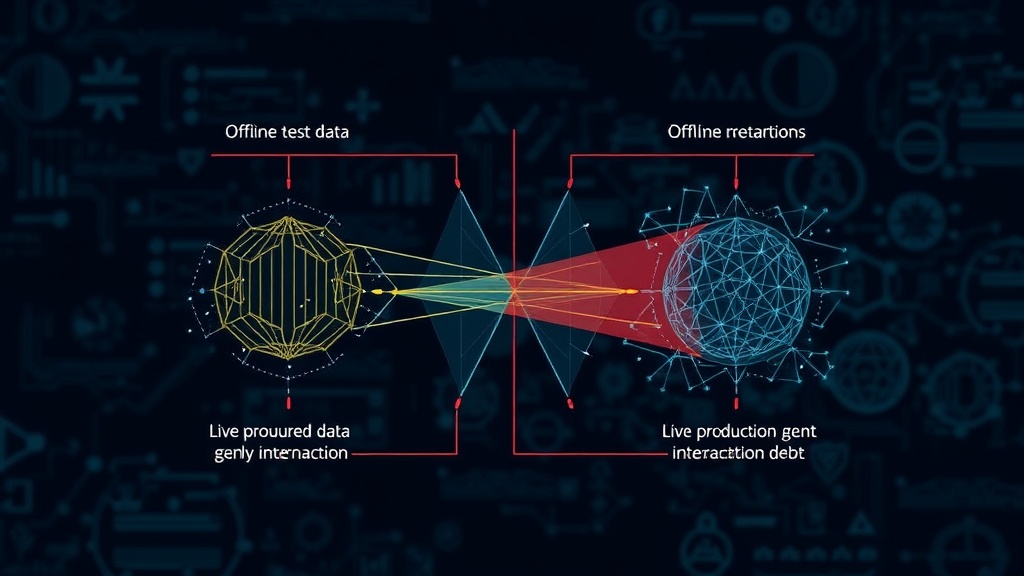
The Root Cause: A Static vs. Dynamic World
The crux of evaluation debt lies in the static nature of traditional evaluation datasets versus the inherently dynamic nature of production environments. When developing an agent, teams typically construct a dataset of representative tasks, often based on anticipated use cases and known failure patterns. The agent is then trained and evaluated against this dataset. The satisfaction of passing these tests, however, can create a false sense of security. The real world, especially in AI applications, is a constantly shifting entity. User queries evolve, external data sources change, and new interaction patterns emerge that were simply not present, or even conceivable, during the offline evaluation phase.
Consider an AI customer service agent. Its offline evaluation might include common query types, product information retrieval, and basic troubleshooting steps. It performs flawlessly on this predefined set. However, in production, it might encounter a user describing a problem using highly colloquial language, referencing a recent, unannounced product change, or attempting to combine multiple complex requests in a single prompt. These scenarios, which represent the true test of an agent's robustness and adaptability, are often absent from static evaluation suites. The agent, having been optimized for a known past, struggles with the unknown future.
The Cost of Unseen Failures
The consequences of this evaluation debt are tangible and costly. For businesses, it translates directly into poor user experience, decreased customer satisfaction, and potentially significant reputational damage. An agent that fails unpredictably erodes user trust, leading to abandonment of the service or product. This can manifest as increased support tickets, negative reviews, and a general perception of unreliability.
From a development perspective, debugging these production failures is exceptionally difficult. The root cause often lies in scenarios that were never captured during the evaluation phase, making them hard to reproduce and fix. Teams might find themselves in a reactive cycle of patching emergent bugs rather than proactively building a resilient system. This firefighting consumes valuable engineering resources that could otherwise be directed towards innovation and improvement. The time spent diagnosing and fixing issues stemming from evaluation debt can significantly slow down product development cycles and increase the overall cost of ownership for AI systems.
Bridging the Gap: Towards Continuous and Dynamic Evaluation
Addressing evaluation debt requires a paradigm shift in how we approach AI agent testing. It's not about finding a better static dataset, but about embracing continuous, dynamic, and adaptive evaluation methodologies. This involves several key strategies:
1. Production Monitoring and Data Drift Detection
The first line of defense is robust production monitoring. Teams need systems in place to continuously track agent performance in real-time. This includes logging all agent interactions, identifying failure points, and analyzing user feedback. Crucially, this monitoring must also focus on detecting data drift – subtle or significant changes in the distribution of production inputs compared to the evaluation data. Tools that can flag when production traffic starts deviating from the expected patterns are essential.
2. Synthetic Data Generation for Edge Cases
To proactively address unseen scenarios, teams can leverage synthetic data generation. Instead of relying solely on historical data or manually curated test sets, sophisticated techniques can be employed to create diverse and challenging edge cases. This could involve using LLMs to generate varied prompts, simulating complex user intents, or creating adversarial examples designed to probe the agent's weaknesses. This approach allows teams to stress-test their agents against a wider range of potential future scenarios before they impact real users.
3. Human-in-the-Loop for Continuous Improvement
A human-in-the-loop (HITL) approach is critical. This doesn't just mean having humans label data for training; it means integrating human oversight into the evaluation process itself. When an agent encounters a novel or uncertain situation, it can flag the interaction for human review. This feedback loop is invaluable for identifying new failure modes, refining evaluation criteria, and continuously updating the agent's knowledge and response strategies. This mimics the adaptive learning process that humans naturally undertake.
4. Beyond Accuracy: Evaluating for Robustness and Safety
Traditional evaluations often focus narrowly on accuracy or task completion rates. However, for agents operating in production, robustness, safety, and ethical considerations are equally, if not more, important. Evaluation metrics need to expand to include measures of resilience against adversarial inputs, fairness across different user demographics, and adherence to safety guidelines. An agent might be accurate on average but still pose significant risks if it fails catastrophically in rare but critical situations.
The Path Forward
Evaluation debt is an unavoidable consequence of deploying AI in dynamic environments, but it is not insurmountable. By shifting from a static, past-oriented evaluation mindset to a dynamic, future-oriented one that prioritizes continuous monitoring, adaptive testing, and human oversight, teams can build more reliable and trustworthy AI agents. Ignoring this debt means accepting a future where unexpected failures are not a bug, but an inevitability.