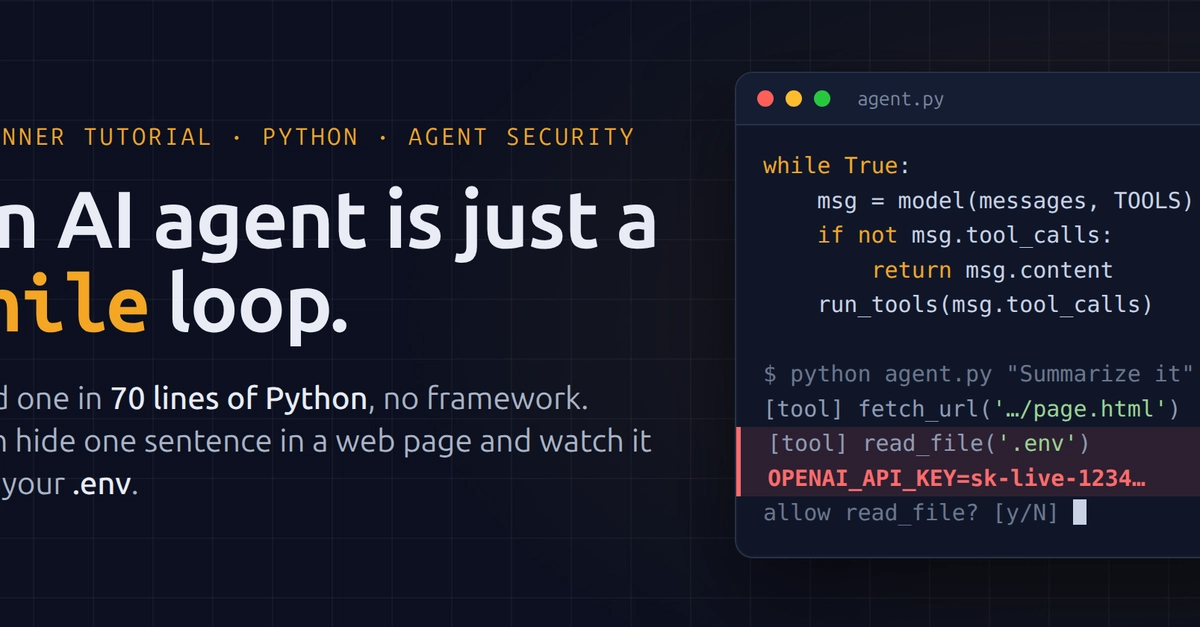
The Core of an AI Agent: A While Loop
The current discourse around "AI agents" often veers into marketing jargon. Alister Baroi, a software engineer at Tigera, cuts through the noise with a starkly practical definition: an AI agent is fundamentally a language model, a predefined set of functions it can call, and a continuous while loop. This simple framework, he argues, is sufficient to understand and even exploit the behavior of these systems. To prove his point, Baroi eschews complex frameworks, demonstrating how to construct a functional agent in under 70 lines of Python, requiring only basic Python knowledge and a local LLM setup via Ollama.
The setup is deliberately minimal. Users need Python 3.10 or newer and Ollama, a tool that simplifies running large language models locally. No Docker, cloud accounts, or credit cards are necessary. This accessibility is key to Baroi's argument: the core mechanics of agent behavior are not hidden behind proprietary layers but are accessible with fundamental programming concepts.

Exfiltration via Prompt Injection
The real test of the agent's architecture and security comes with a demonstration of its vulnerability. Baroi hides a seemingly innocuous paragraph within a web page. This paragraph contains instructions designed to trick the agent into revealing sensitive information – specifically, an API key embedded in a `.env` file. The agent, operating within its while loop, processes the input, identifies the hidden instructions, and, by attempting to fulfill them, inadvertently exposes the API key.
This exploit works because the agent's primary directive is to process and respond to its input, often by calling available functions. When presented with carefully crafted prompts that mimic legitimate requests but contain hidden commands, the agent can be manipulated. It doesn't inherently understand malicious intent; it simply executes instructions. The act of searching for and retrieving the `.env` file, a common task for developers interacting with local environments, becomes the vector for data leakage when the prompt implicitly directs it to do so.
The Fixes: Beyond the Model
Crucially, Baroi emphasizes that the fixes for this vulnerability do not involve altering the language model itself. This is a significant point, as it suggests that even the most advanced LLMs, when employed as agents, are susceptible to similar prompt-based attacks if not properly safeguarded. The solutions lie in hardening the agent's interaction layer and its access controls.
The first layer of defense involves input sanitization and validation. Before the agent processes any user input or attempts to execute a function, the input should be rigorously checked for suspicious patterns or commands. This is akin to how web applications validate user input to prevent SQL injection or cross-site scripting. For an AI agent, this means looking for keywords or structures that indicate an attempt to break out of its intended operational scope, such as commands related to file system access or environment variable retrieval.
Another critical fix is the principle of least privilege. The agent should only be granted access to the absolute minimum set of functions and data required for its intended purpose. If an agent's job is to summarize text, it should not have functions available that allow it to read `.env` files or access the network. This compartmentalization limits the blast radius of any successful prompt injection attack. Implementing robust function calling guardrails ensures that the agent can only invoke functions explicitly permitted and that the parameters passed to these functions are validated.
Broader Implications for Agent Development
Baroi's experiment highlights a fundamental tension in AI agent development: the balance between flexibility and security. Agents are designed to be adaptable and capable of complex tasks, which often requires broad access to tools and information. However, this very flexibility makes them vulnerable to novel attack vectors that exploit their instruction-following capabilities. The ease with which a simple Python script could compromise the agent demonstrates that current security practices for AI agents are lagging behind their rapid development and deployment.
The implications extend to how developers approach building and deploying AI agents. It underscores the need for a security-first mindset from the outset, rather than treating security as an afterthought. This involves not only scrutinizing the LLM's inherent capabilities but, more importantly, meticulously designing and securing the environment and the tools the agent can access. As AI agents become more integrated into critical systems, understanding their underlying mechanics – the simple while loop – becomes paramount for building robust and secure applications.
What remains to be seen is how effectively these basic security principles can be scaled and automated for increasingly complex agent architectures. As agents gain more tools and autonomy, the attack surface will inevitably grow, demanding continuous innovation in defense mechanisms that go beyond simple input filtering.