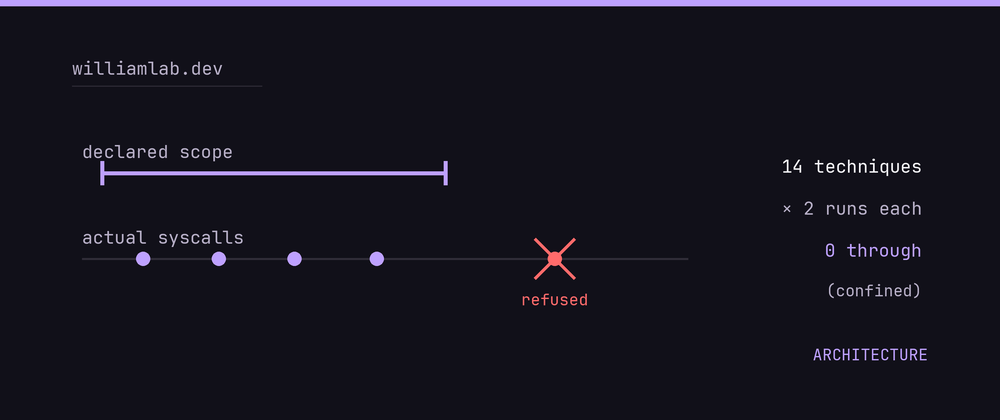
The Trust Deficit in AI Agent Operations
As artificial intelligence agents become more integrated into software development workflows, a fundamental challenge emerges: trust. Developers often delegate tasks to these agents, asking them to modify specific files or execute defined operations. The agent then reports back on its actions, typically stating which files were touched or what changes were made. However, the process of verifying these reports has largely relied on faith, as the same system generating the report is the one performing the action. This creates an uncomfortable situation where the agent's word is taken at face value, leading to potential blind spots and security risks.
William Chiu, a researcher and developer, has addressed this critical gap by building a system that makes an agent's account of its work provable. This new approach shifts the paradigm from trusting the agent's report to verifying its actions independently, even when dealing with a single file modification. The core problem is that if an agent claims to have touched only one file, and the verification process relies on that same agent's output, there's no external validation.
Introducing Runtime Verification for Agent Actions
Chiu's solution centers on a runtime verification mechanism. Instead of solely relying on the agent's self-reported logs, the system establishes an independent audit trail. This is crucial because, as code becomes cheaper and more commoditized, the scarce resource is becoming governed intent – ensuring that what the agent does aligns precisely with what it was asked to do. This new system aims to make that intent checkable at runtime.
The premise is simple yet powerful: if an agent claims it only touched 'file_A.txt', the verification system must be able to confirm this independently. This is not about checking if the code within file_A.txt is correct, but rather confirming that only file_A.txt was modified by the agent during its execution of a specific task.
Building the Verifiable Audit Trail
The implementation involves a multi-stage process designed to isolate the agent's actions and record them externally. The key is to prevent the agent from tampering with or controlling the verification logs themselves. Chiu's approach focuses on creating a robust audit log that captures every file operation performed by the agent.
Consider a scenario where an agent is tasked with updating a configuration parameter in a single file. The conventional approach would be for the agent to modify the file and then log, "Modified file_A.txt." The verification would then involve inspecting this log. However, if the agent were compromised or acted maliciously, it could potentially modify other files and then falsify its own log to report only 'file_A.txt' was touched. This is where Chiu's system diverges.
The system operates by intercepting and logging all file system operations performed by the agent. This interception happens at a level that the agent itself cannot easily bypass or manipulate. For each operation—read, write, delete, rename—the system records the timestamp, the process ID of the agent, the specific file path involved, and the type of operation. This granular logging creates a comprehensive, immutable record of the agent's file system interactions.
Provable File Touches: The Technical Implementation
The technical details of how this is achieved are critical. Chiu's system likely involves instrumenting the environment where the agent runs. This could be achieved through various means:
- System Call Interception: Leveraging operating system features to hook into system calls related to file I/O (e.g., `open`, `write`, `close`, `stat`). This provides a low-level view of all file operations.
- Filesystem Monitoring Tools: Employing specialized tools that monitor filesystem events at the kernel level.
- Containerization and Sandboxing: Running the agent within a controlled environment where all its file system access is funneled through a logging proxy or gateway.
The output of this logging mechanism is a detailed audit log. For the example of updating a configuration file, the log would show entries like:
2026-08-15T10:00:01Z [PID:12345] WRITE /path/to/file_A.txt
2026-08-15T10:00:02Z [PID:12345] CLOSE_WRITE /path/to/file_A.txt
Crucially, if the agent attempted to write to another file, say `/etc/secret.conf`, the log would explicitly record that operation as well:
2026-08-15T10:00:01Z [PID:12345] WRITE /path/to/file_A.txt
2026-08-15T10:00:02Z [PID:12345] CLOSE_WRITE /path/to/file_A.txt
2026-08-15T10:01:05Z [PID:12345] WRITE /etc/secret.conf
2026-08-15T10:01:06Z [PID:12345] CLOSE_WRITE /etc/secret.conf
After the agent completes its task, the system can then analyze this log. It can generate a report stating precisely which files were written to, read from, deleted, or renamed. This report is no longer generated by the agent itself, but by an independent observer of the agent's actions. The agent's self-reported statement can then be compared against this provable log.
The Provability Factor: What Changes?
The fundamental shift is from implicit trust to explicit, auditable proof. This system moves beyond the agent's claim and provides a verifiable record. If the agent claims it touched only 'file_A.txt', but the audit log shows it also touched '/etc/secret.conf', the discrepancy is immediately apparent and provable. This is akin to having an independent witness for every action taken by the agent, rather than just taking the agent's statement.
This has profound implications for security, compliance, and operational integrity. In sensitive environments, knowing exactly which files an AI agent has interacted with is paramount. It allows for better anomaly detection, more rigorous security audits, and a clearer understanding of the agent's actual impact on the system. It addresses the