
The AI Disconnect: Widespread Use, Nascent Infrastructure
The proliferation of artificial intelligence across enterprises has reached a critical juncture. While businesses readily adopt AI tools for everything from customer service to complex analytics, a significant gap persists: the underlying data infrastructure. Many organizations are finding that their existing data platforms, designed for traditional analytics, are ill-equipped to handle the demands of modern AI workloads. This disconnect means that while AI is being used, its potential is often throttled by data silos, governance challenges, and a lack of specialized architecture. Building an AI-native enterprise data platform is not merely an upgrade; it's a fundamental shift in how data is managed, governed, and leveraged.
An AI-native enterprise data platform differs from traditional data warehouses or data lakes in its core design principles. It's built from the ground up with AI and machine learning workloads as a primary consideration, rather than as an afterthought. This means integrating capabilities for data discovery, feature engineering, model training, deployment, and monitoring directly into the platform. Think of it less like a vast, unorganized warehouse where you occasionally find a tool, and more like a hyper-specialized workshop where every tool is at your fingertips, perfectly calibrated for AI-driven creation and operation.
Key Pillars of an AI-Native Data Platform
Constructing such a platform involves several critical components that address the unique challenges AI presents. These pillars ensure that data is not only accessible but also reliable, secure, and optimized for AI model performance.
Data Agents for Intelligent Data Management
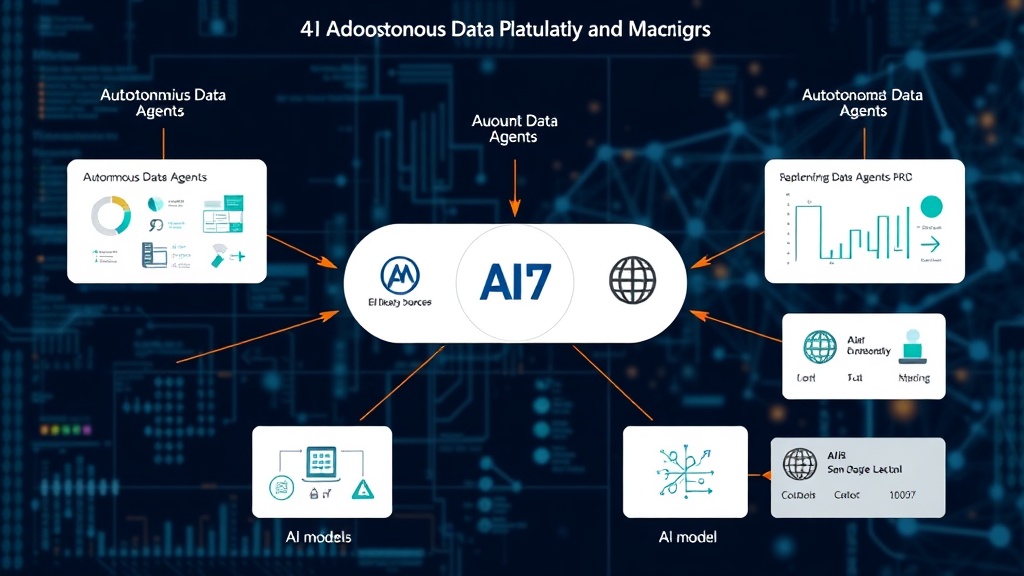
Traditional data management often relies on manual processes or rigid ETL pipelines. An AI-native platform incorporates 'data agents'—intelligent, autonomous software components that can understand data context, perform automated data quality checks, and even suggest data transformations. These agents act like proactive librarians, constantly cataloging, cleaning, and organizing the information. They can identify anomalies, flag potential bias in datasets, and ensure data lineage is meticulously tracked, which is crucial for regulatory compliance and model explainability. This automation frees up data scientists and engineers from tedious data wrangling, allowing them to focus on higher-value tasks like model development and experimentation.
AI-Powered Quality Assurance and Governance
Data quality is paramount for AI success. Poor quality data leads to biased, inaccurate, or unreliable models. An AI-native platform embeds AI into its QA and governance processes. This means using machine learning models to detect data drift, identify outliers, and validate data integrity automatically. Instead of relying on periodic, human-driven audits, the platform continuously monitors data health. AI-powered governance extends this by enforcing policies dynamically. For instance, it can automatically mask sensitive PII based on user roles and data context, or alert teams when data usage patterns deviate from established compliance rules. This proactive approach to quality and governance is essential for building trust in AI systems and ensuring ethical deployment.
Scalability and Performance for Training and Inference
AI models, especially deep learning models, require significant computational resources for training and often for inference. An AI-native platform is architected for extreme scalability, seamlessly integrating with distributed computing frameworks and leveraging specialized hardware like GPUs and TPUs. It provides elastic compute capabilities, allowing resources to scale up or down based on demand. This ensures that training jobs complete in a timely manner and that deployed models can handle real-time inference requests without performance degradation. This agility is vital in a rapidly evolving AI landscape where model iteration and deployment speed are key competitive advantages.
Unified Development and Operations (MLOps) Environment
Bridging the gap between data science and IT operations is a core tenet of an AI-native platform. It provides a unified environment that supports the entire machine learning lifecycle, from experimentation and development to deployment, monitoring, and retraining. This integrated MLOps approach streamlines workflows, improves collaboration between teams, and accelerates the path from model conception to production value. Features like automated model versioning, continuous integration/continuous deployment (CI/CD) for models, and robust model performance monitoring are essential. Without this unified approach, models often languish in development environments, never reaching their full potential in production.
The Road Ahead: From AI Use to AI-Native Enterprise
The transition to an AI-native enterprise data platform is not trivial. It requires a strategic investment in technology, talent, and a shift in organizational mindset. Companies that continue to operate with legacy data architectures will find themselves increasingly outmaneuvered by competitors who can harness the full power of their data through AI. The initial investment in building this robust foundation will pay dividends in faster innovation, more accurate insights, and a more resilient, ethical, and scalable AI strategy.
What remains to be seen is how quickly traditional enterprises can pivot. The technical challenges are significant, but the organizational and cultural inertia might prove to be the greater hurdle. Companies must foster a data-centric culture where AI is not just a tool but an integral part of the operational fabric, supported by infrastructure designed for its unique demands.