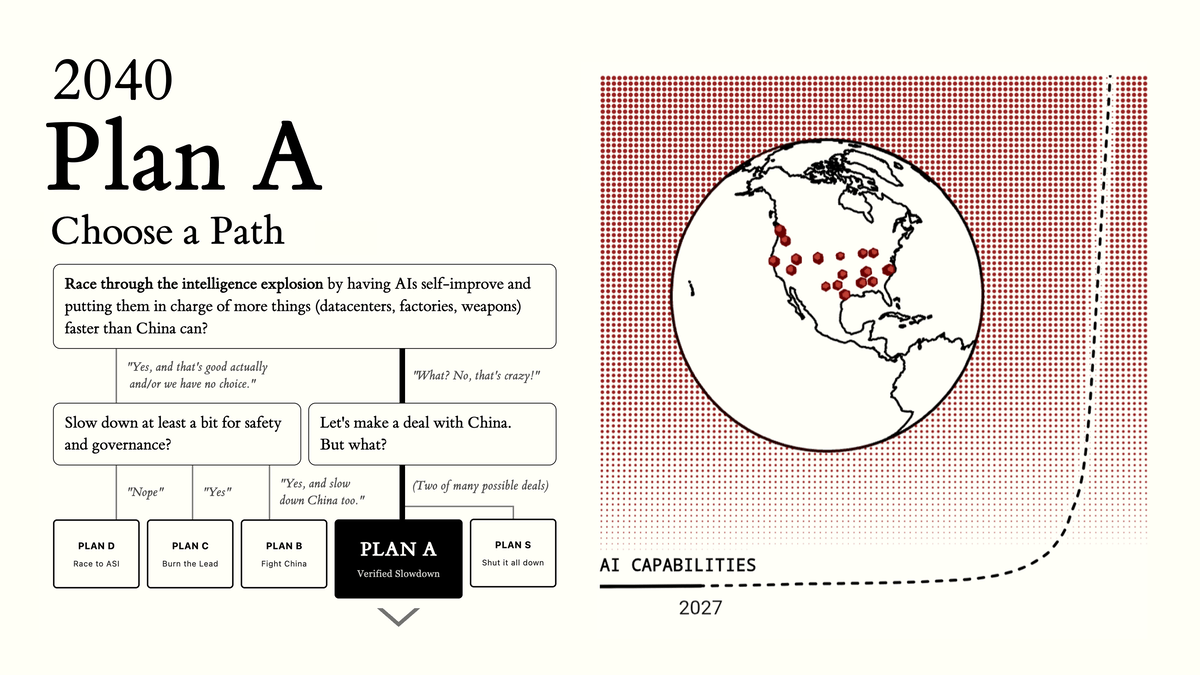
The Vision: AI Integration by 2040
A recently published whitepaper, dubbed "AI 2040: Plan A," lays out an ambitious roadmap for the pervasive integration of artificial intelligence across societal functions by the year 2040. The document, which has garnered significant attention on Hacker News, proposes a future where AI systems are not merely tools but integral components of infrastructure, governance, and daily life. The core thesis revolves around a proactive, planned approach to AI development and deployment, aiming to steer the technology towards beneficial outcomes rather than allowing its evolution to be dictated by market forces alone.
The paper's authors, who remain largely anonymous within the document itself, envision a world where AI assists in complex decision-making, optimizes resource allocation on a global scale, and personalizes education and healthcare to an unprecedented degree. This is not a speculative fiction piece; it's presented as a strategic blueprint. It posits that a coordinated, global effort, akin to the Manhattan Project or the Apollo Program, is necessary to achieve these goals responsibly and effectively. The "Plan A" moniker suggests an optimistic, best-case scenario, implying that alternative, less desirable outcomes are possible if such a structured approach is not adopted.
Key Pillars of Plan A
"AI 2040: Plan A" is structured around several key pillars, each addressing a critical facet of AI's future integration:
- Ubiquitous AI Infrastructure: The plan calls for the development of a robust, globally accessible AI infrastructure. This includes standardized protocols, secure data-sharing frameworks, and high-performance computing resources accessible to all nations and organizations. The aim is to democratize AI capabilities, preventing a future where only a few entities control advanced AI.

- Ethical AI Governance: A significant portion of the whitepaper is dedicated to establishing a global ethical framework for AI development and deployment. This includes mechanisms for accountability, transparency, and bias mitigation. The authors propose international bodies to oversee AI ethics, akin to existing nuclear non-proliferation treaties, but focused on AI safety and alignment.
- Human-AI Collaboration: Rather than a future of AI replacing humans, Plan A emphasizes a symbiotic relationship. It outlines strategies for AI to augment human capabilities in fields like scientific research, creative arts, and complex problem-solving. The focus is on AI as a co-pilot, enhancing human potential rather than supplanting it.
- Adaptive Education and Workforce Development: Recognizing the transformative impact of AI on employment, the plan includes a strong component on re-skilling and up-skilling the global workforce. It advocates for educational systems that adapt rapidly to new AI-driven job markets, fostering lifelong learning and critical thinking skills necessary to navigate an AI-infused world.
Developer Reaction and Unanswered Questions
The response from the developer community, as evidenced by Hacker News discussions, has been a mix of intrigue, skepticism, and outright concern. While the ambition of the plan is undeniable, many developers are grappling with the practicalities of its implementation. The sheer scale of the undertaking, requiring unprecedented global cooperation and technological advancement, raises immediate questions about feasibility. How can such a complex, multi-decade project be coordinated across diverse political and economic landscapes?
One of the most persistent concerns centers on the role of developers themselves. The whitepaper's vision of a planned AI future could imply centralized control over AI development, potentially stifling the innovation and open-source ethos that has characterized much of the AI revolution to date. What happens to the vibrant ecosystem of independent AI researchers and developers if a global, standardized infrastructure becomes the primary mode of operation? Will this plan inadvertently create a new form of technological gatekeeping, albeit one with benevolent intentions?
Furthermore, the paper is conspicuously light on the specific technical architectures required to realize such a vision. While it speaks of "standardized protocols" and "high-performance computing," the concrete details for achieving AI systems that are simultaneously powerful, ethical, and universally accessible remain elusive. This lack of technical depth leaves many developers questioning whether "Plan A" is a genuine blueprint or a high-level philosophical statement.
The 'Plan B' Shadow
The very existence of "AI 2040: Plan A" implicitly suggests the possibility of a "Plan B" – a less controlled, potentially more chaotic or even detrimental trajectory for AI development. The whitepaper doesn't explicitly define Plan B, but the underlying message is clear: without a concerted, proactive global strategy, the future of AI could be fraught with risks, including unchecked AI power, societal disruption, and existential threats. This framing, while intended to galvanize action, also feeds into the broader anxieties surrounding advanced AI, prompting discussions about AI safety research, alignment challenges, and the potential for unintended consequences.
The surprise here is not the articulation of an optimistic AI future, but the framing of it as a singular, deliberate "Plan A." It implies a level of foresight and control over technological destiny that is rarely achieved. The challenge now lies in translating this ambitious vision into actionable steps that can garner the necessary global consensus and technical execution. Whether "AI 2040: Plan A" becomes a guiding star or a cautionary tale will depend on the collective response of technologists, policymakers, and the public in the coming years.