
Introducing agents-cli
A new command-line interface tool, agents-cli, has emerged with the explicit goal of simplifying the development and deployment lifecycle of AI agents. In the rapidly evolving landscape of artificial intelligence, agents are becoming increasingly sophisticated, capable of performing complex tasks autonomously. However, the process of building, testing, and deploying these agents often involves intricate workflows and a steep learning curve. agents-cli aims to abstract away much of this complexity, providing developers with a unified and intuitive interface.
The core promise of agents-cli is to act as the central hub for an AI agent's operational needs. This means it's not just about writing code; it's about managing the agent's environment, its dependencies, its execution, and its eventual deployment. For developers already immersed in the command-line environment, this tool intends to feel like a natural extension of their existing toolset, rather than another abstraction layer to learn.
Think of agents-cli less like a new IDE and more like a specialized toolkit for a master craftsman. If building an AI agent is akin to constructing a complex automaton, agents-cli provides the precision tools for assembly, calibration, and integration. It’s designed to handle the nitty-gritty of shipping these intelligent systems, which often involve managing model versions, data pipelines, and interaction protocols.
Key Functionality and Developer Experience
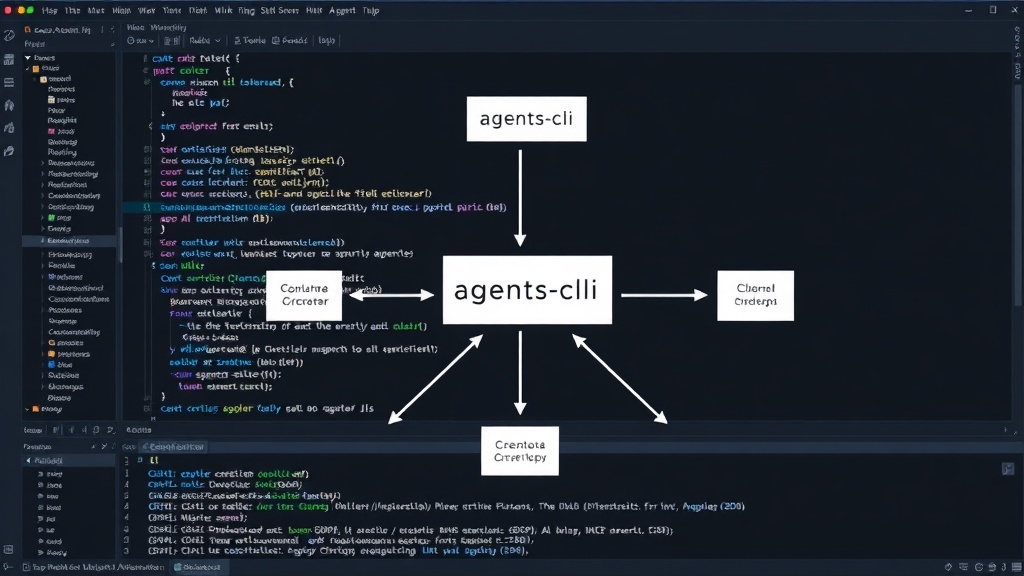
While specific technical details are still emerging, the product description suggests a focus on several key areas that are critical for agent development:
- Agent Definition and Configuration: The CLI likely provides commands to define the architecture of an agent, including its core logic, memory, tools, and any external services it needs to interact with. Configuration management is crucial for agents that might operate in different environments or with different parameters.
- Development and Testing: A significant hurdle in agent development is effective testing. agents-cli is expected to offer features that facilitate local testing and simulation environments, allowing developers to iterate rapidly without full-scale deployment. This could include mocking external services or providing synthetic data generation capabilities.
- Deployment and Orchestration: The ultimate goal is to ship agents. The CLI should provide straightforward commands to package an agent and deploy it to various target environments, whether that's a cloud platform, a local server, or an edge device. Orchestration features might also be included to manage multiple agents or complex agent networks.
- Monitoring and Management: Once deployed, agents require ongoing monitoring. agents-cli could offer integrated tools for observing agent performance, resource utilization, and error reporting, providing insights into their operational health.
The emphasis on a CLI-first approach signals a commitment to developer workflow integration. Many developers prefer the speed and scriptability of command-line tools for automation and repetitive tasks. By offering a robust CLI, agents-cli positions itself as a tool that can be easily integrated into existing CI/CD pipelines and automated workflows. This is particularly important for AI development, where experimentation and iteration are constant.
The Broader Context of AI Agent Development
The emergence of tools like agents-cli is a direct response to the growing demand for sophisticated AI agents. These agents are envisioned as the next frontier in human-computer interaction, moving beyond simple task execution to more proactive and collaborative roles. Companies are exploring agents for everything from customer service and software development to scientific research and personal assistance.
However, building these agents presents unique challenges. Unlike traditional software, AI agents often involve complex state management, continuous learning, and the need to interact with dynamic, unpredictable environments. The underlying models themselves are also constantly evolving, requiring developers to manage dependencies on large language models (LLMs) and other AI components.
This is where a specialized tool like agents-cli can make a significant impact. By providing a standardized way to manage the lifecycle of an agent, it can accelerate innovation and reduce the barrier to entry for creating and deploying these advanced AI systems. It democratizes the ability to build agents, moving it from a highly specialized research endeavor to a more accessible development practice.
What’s Next for agents-cli?
The initial announcement on Product Hunt suggests that agents-cli is in its early stages. The true measure of its success will lie in its adoption by developers and its ability to address the real-world pain points of building and shipping AI agents. Developers will be looking for comprehensive documentation, active community support, and a clear roadmap for future features.
The surprising detail here is not the tool itself, but the timing. As the capabilities of LLMs expand, so does the desire to operationalize them into agents. Tools that can bridge the gap between raw model power and deployed, functional agents are becoming essential. agents-cli appears to be positioning itself to fill that critical niche.
The question now is how well agents-cli will integrate with the diverse ecosystem of AI tools and platforms. Will it support multiple LLM providers? How flexible will its deployment options be? The answers to these questions will determine whether agents-cli becomes an indispensable tool for the burgeoning field of AI agent development, or another promising project that doesn't quite bridge the gap from concept to widespread adoption.