
Introducing Agentproto 0.5.0: Secure, Remote, and Accountable Agent Deployments
Agentproto has just released version 0.5.0, a significant update that addresses critical aspects of deploying and managing AI agents. Building on the foundation of version 0.4.0, which transformed the daemon into a supervision surface, this new release introduces robust credential management, secure sandboxing capabilities, and a novel approach to cost accounting designed for transparency and accuracy. This release, comprising 37 packages with six new additions, aims to make agent deployments more secure, versatile, and measurable.
Arc 1: Secure Authentication with Agentproto Auth
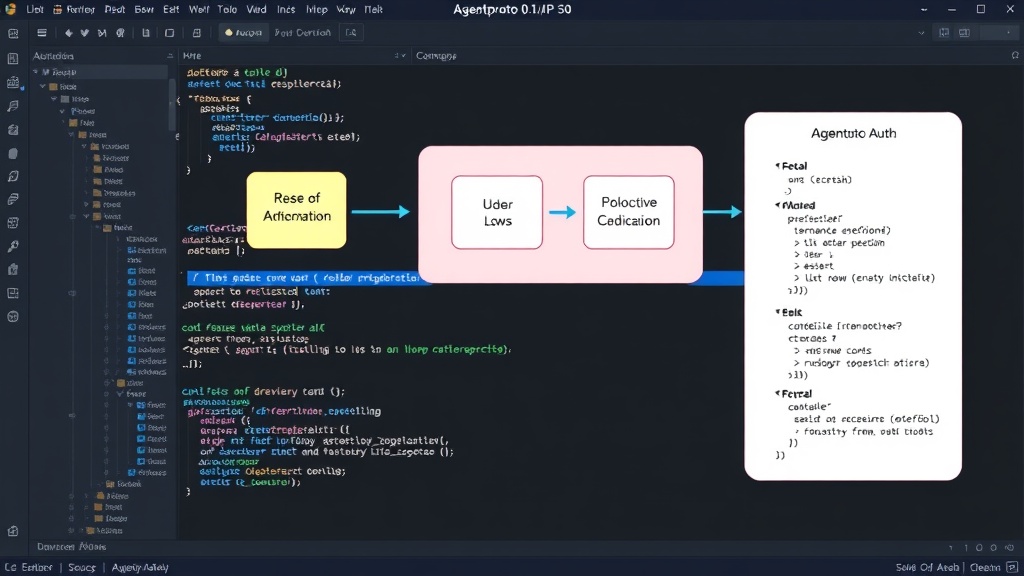
The most prominent feature in this release is the introduction of @agentproto/auth@0.1.0, a dedicated package for handling agent authentication. This package fully implements AIP-50, a standard for agent authentication. It offers three distinct CredentialStore backends: Keychain for secure system-level storage, Memory for in-process, ephemeral storage, and File for persistent storage on disk. This flexibility allows developers to choose the most appropriate security model for their specific deployment environment.
At the heart of the authentication system is a full RFC 8628 device-code flow engine. This standard OAuth 2.0 flow enables user authorization for agents through a secondary device, such as a mobile phone, without requiring direct user input on the agent's execution environment. This is particularly useful for agents that operate in headless or remote servers.
The CredentialBroker component is a key innovation. It simplifies the process of obtaining credentials by abstracting away the complexities of different authentication providers. Developers can request headers by provider path, and the broker intelligently fetches and formats them, ready for use in API requests. This means sensitive credentials never need to touch the agent's environment variables or configuration files, significantly reducing the attack surface.
Arc 2: Isolated Execution with Agentproto Sandboxes
@agentproto/sandbox@0.1.0 introduces a crucial security and isolation layer for agent execution. This package provides a robust sandboxing mechanism, ensuring that agents run in controlled environments with defined resource limits and permissions. This prevents agents from interfering with the host system or other agents, and mitigates risks associated with untrusted or malicious agent code.
The sandbox implementation is designed to be lightweight yet effective. It leverages system-level features to create isolated execution contexts. This isolation is critical for multi-tenant environments or when running agents from various sources, where security and resource contention are major concerns. By default, these sandboxes have restricted access to the network, filesystem, and system processes, offering a strong security posture out-of-the-box.
Developers can configure various aspects of the sandbox, including CPU and memory limits, allowed network access, and permitted filesystem paths. This granular control empowers users to tailor the isolation level to their specific needs, balancing security requirements with the operational demands of their agents. The ability to run agents in these secure environments is a major step towards deploying complex agent systems reliably and safely.
Arc 3: Transparent Cost Accounting
A critical challenge in managing AI agents, especially those with significant computational or API call costs, is accurate and transparent cost accounting. Agentproto 0.5.0 tackles this head-on with its new cost accounting features, integrated across the platform. This system is designed to be honest and detailed, providing developers with clear insights into where their agent's resources are being spent.
The cost accounting system tracks various metrics, including CPU time, memory usage, network bandwidth, and importantly, calls to external LLM APIs or other metered services. Unlike previous methods that might rely on estimations or opaque billing, Agentproto's approach aims to provide near real-time, granular data on resource consumption. This data is aggregated and presented in a way that is easily understandable, allowing for precise budget management and cost optimization.
The system is built to be extensible. Developers can define custom cost models or integrate with existing billing infrastructure. For instance, if an agent makes calls to OpenAI, Anthropic, or Google AI, the cost accounting module can track these specific API calls, their token usage, and translate them into monetary values based on provider pricing. This level of detail is invaluable for businesses looking to control operational expenses and for developers aiming to build cost-efficient AI applications. The refusal to lie about costs means developers can trust the figures presented, enabling informed decisions about agent design and deployment strategy.
Broader Implications and Future Directions
The release of agentproto 0.5.0 marks a maturation of the platform, moving beyond basic agent orchestration to sophisticated, secure, and accountable deployment. The integration of robust authentication, secure sandboxing, and transparent cost accounting addresses key pain points for developers and organizations looking to operationalize AI agents at scale.
The focus on AIP-50 and RFC 8628 for authentication signals a commitment to industry standards, enhancing interoperability and security. The sandboxing capabilities provide a much-needed layer of protection, making it safer to deploy diverse agent workloads. Most importantly, the honest cost accounting feature offers a level of financial transparency that is often lacking in complex distributed systems, empowering users to manage budgets effectively.
If you're building or deploying AI agents, the implications are clear: Agentproto 0.5.0 provides the tools to do so more securely, reliably, and with a clear understanding of the financial implications. This release sets a new benchmark for what to expect from agent orchestration platforms, particularly for those operating in sensitive environments or managing significant operational costs.