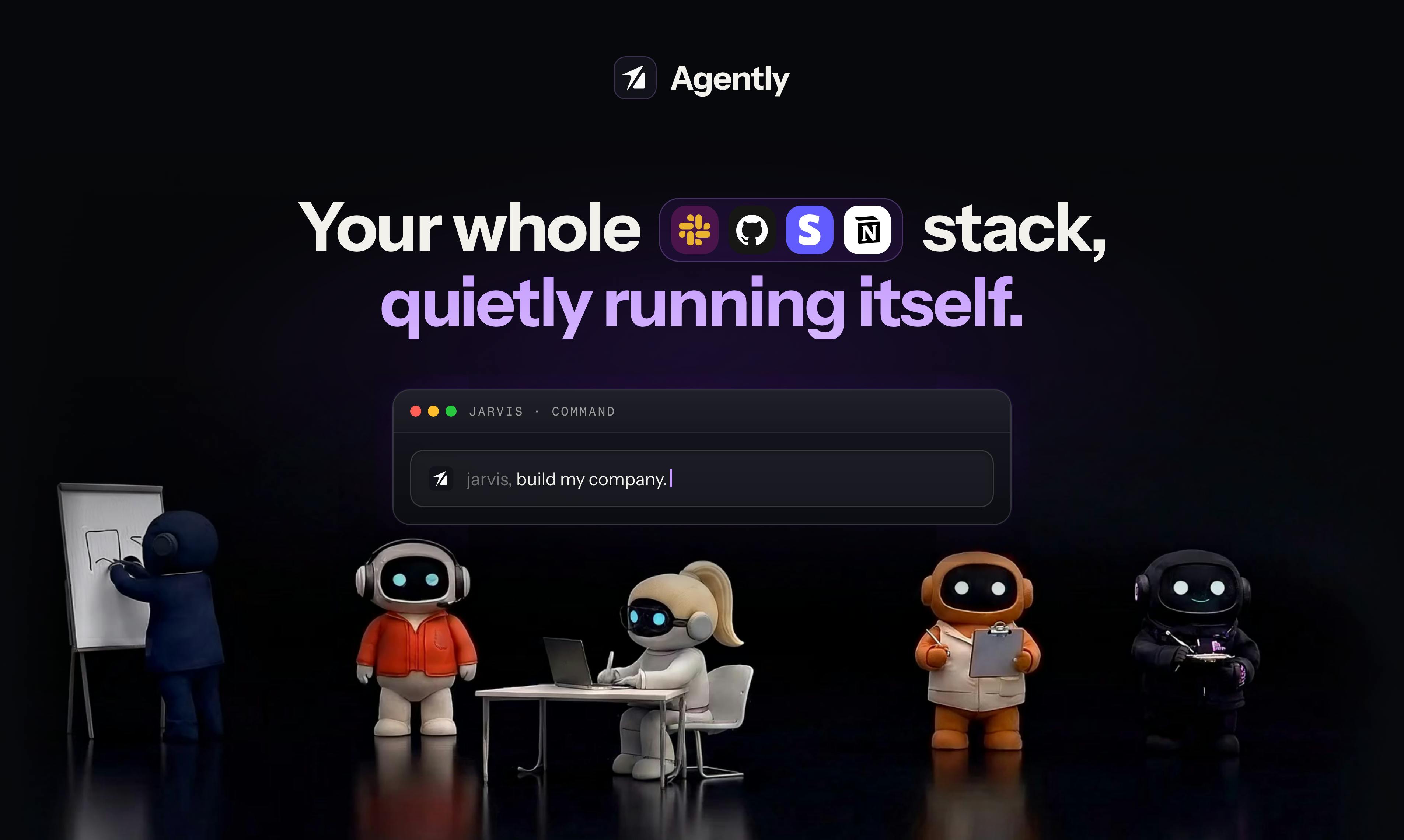
Agently: Orchestrating the Modern Tech Stack
Agently emerges with a bold promise: to automate your entire technology stack. In an era where development teams juggle an ever-growing array of specialized tools for coding, testing, deployment, monitoring, and security, the complexity of managing these disparate systems has become a significant overhead. Agently positions itself as the central nervous system for this distributed ecosystem, aiming to bring order and automation to the chaos.
The platform's core proposition is to act as an intelligent orchestrator. Instead of developers manually configuring and connecting each service – the CI/CD pipeline, the cloud infrastructure, the security scanning tools, the logging services – Agently seeks to abstract this complexity away. It aims to understand the dependencies and workflows inherent in a typical software development lifecycle and manage them autonomously. This is not merely about scripting; Agently suggests a deeper level of intelligence, capable of reacting to events and making decisions across the stack.
Consider the typical journey of a code commit. It triggers a build, followed by unit tests, then integration tests, security scans, and finally, deployment to various environments. Each of these steps involves multiple tools, often from different vendors, each with its own configuration, APIs, and potential failure points. Agently's goal is to ingest these processes, understand the desired outcomes, and ensure they happen reliably and efficiently, without manual intervention at each juncture.

Automating the Labyrinth of Development Tools
The challenge Agently tackles is substantial. Modern development environments are a mosaic of specialized services. Developers use Git repositories (GitHub, GitLab, Bitbucket), CI/CD platforms (Jenkins, GitHub Actions, CircleCI), cloud providers (AWS, Azure, GCP), container orchestration (Kubernetes, Docker Swarm), infrastructure as code (Terraform, Pulumi), monitoring tools (Datadog, Prometheus, Grafana), logging solutions (ELK stack, Splunk), and a host of security scanning tools (SAST, DAST, SCA). Each requires configuration, maintenance, and integration.
Agently's approach appears to be built around defining desired states and outcomes. Rather than specifying the exact commands for each tool, users would theoretically define what success looks like – for example, a successful build, passing all tests, a security vulnerability score below a certain threshold, and a successful deployment to production. Agently would then be responsible for selecting the appropriate tools, configuring them, executing the tasks, and handling any intermediate steps or failures.
This abstraction aims to free up developer time. Instead of spending hours setting up and debugging pipelines or infrastructure, developers can focus on writing code and building features. The platform suggests it can manage updates to underlying tools, ensuring that the development environment remains current and secure without requiring manual patching or re-configuration across the board. This could be particularly valuable for smaller teams or startups that lack dedicated DevOps or SRE personnel.
The Promise of an Autonomous Stack
The implications of a truly autonomous tech stack are significant. For founders, it could mean faster time-to-market and reduced operational costs. For development teams, it promises a more streamlined and less error-prone workflow. The potential for Agently lies in its ability to act as a universal adapter, translating high-level objectives into concrete actions across a heterogeneous landscape of software and services.
However, the devil is in the details. The success of such a platform hinges on its ability to integrate deeply and reliably with a vast and constantly evolving set of third-party tools. The complexity of modern software stacks means that edge cases and unique configurations are common. Agently’s ability to infer, adapt, and correctly orchestrate these diverse scenarios will be its ultimate test. The platform needs to be more than a sophisticated script runner; it must possess a nuanced understanding of software delivery and operations.
What remains to be seen is how Agently handles the inevitable complexities and exceptions that arise in real-world development. Can it intelligently debug a failing test suite across multiple services? Can it gracefully manage rollbacks when a deployment introduces unexpected issues? The promise of an entirely self-running stack is compelling, but the path to achieving it is fraught with technical challenges that Agently will need to overcome to gain widespread adoption.