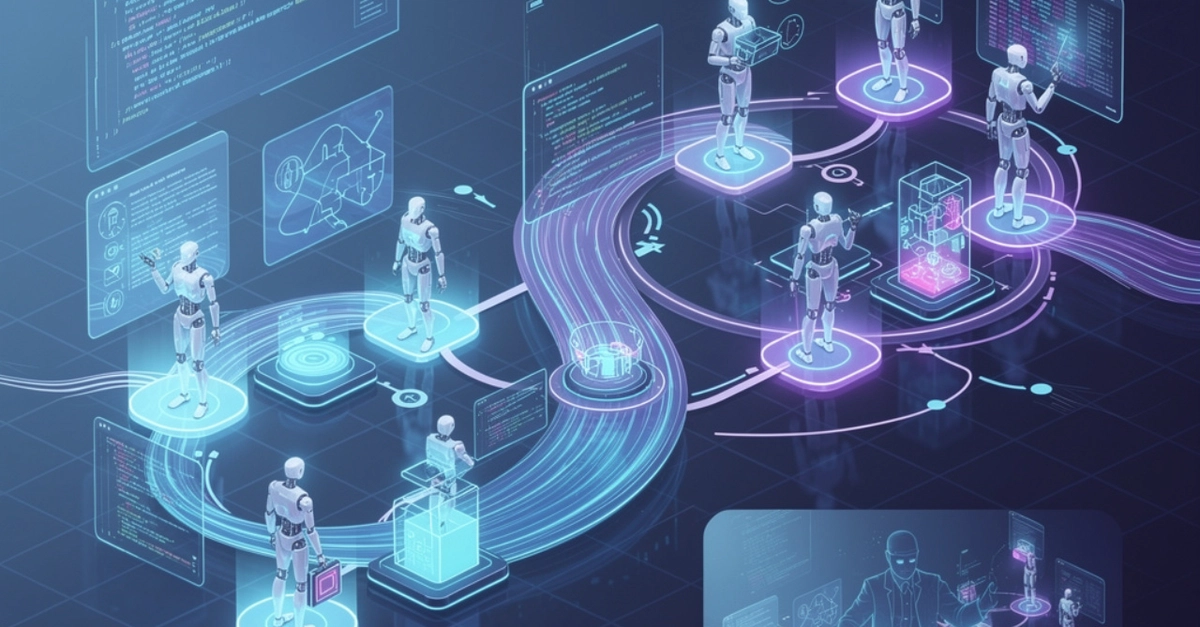
The Evolution of AI in Development Workflows
For years, AI has been a steadily growing presence in the developer's toolkit. It started as a helpful assistant, capable of debugging tricky React components, generating repetitive boilerplate code, or explaining complex, unfamiliar concepts. The common interaction model was straightforward: a developer would ask a question or provide a prompt, the AI would generate an output, and the developer would then review and refine that output. This reactive approach, where AI serves as a sophisticated autocomplete or a tireless intern, has saved countless hours and accelerated development cycles.
However, a new term has begun to surface in developer discussions, conference talks, and technical articles: Agentic Software Development. Initially, it might sound like just another piece of AI jargon. But digging deeper reveals a fundamental shift in how we can conceive of and build software with AI.
Beyond Prompt-Response: Understanding Agentic Development
Agentic Software Development describes a paradigm where AI agents are not just passive responders but active participants in the development lifecycle. Instead of simply taking instructions, these agents can understand goals, plan steps, execute tasks, and even self-correct. They can take a high-level objective, break it down into smaller, manageable tasks, and then autonomously work towards completing them. This is a significant departure from the current prompt-response loop.
Think of it less like a chatbot you ping for answers and more like a junior developer who you can assign a task to, and they'll come back with a working solution, potentially asking clarifying questions along the way or even suggesting improvements you hadn't considered. The key distinction is the agent's ability to perform a sequence of actions, learn from the results, and adapt its strategy without constant human intervention for each micro-step.
Key Characteristics of Agentic Systems
Several core characteristics define agentic software development:
- Autonomy: Agents can operate independently to achieve a goal without direct, step-by-step human command.
- Goal-Oriented: They are designed to accomplish specific objectives, which can range from writing a feature to optimizing performance.
- Planning and Reasoning: Agents can break down complex goals into smaller sub-tasks, strategize their execution, and reason about the best course of action.
- Tool Use: They can interact with external tools, such as code editors, compilers, testing frameworks, APIs, and even search engines, to gather information and execute tasks.
- Learning and Adaptation: Agents can learn from their experiences, feedback, and the results of their actions to improve their performance over time.
From Frontend Assistant to Autonomous Coder
For a frontend developer, this shift means moving from an AI that helps you write code to an AI that can potentially write significant portions of your application. Imagine defining the user stories for a new feature, and an agentic system then:
- Generates the component structure.
- Writes the JSX and CSS.
- Implements the necessary state management logic.
- Writes unit and integration tests.
- Runs these tests and iterates based on failures.
- Submits a pull request for review.
This is not science fiction; early iterations of these capabilities are already emerging. Tools are being developed that can take a natural language description of a feature and translate it into functional code. The agentic approach amplifies this by allowing the AI to manage the entire process, from initial interpretation to a tested, deployable artifact. The developer's role evolves from being the primary coder to being the orchestrator, reviewer, and quality assurance manager. You become the architect and the product owner, setting the vision and validating the execution.
The Learning Curve for Developers
Adopting agentic development requires a new mindset. Instead of focusing on the minute details of syntax and implementation, developers will need to excel at:
- Precise Goal Definition: Clearly articulating what needs to be built and the desired outcomes. This requires a deep understanding of the problem domain and user needs.
- System Design: Designing the overall architecture and how different agentic components will interact.
- Prompt Engineering for Agents: Crafting complex prompts that guide agents through multi-step processes and define success criteria.
- Verification and Validation: Rigorously testing and reviewing the output of agents to ensure correctness, security, and adherence to standards.
- Debugging Agent Behavior: Understanding why an agent might fail or produce suboptimal results and how to correct its course.
The surprising detail here is not that AI can write code, but that it can now be tasked to manage the *entire process* of building a feature. This moves AI from a code-generation tool to a development partner. The challenge for developers is to adapt their skills to this higher level of abstraction, focusing on strategy and oversight rather than direct implementation.
The Future of Software Creation
Agentic software development promises to accelerate innovation dramatically. It allows teams to tackle more ambitious projects with fewer resources and to iterate on ideas at an unprecedented speed. For individual developers, it offers the potential to offload tedious tasks and focus on more creative and strategic aspects of software engineering.
However, it also raises questions. What happens to the current skill sets that are heavily focused on manual coding? How do we ensure the quality and security of software built autonomously? These are challenges the industry will need to address as agentic development matures.
For frontend developers, this is not just another tool; it's a fundamental change in the development landscape. Embracing this shift means learning to collaborate with AI agents that can act with increasing autonomy, transforming the way we build the web.