The Core Distinction: Single Agent vs. Orchestrated System
The burgeoning field of artificial intelligence is rapidly evolving, and with it, the terminology used to describe its capabilities. Two terms frequently appear, often interchangeably, yet denoting fundamentally different approaches: 'AI Agents' and 'Agentic AI'. Understanding this distinction is not merely an academic exercise; it's critical for developers, founders, and anyone deploying AI systems to choose the right architecture for their specific needs. At its heart, the difference lies in scope and complexity: a single AI agent excels at well-defined, singular tasks, while agentic AI represents a sophisticated orchestration of multiple agents designed to tackle complex, multi-step goals.
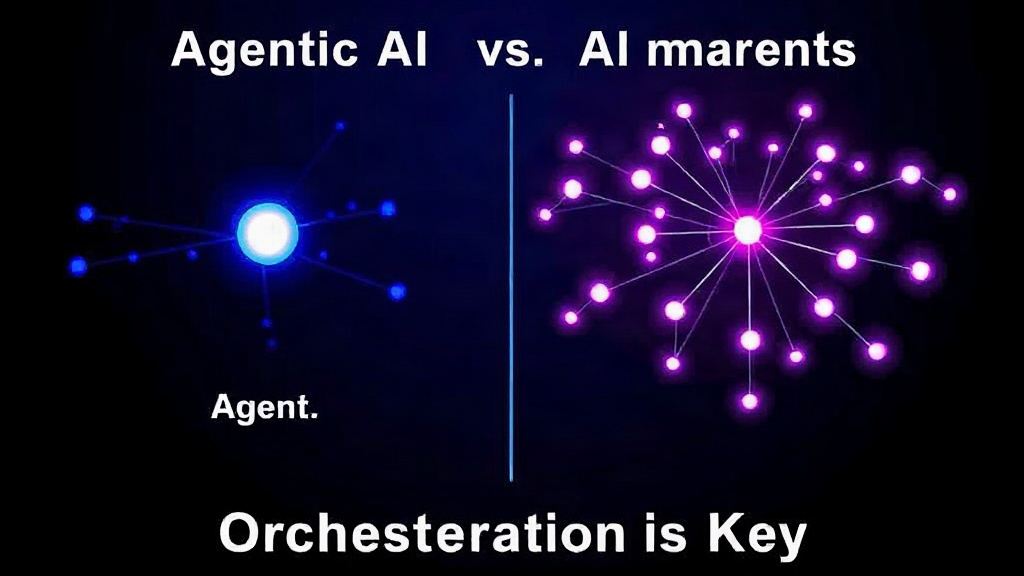
An AI agent, in its purest form, is a self-contained unit designed to perform a specific job. Think of it as a highly specialized worker. This worker is equipped with a particular toolset and operates within a well-scoped environment. Its success is measured by its ability to complete a single, verifiable task with a clear output. For instance, an AI agent might be tasked with summarizing a single document, classifying an image, or generating a short piece of code based on precise instructions. When the objective is a singular, measurable outcome, a lone agent is often the most efficient and cost-effective solution. Introducing orchestration or multiple agents for such a task would only add unnecessary complexity, increase potential failure points, and inflate costs without providing any additional capability.
Agentic AI, conversely, describes a system where multiple specialized AI agents collaborate. This is not simply a collection of independent agents; it's an orchestrated ecosystem. These agents possess capabilities like planning, memory, and the ability to hand off tasks to one another. This approach is necessary when a goal cannot be achieved by a single agent. Such goals typically decompose into a series of subtasks, each potentially requiring different skill sets, tools, or contextual memory that no single agent can fully encompass. This is where the power of coordination and inter-agent communication becomes paramount. Imagine a complex research project: one agent might be responsible for data gathering, another for initial analysis, a third for literature review, and a fourth for report generation. Agentic AI is the system that manages these handoffs, maintains context, and synthesizes the results into a coherent final output.
When to Choose Which Approach
The practical guidance for adopting these architectures is straightforward: start with a single AI agent. This is the principle of least complexity. Deploy a single agent for a defined task, and rigorously evaluate its performance. If the scored evaluation of the workflow indicates that the task genuinely requires decomposition into multiple subtasks, persistent memory across sessions, or coordination among different specialized workers, then it's time to consider promoting the architecture to agentic orchestration.
This principle can be illustrated with a real-world analogy. Consider building a house. A single AI agent is akin to a skilled carpenter who can expertly frame a wall. They have the tools and expertise for that specific job. If you need the entire house built, from foundation to roof, you don't ask the carpenter to do everything. Instead, you orchestrate a team: a foundation specialist, plumbers, electricians, roofers, and carpenters. Agentic AI is the general contractor who manages this team, ensuring each specialist performs their role, materials are delivered on time, and the overall project progresses towards completion. The contractor possesses the overarching plan, manages dependencies, and ensures seamless handoffs between different trades. The carpenter is a component; the general contractor represents the agentic system.
Defining the Boundaries: Component vs. Property
A clean way to delineate the two concepts is to view an AI agent as a *component* that can be bought or built. It's a discrete piece of software with defined inputs, processes, and outputs. You can acquire agents from third-party providers or develop them in-house. Agentic AI, on the other hand, is not a component itself but rather a *property* of the assembled system. It's the emergent intelligence and capability that arises from the structured interaction and coordination of multiple agents. It's the system's ability to plan, adapt, and execute complex workflows by leveraging the strengths of its constituent agents.
The implication for development teams is clear: resist the urge to over-engineer. Begin with the simplest viable solution – a single, well-trained agent for a specific task. Monitor performance metrics, user feedback, and the actual complexity of the problems being solved. Only when the limitations of single-agent approaches become apparent – such as the need for long-term memory, complex decision-making across multiple stages, or the integration of diverse skill sets – should the move towards agentic AI orchestration be considered. This iterative approach minimizes development overhead, reduces technical debt, and ensures that the complexity of the AI system scales precisely with the complexity of the problem it is intended to solve.
The Unanswered Question: Scalability and Cost of Orchestration
While the benefits of agentic AI for complex tasks are evident, a critical question remains largely unaddressed: at what point does the overhead of orchestration—managing memory, communication protocols, task scheduling, and error handling between agents—begin to outweigh the benefits for increasingly complex, but still potentially decomposable, tasks? The current guidance suggests moving to orchestration when a single agent fails. However, the precise cost-benefit analysis for scaling orchestration, especially concerning computational resources and latency, needs further empirical investigation and standardized benchmarks.