The Problem of Unsubstantiated Claims
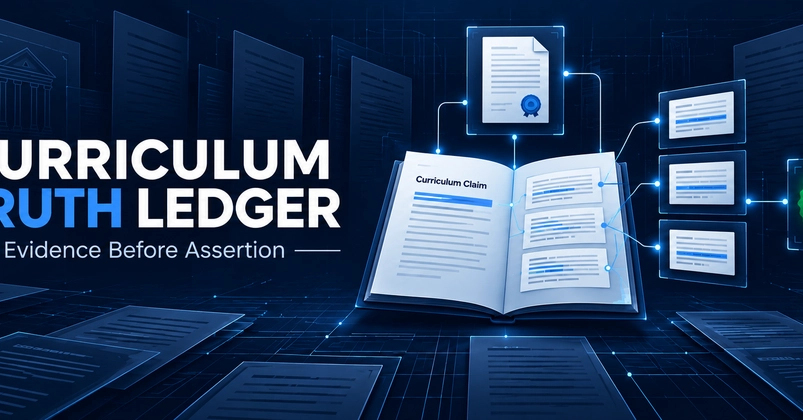
Educational curricula are the bedrock of learning, yet the origins and veracity of many curriculum statements often remain opaque. Claims are frequently repeated without clear attribution, making it difficult to trace information back to its official source. This lack of transparency can lead to the propagation of inaccuracies and the erosion of trust in educational materials. Recognizing this challenge, a new proof-of-concept application, the Curriculum Truth Ledger, has emerged to address this critical need for verifiable evidence in education.
Introducing the Curriculum Truth Ledger
The Curriculum Truth Ledger is an evidence-first application designed to record curriculum claims, rigorously connect them to their official sources, and present precise, human-reviewed evidence. The core philosophy is simple: every conclusion presented must be directly linked to an official document, an exact excerpt from that document, its specific location within the document, and a human review validating the connection. This approach aims to create an immutable record of educational claims, fostering greater transparency and accountability.
The application was developed as a submission for the Sanity Challenge, Path Two: Vibe-Code Something Strange. This context highlights the project's experimental and innovative nature, pushing the boundaries of how we can apply technology to address fundamental issues in information dissemination.
Proof of Concept: Verifying Programming Education
The current proof of concept demonstrates the ledger's capability by verifying a specific claim: "Programming is included in Grade 10 Computer Science education." To substantiate this statement, the ledger points to two precise learning outcomes extracted from the official Punjab Grade 10 Computer Science textbook.
The first learning outcome states: "Introduction to Python programming." This immediately signals the inclusion of programming concepts. The second, more detailed outcome elaborates: "Understand basic programming concepts and set up a Python development environment." These excerpts, directly from the official textbook, serve as concrete evidence that programming is indeed a component of the Grade 10 Computer Science curriculum in the Punjab region.
This verification process illustrates the ledger's methodology. A claim is made, and then the system seeks out the foundational evidence. This evidence is not a vague reference, but specific text from an authoritative source. The ledger ensures that each piece of evidence is not only identified but also contextualized with its exact location and a human review, adding a layer of reliability.
The Architecture of Trust
While the current implementation is a proof of concept, the underlying architecture of the Curriculum Truth Ledger is built for scalability and robustness. The system can be envisioned as a decentralized or blockchain-based ledger, where each entry—a claim, its supporting evidence, and the review—is cryptographically secured. This would make tampering virtually impossible and ensure the integrity of the educational record.
The process involves several key steps:
- Claim Submission: An educator, researcher, or interested party submits a statement about a curriculum.
- Evidence Sourcing: The system, or a human curator, identifies the official source document (e.g., textbook, government policy, official syllabus).
- Excerpt Extraction: Precise text excerpts that directly support or refute the claim are identified and recorded. The exact page number, chapter, or section is crucial here.
- Human Review: A subject matter expert or reviewer examines the claim and the extracted evidence to confirm the validity of the connection. This review is logged alongside the evidence.
- Ledger Entry: The complete record—claim, source, excerpt, location, and review—is added to the ledger, creating an auditable trail.
This structured approach ensures that information is not simply asserted but demonstrably proven. It moves beyond anecdotal evidence or widely circulated, unverified statements to a system grounded in verifiable facts.
Broader Implications for Education
The potential impact of the Curriculum Truth Ledger extends far beyond a single curriculum or region. Imagine this system applied to:
- Curriculum Development: Ensuring that new curricula are built on a foundation of accurate and well-sourced information.
- Policy Making: Providing policymakers with clear, evidence-based data on existing educational standards and practices.
- Teacher Training: Offering teachers direct access to the authoritative sources behind the materials they teach.
- Public Scrutiny: Empowering parents, students, and the public to verify curriculum content independently.
- Combating Misinformation: Creating a counter-narrative to the spread of educational misinformation, which has become increasingly prevalent in the digital age.
The current challenge in education often mirrors the broader challenges in information ecosystems: how do we establish trust when facts are contested or obscured? The Curriculum Truth Ledger offers a compelling model for rebuilding that trust by prioritizing transparency and verifiable evidence. It’s less like a traditional database and more like a meticulously organized library archive, where every book (claim) is cross-referenced with its exact page number (excerpt) in a definitive reference volume (official source), with a librarian's stamp of approval (human review).
The Future of Verifiable Education
The Curriculum Truth Ledger is still in its nascent stages, but its potential is significant. As educational systems worldwide grapple with issues of accuracy, standardization, and public trust, tools that can systematically verify curriculum claims will become increasingly vital. The project's success in demonstrating a clear link between an educational claim and its evidentiary support from an official textbook sets a promising precedent. The next steps would likely involve scaling the system, integrating more sophisticated sourcing and verification tools, and potentially exploring decentralized technologies to enhance immutability and accessibility. The question remains: how quickly can educational institutions adopt such evidence-first approaches to ensure the integrity of what is taught?