What is Agentic AI?
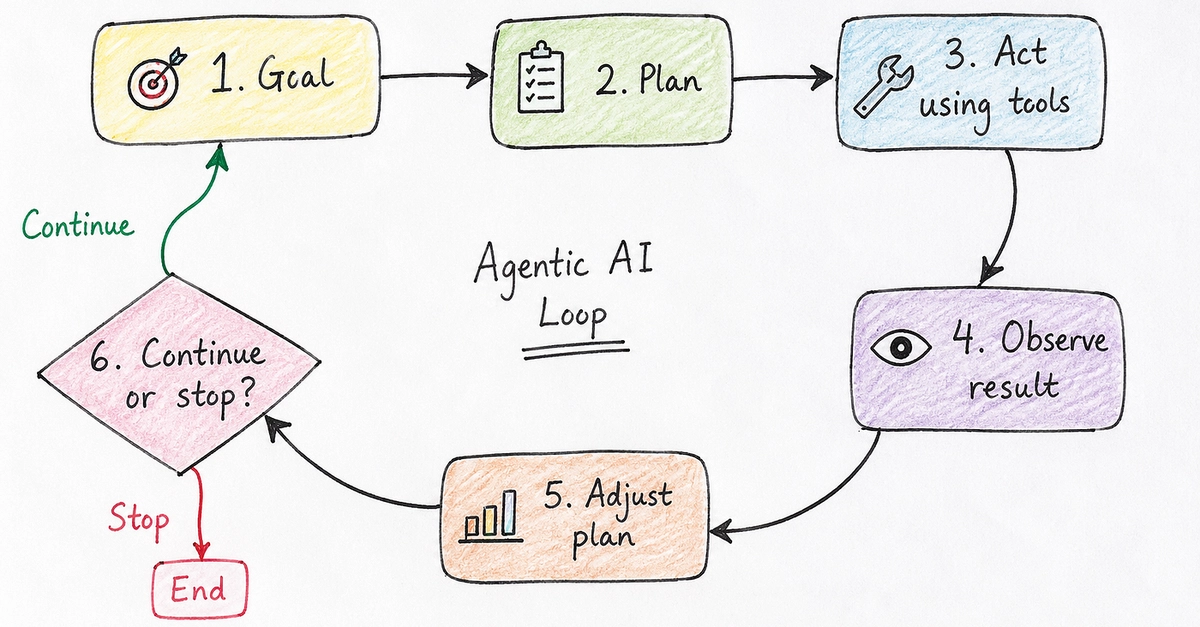
Agentic AI represents a significant evolution in artificial intelligence, moving beyond simple command-response systems to intelligent agents capable of planning and executing complex sequences of actions to achieve a defined goal. At its core, agentic AI is about empowering one or more AI agents to work autonomously towards a desired outcome, which often requires breaking down a broad objective into a series of smaller, manageable tasks. This is fundamentally different from traditional AI applications that might perform a single, well-defined operation. Think of it less like a smart toaster that just toasts bread, and more like a personal assistant who can understand you want a "publish-ready blog post on space programs" and then figures out the steps: research topics, draft an outline, write sections, find supporting data, and format it for publication.
To grasp agentic AI, we must first define an 'agent.' An agent, in this context, is a software system designed to act on behalf of a user, fulfilling a specific task or a broader goal. The distinction between a task and a goal is crucial. A task is a singular, concrete action, such as "summarize this document" or "translate this sentence." A goal, however, is a more abstract and overarching objective, like "prepare a comprehensive market analysis report" or "plan a vacation itinerary." A goal typically necessitates the successful completion of multiple tasks, often in a specific order, and this is where agentic AI shines.
What Agentic AI is Not
It's important to clarify what agentic AI is not, to avoid confusion with other AI concepts. Agentic AI is not simply a large language model (LLM) like GPT-4 or Claude, although LLMs are often a foundational component. While LLMs excel at understanding and generating human-like text, they typically require explicit prompting for each step of a process. An agentic AI system, on the other hand, uses the LLM's capabilities to reason, plan, and then autonomously execute those plans. It's the difference between asking an LLM to "write a paragraph about X" versus an agentic system that understands "write a chapter about X" and then performs multiple summarization, composition, and editing tasks to achieve it.
Furthermore, agentic AI is not an expert system in the traditional sense. Expert systems are rule-based and designed for specific domains, often with a limited scope of knowledge. Agentic AI, especially when powered by modern LLMs, can exhibit broader understanding and adaptability. It doesn't rely solely on pre-defined rules but can infer, learn, and adapt its strategy based on the context and the results of its executed tasks.
The Problem Agentic AI Solves
The primary problem agentic AI addresses is the complexity and tedium of multi-step processes. Many real-world objectives, whether in software development, business operations, scientific research, or creative work, involve a sequence of interconnected tasks. Manually managing these sequences is time-consuming, error-prone, and requires constant human oversight. Agentic AI automates this management, allowing for more ambitious and complex projects to be undertaken with greater efficiency and less human intervention.
Consider the task of creating a detailed report. This involves gathering data from various sources, cleaning and processing that data, analyzing it, synthesizing findings, and then formatting the output. Each of these steps can be complex and requires different tools or techniques. An agentic AI system can orchestrate these steps, querying databases, running analytical models, and generating textual summaries, all without explicit human instruction for each micro-action.
Single-Agent vs. Multi-Agent Systems
Agentic AI systems can be structured in two primary ways: single-agent and multi-agent.
Single-Agent Systems
A single-agent system involves one AI agent responsible for the entire goal. This agent must possess all the necessary capabilities, including task decomposition, planning, execution, and self-correction. It plans a sequence of actions, executes them, observes the results, and adjusts its plan as needed. This approach is suitable for goals that can be broken down into a linear or moderately branched sequence of tasks that a single entity can manage effectively.
Multi-Agent Systems
Multi-agent systems, on the other hand, involve multiple AI agents collaborating to achieve a common goal. Each agent might specialize in a particular type of task or possess unique capabilities. For example, one agent might be responsible for data retrieval, another for data analysis, and a third for report generation. These agents communicate and coordinate their actions to achieve the overall objective. This architecture is particularly powerful for complex goals that benefit from parallel processing, specialization, and diverse perspectives. The challenge here lies in effective inter-agent communication, coordination, and conflict resolution.
Architecture of Agentic AI
While specific implementations vary, a common architectural pattern for agentic AI systems includes several key components:
- Perception/Observation: The agent's ability to perceive its environment or receive input (e.g., user requests, data streams, results from previous tasks).
- Reasoning/Planning: The core cognitive function where the agent interprets the input, breaks down the goal into tasks, and creates a plan of action. This often involves using LLMs for understanding context and generating potential steps.
- Action/Execution: The agent's ability to perform tasks. This could involve calling APIs, interacting with software tools, generating content, or manipulating data.
- Memory: The agent's capacity to store and recall information from past experiences, task outcomes, and user interactions. This is crucial for learning and improving performance over time.
- Learning/Adaptation: The mechanism by which the agent refines its plans and actions based on feedback and outcomes, improving its efficiency and effectiveness.
Referenced Sources
- verified