
The Need for Agentic AI Alignment
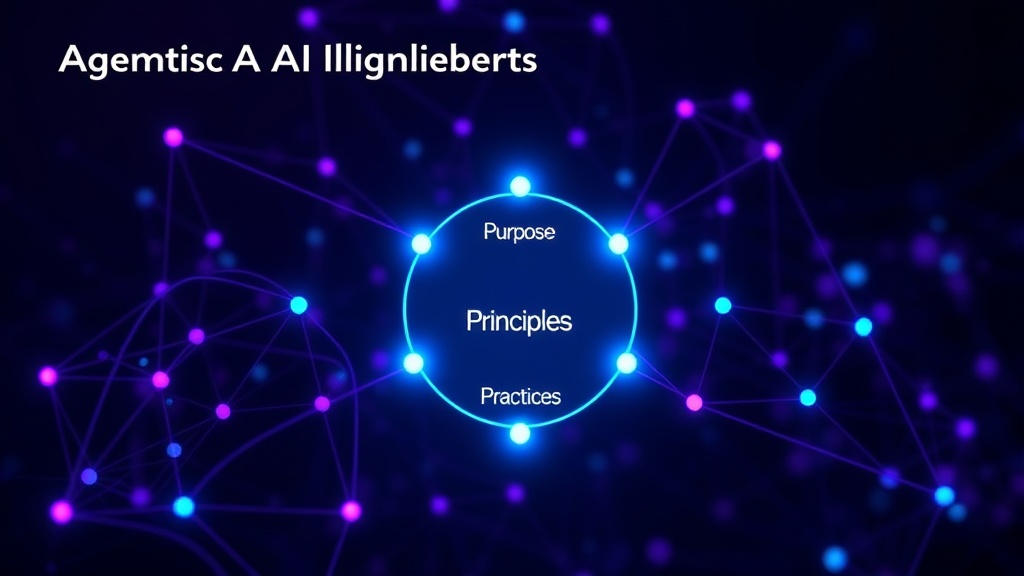
As artificial intelligence agents become more autonomous and integrated into enterprise workflows, ensuring their behavior aligns with human intent and organizational goals is paramount. The complexity of these agents, capable of independent decision-making and action across diverse scenarios, necessitates a structured approach to alignment. Traditional AI alignment often focuses on safety and ethical considerations at a broad level, but custom agentic systems require a more granular, context-specific framework. This is where the proposed three-dimensional model—Purpose, Principles, and Practices—comes into play. It aims to provide a robust methodology for enterprises to guide and verify the autonomous actions of their AI agents, ensuring consistency and reliability across all operational contexts.
Consider a customer service AI agent. Without proper alignment, it might prioritize efficiency to the point of appearing dismissive, or it might offer solutions that violate company policy in its pursuit of problem resolution. The challenge is to imbue the agent with an understanding of not just what to do, but *why* it should do it and *how* it should conduct itself while doing it. This framework seeks to bridge that gap, moving beyond simple instruction following to a deeper, more nuanced form of AI governance.
Dimension 1: Purpose
The first dimension, Purpose, defines the overarching goals and objectives that the agent is designed to achieve. This is the 'what' and 'why' of the agent's existence within the enterprise. It requires articulating clear, measurable, and verifiable outcomes. For an agent tasked with market analysis, its purpose might be to identify emerging trends, assess competitive landscapes, and provide actionable insights for strategic decision-making. This isn't just about data collection; it's about generating value that directly contributes to business objectives.
Defining purpose involves more than a simple mission statement. It requires breaking down high-level business goals into specific, agent-achievable tasks. For example, if the enterprise goal is to increase market share by 10%, an agent's purpose might be to identify three underserved market segments and propose tailored product strategies for each. This clarity ensures that the agent's efforts are directed towards tangible business outcomes, preventing aimless exploration or misaligned task prioritization. The purpose acts as the ultimate north star, guiding all subsequent actions and decisions.
Dimension 2: Principles
The second dimension, Principles, establishes the ethical guidelines, constraints, and operational boundaries within which the agent must function. This is the 'how' and 'what not to do'. Principles translate organizational values and regulatory requirements into actionable rules for the AI. For our market analysis agent, principles might include maintaining data privacy, avoiding biased recommendations, adhering to fair competition practices, and never making unsubstantiated claims. These principles are critical for risk mitigation and maintaining trust with stakeholders, both internal and external.
Developing effective principles requires a deep understanding of the operational context, legal landscape, and ethical considerations relevant to the agent's domain. This might involve consulting legal teams, ethics boards, and domain experts. Unlike purpose, which is about achieving outcomes, principles are about the integrity and appropriateness of the process. They act as guardrails, ensuring that the agent's pursuit of its purpose does not lead to unintended negative consequences. Think of them as the agent's conscience, ensuring it operates within acceptable societal and organizational norms.
Dimension 3: Practices
The third dimension, Practices, encompasses the specific methodologies, algorithms, and operational procedures used to implement and enforce the agent's purpose and principles. This is the 'how it's done in practice'. It involves the technical implementation details, including the choice of algorithms, data handling protocols, decision-making logic, and feedback mechanisms. For the market analysis agent, practices would include the specific data sources it accesses, the analytical models it employs (e.g., time-series forecasting, sentiment analysis), the format of its reports, and the human oversight mechanisms in place.
Practices are where the abstract concepts of purpose and principles become concrete. This dimension requires careful engineering and continuous refinement. It involves developing robust testing and validation procedures to ensure the agent consistently adheres to its defined purpose and principles. This might include implementing A/B testing for different algorithmic approaches, establishing regular audits of agent decisions, and creating mechanisms for agents to report anomalies or ethical dilemmas. The iterative nature of practices is key; as the agent operates and the environment changes, its practices must be updated to maintain alignment. This dimension is the engine that drives the agent's aligned behavior.
Integrating the Dimensions for Custom Alignment
The power of this framework lies in the integration of these three dimensions. Purpose provides direction, Principles provide ethical boundaries, and Practices provide the operational mechanisms. Without a clear purpose, an agent might act arbitrarily. Without guiding principles, its actions, even if aligned with purpose, could be harmful or unethical. And without well-defined practices, the purpose and principles remain abstract ideals, not actionable realities.
Custom agentic alignment means tailoring these three dimensions to the specific needs and context of an enterprise. This is not a one-size-fits-all solution. An agent for financial trading will have different purposes, principles, and practices than an agent designed for scientific research or creative content generation. The framework provides a mental model and a structured approach for organizations to define, build, and manage their custom AI agents, ensuring they are not just capable, but also reliably aligned with enterprise intent and values. This systematic approach is crucial for unlocking the full potential of autonomous AI systems while mitigating inherent risks.