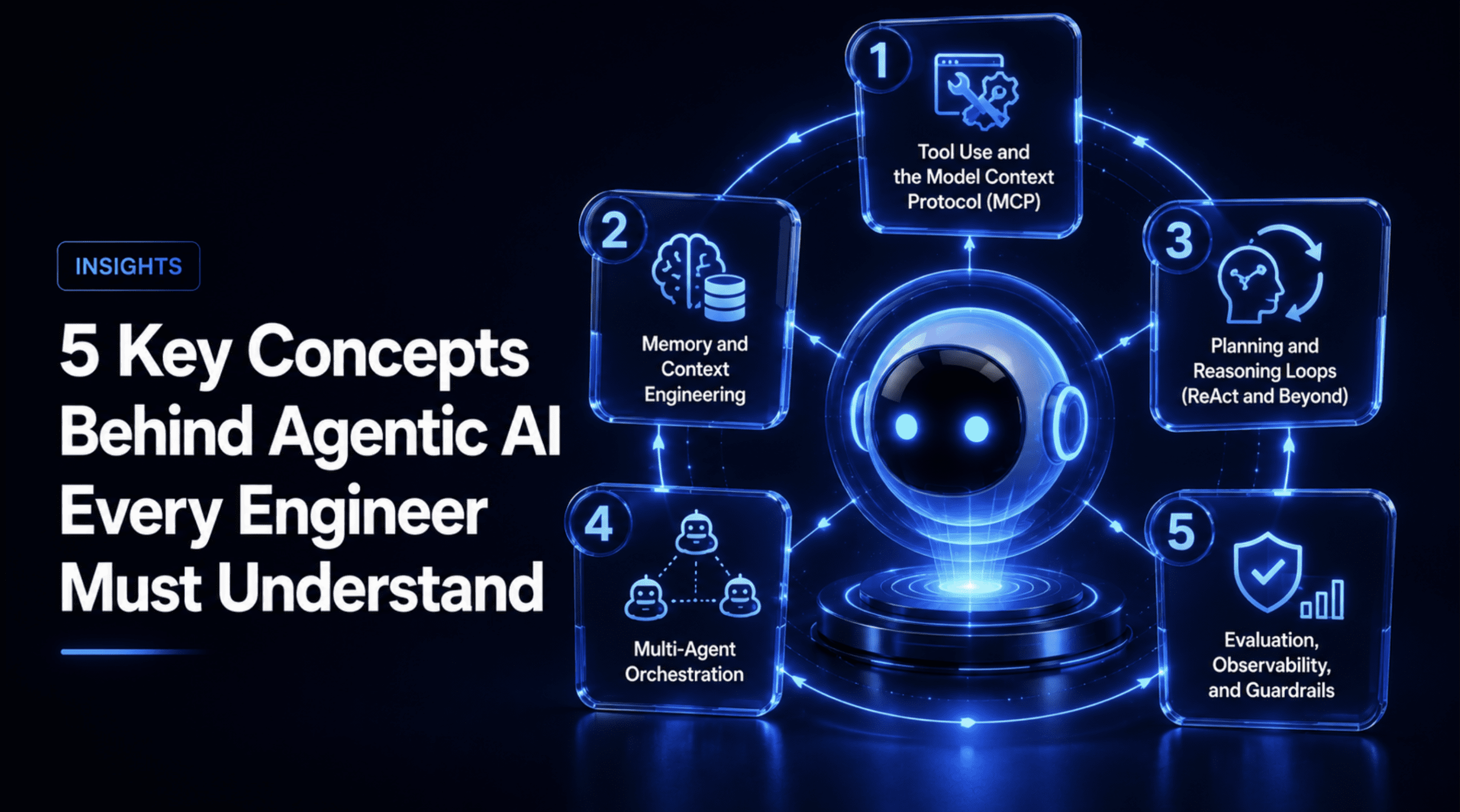
Understanding the Foundation: What is Agentic AI?
Agentic AI represents a significant leap beyond current large language models (LLMs). Instead of merely responding to prompts, these systems are designed to act autonomously, pursuing goals, making decisions, and interacting with their environment. Think of it less like a sophisticated chatbot and more like a digital assistant that can not only understand your request but also figure out the best way to execute it, often without continuous human oversight. This shift from passive response to active agency is what defines agentic AI and makes it a critical area for engineers to understand.
1. Goal-Oriented Autonomy
At its heart, agentic AI is about autonomy driven by a defined objective. Unlike traditional AI that performs specific tasks, an agentic system is programmed with a high-level goal. It then breaks this goal down into smaller, manageable sub-goals and executes them sequentially or in parallel. This process involves continuous perception, reasoning, and action. The agent observes its current state, reasons about the best course of action to achieve its goal, and then acts upon the environment. This cycle repeats, allowing the agent to adapt to changing conditions and navigate complex tasks. For engineers, this means designing systems that can not only interpret a goal but also self-correct and adapt their strategy as they progress.
2. Memory and State Management
A key differentiator for agentic AI is its ability to maintain memory and understand its current state. This isn't just about recalling past conversations; it's about building a persistent, contextual understanding of its environment and its own actions. Agents typically employ different types of memory:
- Short-term memory (Context Window): This is akin to the working memory of a human, holding immediate information relevant to the current task. LLMs have a limited context window, which agents must manage efficiently.
- Long-term memory: This allows agents to store and retrieve information over extended periods, enabling them to learn from past experiences and maintain consistency across tasks. Techniques like vector databases are crucial here, allowing agents to store and search vast amounts of information semantically.
- Scratchpad/Working Memory: A dedicated space for agents to perform intermediate calculations, store temporary results, and plan future steps. This is where the agent 'thinks' through its problem.
Effective memory management is critical for an agent to avoid repeating mistakes, build on previous successes, and maintain a coherent understanding of complex, multi-step processes. Engineers must consider how to implement robust memory systems that can scale and efficiently retrieve relevant information.
3. Planning and Reasoning
Agentic AI systems possess sophisticated planning and reasoning capabilities. They don't just react; they anticipate. This involves:
- Decomposition: Breaking down a complex goal into a series of smaller, executable steps.
- Task Prioritization: Deciding which sub-goal to tackle next based on dependencies, urgency, or efficiency.
- Conditional Logic: Adapting plans based on environmental feedback or unexpected outcomes. If a step fails, the agent must have a strategy to recover or replan.
- Reasoning: Applying logical deduction and inference to understand the implications of its actions and the state of the environment.
Techniques like Chain-of-Thought (CoT) prompting, Tree of Thoughts (ToT), and Generative Agents' simulated social interactions are all methods that enhance an agent's ability to plan and reason. For developers, this means integrating or developing algorithms that enable these advanced cognitive functions.
4. Tool Use and Environment Interaction
A defining characteristic of agentic AI is its ability to interact with external tools and environments. This is how agents move beyond theoretical reasoning and perform tangible actions. These tools can range from simple APIs and web search engines to complex software applications or even physical robotic actuators. An agent needs to:
- Identify Necessary Tools: Determine which tool is best suited for a specific sub-task.
- Formulate Tool Calls: Generate the correct input parameters for the chosen tool.
- Interpret Tool Output: Understand the results returned by the tool and integrate them into its ongoing reasoning process.
This capability transforms LLMs from isolated text generators into active participants in digital or even physical workflows. Engineers building agentic systems must consider the security implications and the robust integration of diverse toolsets.
5. Iteration and Self-Correction
The ability to learn and improve over time is crucial for agentic AI. Agents are not static; they are designed to iterate on their performance. This involves:
- Feedback Loops: Incorporating feedback from the environment or human users to refine strategies.
- Error Analysis: Identifying why a particular action or plan failed.
- Strategy Adaptation: Modifying future behavior based on lessons learned from past failures or successes.
This continuous self-improvement loop is what allows agents to become more capable and reliable over time. It’s akin to how a human learns a new skill through practice and refinement. For engineers, building effective agentic systems means designing for this iterative improvement, ensuring that the agent can learn and adapt without constant human intervention.
The Path Forward for Engineers
Agentic AI is not a single technology but a paradigm shift enabled by the convergence of LLMs, sophisticated memory architectures, planning algorithms, and tool integration. Understanding these five core concepts—goal-oriented autonomy, memory, planning, tool use, and self-correction—is essential for any engineer looking to build the next generation of intelligent systems. The challenge lies in orchestrating these components into robust, reliable, and scalable agents that can tackle increasingly complex real-world problems.