AgentGuard Achieves Perfect Score in AI Agent Security Scan
A recent test pitting AgentGuard against industry-standard security scanners Semgrep and CodeQL has yielded stark results: AgentGuard detected 100% of AI agent security vulnerabilities, while the other two tools found none.
The evaluation, conducted by Dev.to user dockfixlabs, involved running 39 distinct AI agent security samples through AgentGuard v0.6.4, Semgrep, and CodeQL. The outcome was unambiguous: AgentGuard identified all 39 samples, registering zero false positives. In contrast, Semgrep and CodeQL reported a 0% detection rate, indicating they currently lack the specialized rulesets necessary to identify these emerging threats.
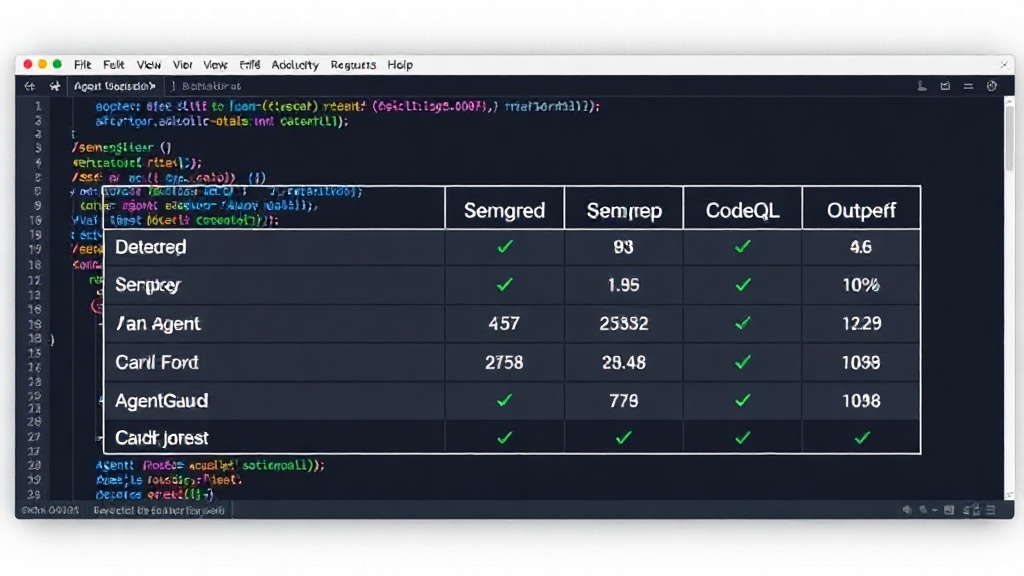
The core of AgentGuard's success lies in its dedicated ruleset. The tool boasts 17 specific detection rules that directly address the 10 categories outlined by OWASP for Artificial Intelligence Security (ASI). Crucially, it also covers four novel attack vectors that are becoming increasingly relevant in the AI agent landscape: Memory Poisoning, Tool Output Trust, Action Chain Amplification, and Multi-Agent Collusion. These are not generic code vulnerabilities; they are specific to the unique architecture and interaction models of AI agents.
The Gap in Existing Static Analysis Tools
The findings highlight a significant gap in the capabilities of general-purpose static analysis tools when it comes to the rapidly evolving domain of AI agents. Semgrep and CodeQL, while powerful for traditional software security, are built upon rule sets primarily designed for conventional codebases. They lack the contextual understanding and specific threat models required to parse the complex interactions, data flows, and emergent behaviors that define AI agents.
For instance, issues like Memory Poisoning involve manipulating an AI agent's training data or runtime memory to influence its decisions or output. Tool Output Trust relates to the agent's reliance on potentially compromised or malicious external tools. Action Chain Amplification occurs when an agent can be tricked into executing a sequence of actions that escalates unintended consequences. Multi-Agent Collusion describes scenarios where multiple AI agents coordinate to achieve malicious objectives.
These are not simply bugs in the traditional sense; they are often logical flaws or emergent properties of the AI system's design and interaction with its environment. Detecting them requires a specialized understanding of AI security principles, which AgentGuard appears to have prioritized.
Real-World Impact and Future Implications
The practical implications of this disparity are substantial. In a real-world deployment, relying solely on Semgrep or CodeQL for AI agent security would leave systems critically exposed. AgentGuard's ability to find 332 critical vulnerabilities across projects like Microsoft AutoGen and LlamaIndex underscores the immediate need for specialized security tooling in this space.
The fact that these vulnerabilities were reported directly to the projects signifies a proactive approach to security and a clear demonstration of AgentGuard's utility in identifying actionable security flaws. This isn't just about theoretical detection; it's about providing developers with the information they need to secure their AI agent applications.
What remains to be seen is how quickly general-purpose tools like Semgrep and CodeQL will adapt their rule sets to include AI agent-specific threats. The pace of AI development is blistering, and security tooling must evolve in lockstep. Developers building AI agents can no longer assume that their existing security stacks will provide adequate protection. They must actively seek out and integrate tools that are purpose-built for the unique attack surface presented by AI agents.
This benchmark serves as a critical wake-up call. While Semgrep and CodeQL remain valuable for securing traditional software, the AI agent ecosystem requires a new generation of security tools. AgentGuard's perfect score suggests it is at the forefront of this emerging category, offering a level of specialized protection that is currently unmatched.
If you are developing or deploying AI agents, the message from this comparison is clear: your current security tools might be leaving you blind to critical risks. It's time to evaluate your defenses and consider specialized solutions like AgentGuard.