The Challenge of Isolated AI Agent Development
Developing web applications with AI coding agents presents a unique challenge: while source code isolation is manageable with tools like Git worktrees, isolating the runtime environment for multiple agents working concurrently on the same project is not. Each agent might need to run a different version of the full stack, including databases, APIs, and frontends, simultaneously on the same machine. This conflict arises because standard development setups assume a single, unified runtime. When multiple AI agents, each operating with its own set of dependencies and configurations, attempt to run their respective versions of an application, they inevitably clash over ports, processes, and services. This leads to unpredictable behavior, difficult debugging, and a stalled development process.
Traditional solutions for managing multiple application instances, such as containerization with Docker Compose, often require manual configuration and can become unwieldy when scaling to numerous agent workspaces. Each agent needs more than just its own isolated source code; it requires its own distinct operational environment. This includes its own running processes, stable network ports, dedicated Docker services, separate browser sessions with grouped tabs, and independent logging and state management. Without this level of isolation, agents interfere with each other, making it impossible to test, review, or even run different agent-generated versions of the application side-by-side.
Introducing Agent-Up: A Solution for Isolated Runtimes
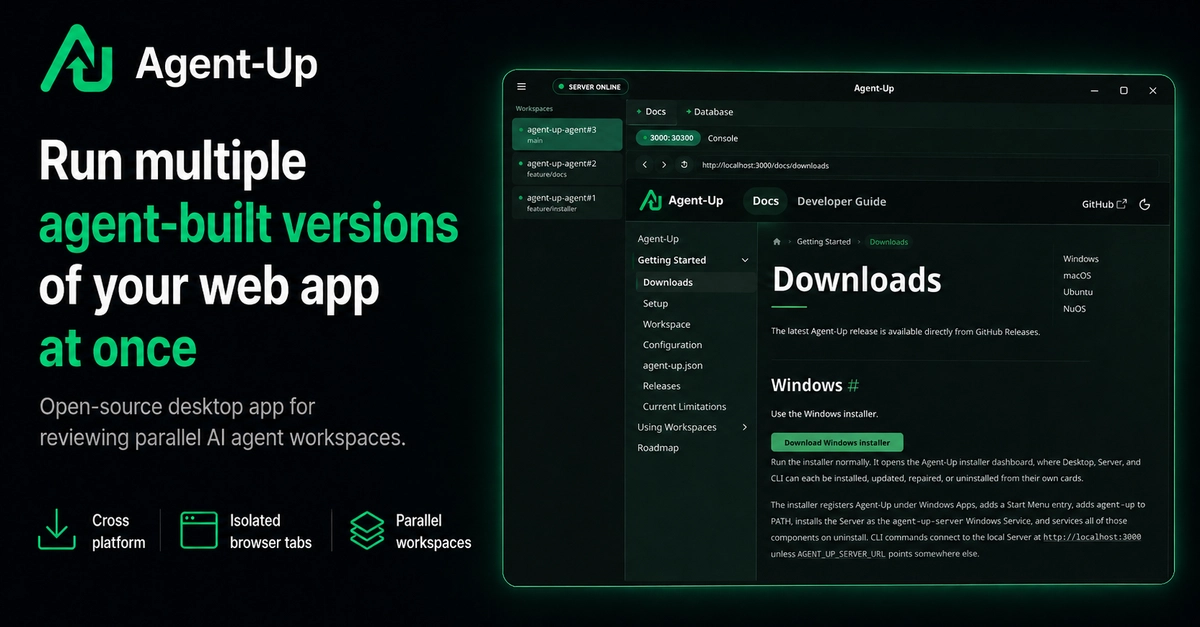
Agent-Up addresses this critical gap by providing an open-source, cross-platform desktop application designed specifically for running and reviewing multiple AI coding agent workspaces on a single machine. Its core innovation lies in its approach to environment isolation. Unlike tools that focus solely on source code management, Agent-Up ensures that each agent workspace operates within its own fully isolated runtime. This means that when an agent is tasked with developing or modifying a web application, its corresponding execution environment is self-contained and does not interfere with other agents or the host system.
Each workspace within Agent-Up is provisioned with a dedicated set of resources. This includes independent processes, stable network ports that do not conflict with other workspaces, isolated Docker services, and a distinct browser session. To further enhance usability, Agent-Up groups browser tabs related to a specific agent workspace, preventing cross-contamination of session cookies or navigation history. Furthermore, each workspace maintains its own logs and runtime state, allowing developers to inspect, compare, and revert changes with confidence. The system leverages MCP (Message Passing Control) for environment management, enabling agents to orchestrate their needs and configurations within their isolated sandboxes.
Key Features and Benefits
Agent-Up's architecture is built around the principle of maximal isolation for AI agent development. The benefits extend directly to the development workflow:
- Complete Runtime Isolation: Every agent workspace runs in its own environment, featuring distinct processes, stable ports, and isolated Docker services. This prevents conflicts and ensures that each agent’s work is reproducible and testable independently.
- Dedicated Browser Sessions: Each agent gets its own browser session, complete with grouped tabs. This prevents state leakage and simplifies managing multiple concurrent development sessions for different application versions.
- Centralized Review Interface: All agent workspaces and their associated logs, runtime states, and browser sessions are accessible and manageable from a single desktop application interface. This streamlines the review process and makes it easier to compare the outputs of different agents.
- Simplified Environment Management: Using MCP, agents can manage their environments more effectively, requesting and configuring resources within their allocated sandbox without impacting others.
- Open-Source and Cross-Platform: Agent-Up is freely available and designed to run on major desktop operating systems, making it accessible to a wide range of developers.
The ability to run multiple, conflicting versions of a web application simultaneously is crucial for advanced AI-assisted development. For instance, one agent might be tasked with refactoring a backend API, requiring a specific version of a database and a modified server process, while another agent works on the frontend, needing a different set of JavaScript dependencies and a distinct build process. Agent-Up facilitates this by providing a robust isolation layer. Developers can initiate these disparate environments side-by-side, test integrations, and review changes without the usual setup friction. This is akin to having several independent virtual machines, each pre-configured for a specific task, but managed through a single, streamlined interface.
Impact on AI-Assisted Development Workflows
Agent-Up's introduction signifies a move towards more sophisticated tooling for AI agents in software development. Historically, AI agents have been constrained by their ability to interact with development environments. While they excel at generating code, integrating their outputs into a live, runnable application has often required significant manual intervention. This new tool directly tackles the operational complexity, allowing developers to harness the power of multiple AI agents concurrently for tasks that require distinct runtime configurations.
For teams leveraging AI for rapid prototyping, A/B testing different features generated by agents, or exploring multiple architectural approaches simultaneously, Agent-Up offers a significant productivity boost. It democratizes the ability to experiment with AI-generated code by removing the infrastructural barriers. The centralized review and management interface further simplifies the workflow, enabling developers to quickly switch context between agent workspaces, examine their outputs, and merge the best-performing or most stable code. This capability is particularly valuable in fast-paced development cycles where exploring multiple AI-driven solutions in parallel can accelerate innovation.
The question remains: as AI agents become more sophisticated and capable of managing complex system interactions, how will tools like Agent-Up evolve to support even deeper levels of integration and automation? The current focus is on runtime isolation for web applications, but the underlying principles could extend to other domains, such as embedded systems development or machine learning model deployment, where isolated environments are equally critical.