The Hidden Journey of AI Code Generation
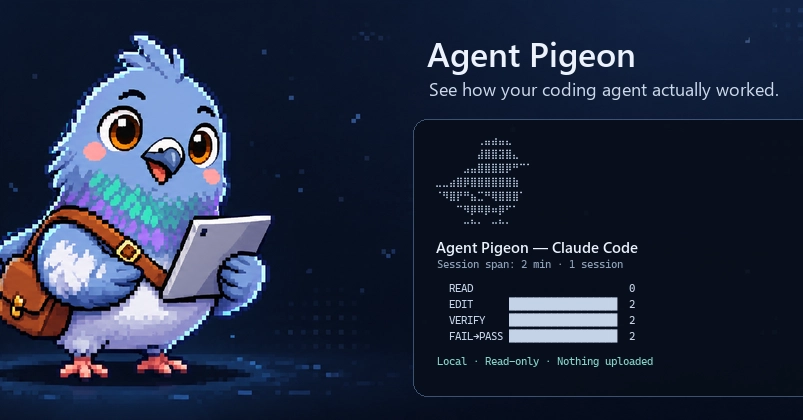
When a coding agent generates a snippet of code, the final output is just the tip of the iceberg. The real story—the edits, the retries, the dead ends explored—remains hidden in session logs. Jay Stride recognized this gap and built Agent Pigeon, a command-line interface (CLI) tool designed to transform verbose AI coding session histories into concise, scannable "Flight Reports." This initiative stems from a desire to demystify the AI coding process, making it more transparent and understandable for developers.
Stride's motivation was simple: a final code answer rarely shows the effort, the experimentation, and the iterative refinement that led to it. Agent Pigeon aims to bring that iterative process into the light. By processing local session history from tools like Claude Code and Codex, it synthesizes the complex interactions into a digestible summary.
The core functionality is accessed via a single, straightforward command: npx agent-pigeon flight. This command initiates the process of reading the relevant session logs and generating the report. The goal is to provide a view that can be grasped in mere seconds, offering a high-level overview of the agent's problem-solving journey.
How Agent Pigeon Works
Agent Pigeon operates by parsing local session history files. These files typically contain a detailed log of every interaction between the developer and the coding agent, including prompts, agent responses, code suggestions, and any modifications made by the developer or subsequent agent iterations. The CLI tool sifts through this raw data, identifying key events such as code generation attempts, edits, and successful completions.
The output, the "Flight Report," is designed for clarity. It abstracts away the minute-by-minute details of the session, focusing instead on the significant milestones. This could include the initial problem statement, major code refactorings, the introduction of new logic, and the final accepted code. The report serves as a narrative of the agent's problem-solving process, offering insights into its decision-making and the evolution of the code.
The development of Agent Pigeon highlights a growing need for transparency in AI-assisted development workflows. As developers increasingly rely on AI agents for coding tasks, understanding how these agents arrive at their solutions becomes crucial for debugging, learning, and improving the overall development process. Stride's tool provides a tangible way to gain this understanding.
Beyond the Final Answer
The traditional way of reviewing code, whether human-written or AI-generated, often focuses solely on the end product. This approach misses the valuable lessons embedded in the development journey. Agent Pigeon's "Flight Report" offers a more holistic view. It allows developers to see the sequence of actions, the trial-and-error involved, and the specific prompts that led to the most effective code iterations.
Consider a scenario where an AI agent provides a complex function. Without Agent Pigeon, a developer might only see the final code. With Agent Pigeon, they could see that the agent initially attempted a simpler, incorrect approach, was guided by specific developer feedback, and then iteratively refined its solution through several attempts before arriving at the optimal version. This context is invaluable for understanding potential edge cases, performance implications, or alternative solutions that might have been explored and discarded.
This level of detail can also help in identifying weaknesses or biases in the AI model itself. By examining the path taken, developers might notice patterns where the agent consistently struggles with certain types of problems or favors less efficient solutions. This information can then be used to provide more targeted feedback to the AI providers or to adjust development strategies when using these tools.
Future Implications for AI Development Tools
Agent Pigeon, though described as "tiny," addresses a significant UX and transparency challenge in the burgeoning field of AI coding assistants. As these tools become more sophisticated and integrated into developer workflows, the ability to inspect their internal reasoning process will become paramount. Tools that offer such insights will likely gain favor among developers who prioritize understanding and control over their development process.
The success of Agent Pigeon could inspire similar tools for other AI agents, such as those used in writing, design, or data analysis. The core problem—the opacity of complex AI decision-making—is not unique to coding. Providing users with a summarized history of the AI's 'thought process' could foster greater trust and more effective collaboration between humans and AI.
What remains to be seen is how AI coding agents themselves will evolve to offer this kind of historical introspection natively. As the market matures, it's plausible that built-in reporting features, akin to Agent Pigeon's "Flight Report," could become standard, further enhancing the developer experience and the utility of these powerful tools. For now, community-driven solutions like Agent Pigeon fill a critical void.