
The Wrong Fight: Model vs. Model
The current discourse around coding agents is fixated on the wrong metric: the large language model (LLM) itself. Developers are debating which model codes best, which has the latest release, and which benchmark shows marginal improvements. This focus is misplaced. The real gains in coding agent performance are being driven by the orchestration and scaffolding around the LLM, not the LLM's inherent capabilities.
Consider the case of LangChain. This framework took a coding agent from rank 30 to the top 5 on the Terminal-Bench benchmark. The critical detail? This leap occurred without any change to the underlying model. The improvements stemmed entirely from the surrounding architecture – the scaffolding – not from a superior "brain" in the LLM.
This isn't an isolated incident. The scaffolding, or the agent's framework, dictates how the LLM interacts with its environment, how it plans, how it accesses tools, and how it iterates. A powerful LLM fed into a poorly designed agent framework will underperform a less capable LLM integrated into a highly optimized one. The framework acts as the conductor, guiding the LLM's raw potential into effective, actionable code generation.
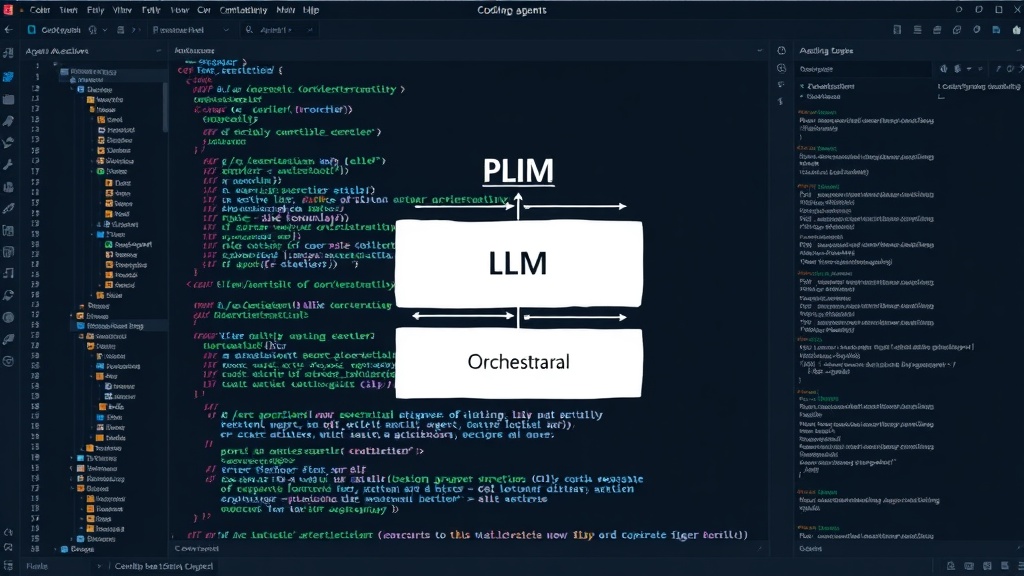
The Scaffolding: What Actually Matters
What constitutes this crucial scaffolding? It's a complex interplay of components that enable the LLM to function effectively as a coding assistant. These include:
- Planning and Reasoning Modules: These components break down complex coding tasks into smaller, manageable steps. They enable the agent to think ahead, anticipate dependencies, and generate a coherent plan before writing code.
- Tool Integration and API Management: Effective agents need seamless access to external tools – compilers, linters, debuggers, version control systems, and even other APIs. The scaffolding determines how efficiently and reliably the agent can invoke and interpret the results of these tools.
- Memory and State Management: Coding is an iterative process. Agents require robust memory systems to recall previous interactions, context, and code snippets. This allows them to build upon prior work and maintain consistency across multiple steps.
- Feedback Loops and Self-Correction: The ability to receive feedback, whether from a human user, a compiler error, or a test suite, and then to self-correct its output is paramount. The scaffolding facilitates these feedback mechanisms.
- Prompt Engineering and Context Window Management: While the LLM is the "brain," how it's prompted and how its context window is managed significantly impacts output quality. Sophisticated scaffolding can dynamically construct prompts and manage context to maximize the LLM's effectiveness for specific coding tasks.
These elements, when optimized, allow an agent to achieve higher levels of performance. They transform the LLM from a sophisticated text predictor into a functional coding assistant. The benchmark results seen with LangChain are a testament to this principle: optimizing the *process* of coding, not just the *language* of coding.
The Market Landscape: Beyond the Model Hype
The market for AI coding assistants is saturated with tools that emphasize their LLM backbone. Companies tout their use of GPT-4, Claude 3, or other leading models as their primary differentiator. However, this overlooks the substantial value provided by the agent orchestration layer. Tools like Agent Protocol (agentproto), AutoGen, CrewAI, and others are building sophisticated frameworks that abstract away the LLM specifics and focus on enabling agents to collaborate, plan, and execute complex tasks.
The surprising detail here is not the performance of any single LLM, but the consistent, significant performance improvements achieved by focusing on the agent's surrounding architecture. This suggests that for developers building or using coding agents, the choice of framework and the quality of its scaffolding may be far more impactful than the choice of LLM. A well-designed agent framework can allow for easy swapping of underlying LLMs as new ones emerge, future-proofing investments in agent development.
As the field matures, we will likely see a bifurcation: foundational LLM providers offering raw power, and orchestration layer providers offering the intelligence and structure to harness that power effectively for specific domains like coding. The real innovation is happening in how agents are built and deployed, not just in the size of their neural networks.
What This Means for Developers and Founders
For developers, this shift in focus is critical. Instead of endlessly tweaking prompts for a specific LLM or chasing the latest model release, the emphasis should be on understanding and leveraging robust agent frameworks. Learning how to effectively integrate tools, manage state, and implement feedback loops within these frameworks will yield more tangible performance improvements. It means building with the scaffolding in mind, treating the LLM as a replaceable component rather than the sole determinant of success.
Founders and product leaders need to recognize that their competitive advantage will increasingly lie in the sophistication of their agent orchestration, not just their choice of LLM. Investing in a flexible, powerful framework that allows for seamless tool integration and efficient task execution will be key. This approach also allows for greater adaptability, as the underlying LLM can be upgraded without a complete overhaul of the agent's core logic. The focus must be on building intelligent systems that can *use* LLMs, rather than simply *being* LLMs.