The Core Problem: LLMs Are Capable But Uneven
Large Language Models (LLMs) have demonstrated astonishing capabilities, from generating creative text to writing complex code. Yet, their raw power often falls short when applied to real-world tasks. This isn't a failure of the model's core intelligence, but a gap in its ability to reliably execute under practical constraints. Think of it like having a brilliant, highly knowledgeable intern who can solve complex theoretical problems but struggles with the day-to-day execution of a project: they might forget instructions, miss deadlines, or require constant supervision. This is where agent engineering steps in.
Agent engineering, at its heart, is a discipline of system design. It aims to transform these capable but uneven models into dependable task finishers. The goal is to build systems that can operate effectively despite messy inputs, long-term objectives, imperfect external tools, and strict resource limitations like time and budget.
Key Components of Agent Engineering
To bridge the gap between raw LLM potential and reliable task execution, agent engineering relies on several critical strategies and components:
- State & Context Management: This involves defining what information an agent remembers, how it retrieves relevant past interactions or data, and when it should forget information to manage context windows and relevance. It's akin to giving the agent a working memory that is both expansive and focused.
- Contracts: Formalizing the interaction between the LLM and its environment. This includes defining clear schemas for expected inputs and outputs, setting timeouts for operations, and implementing retry mechanisms for failed tasks. These contracts ensure predictable behavior and graceful handling of errors.
- Verification: Implementing checks to ensure that each step of a task is executed correctly before proceeding. This is crucial for tasks requiring accuracy, preventing small errors from cascading into larger failures.
- Budgets & Stop Conditions: Imposing hard limits on computational resources. This can include caps on the number of conversational turns, tokens used, or total execution time. These budgets are essential for cost control and ensuring tasks complete within acceptable timeframes.
- Permissions & Risk Tiers: Carefully managing the agent's access to external tools and data. This involves distinguishing between read-only operations and potentially destructive actions, and gating the latter behind explicit confirmations or risk assessments.
Why Agent Engineering is Necessary: The Strawberry Problem
The need for agent engineering becomes starkly clear when we consider the limitations of LLMs in specific, nuanced tasks. A classic illustration is what's often called 'The Strawberry Problem.' While an LLM might be able to write a poem about strawberries or explain their nutritional value, it can struggle with a simple, concrete instruction like counting the number of 'r's in the word 'strawberry.' This isn't because the model doesn't 'understand' the concept of letters or counting; it's a manifestation of how LLMs process information. They are probabilistic models, excellent at predicting the next token based on vast training data, but not inherently suited for precise, deterministic operations or for admitting when they lack specific, factual knowledge. When faced with such a query, an LLM might 'hallucinate,' generating a plausible-sounding but incorrect answer rather than stating it doesn't know or cannot perform the task reliably.
Agent engineering addresses this by building an external scaffolding around the LLM. Instead of relying on the LLM to intrinsically handle all aspects of a task, we design systems that guide the LLM, constrain its operations, and verify its outputs. This scaffolding ensures that even for tasks where the LLM might falter, the overall system can achieve the desired outcome reliably.
The Trajectory: From Simple Agents to Complex Orchestrations
The evolution of agent engineering is moving towards increasingly sophisticated systems. Initially, agents were designed to perform single, well-defined tasks, often acting as wrappers around specific APIs or functions. The focus was on making a single LLM call reliable by adding input validation, output parsing, and basic error handling.
The next phase saw agents capable of chaining multiple LLM calls or tool uses together to achieve more complex objectives. This involves breaking down a larger goal into smaller, manageable sub-tasks, executing them sequentially or in parallel, and synthesizing the results. This is where concepts like planning, reasoning, and memory become critical for the agent system itself, not just the underlying LLM.
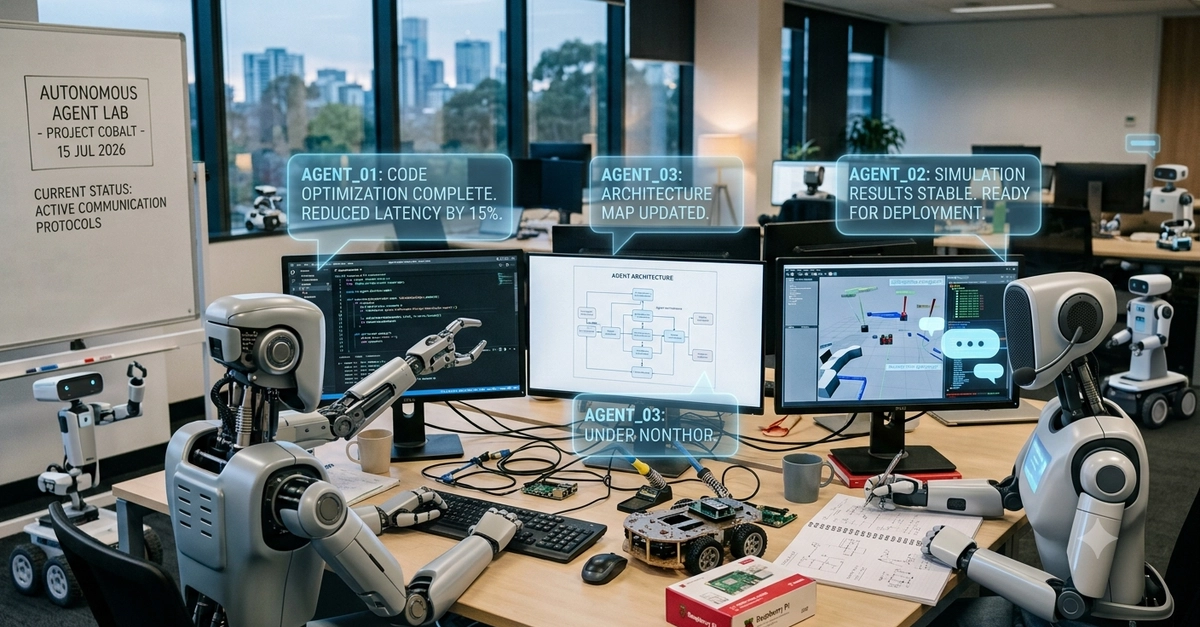
Looking ahead, the trajectory points towards highly autonomous, multi-agent systems. These systems could involve multiple specialized agents collaborating to solve multifaceted problems, much like a team of human experts. One agent might be responsible for information gathering, another for analysis, and a third for execution or creative generation. The engineering challenge then shifts to managing inter-agent communication, conflict resolution, and emergent behaviors. This could lead to AI systems capable of tackling complex, open-ended challenges that currently require significant human oversight and coordination.
Broader Implications for AI Development
Agent engineering represents a paradigm shift in how we build and deploy AI applications. It moves beyond simply prompting a model to effectively architecting AI-powered solutions. For developers, this means a new set of skills and tools to master. It requires understanding system design principles, state management, and robust error handling in the context of probabilistic AI models. For founders, it signals an opportunity to build more reliable and valuable AI products that can operate with greater autonomy and efficiency, tackling business problems that were previously out of reach for AI.
The surprising detail here is not the inherent limitation of LLMs, but the emergence of a new engineering discipline specifically designed to work *around* and *with* those limitations. Agent engineering is not about making LLMs perfect; it's about making them useful in the messy, unpredictable real world. The development of robust agent frameworks, libraries, and best practices will be critical in unlocking the next wave of AI innovation, moving from impressive demos to dependable, production-ready applications.