The Problem with Average Scores
Ranking AI agent configurations based solely on average scores is a common practice, but it's fundamentally flawed. This approach obscures critical trade-offs and can lead teams to prioritize configurations that perform well on average but fail in crucial edge cases or specific scenarios. Imagine a chef who only considers the average deliciousness of a dish across all possible diners. They might miss that while most people find it merely 'okay,' a select few find it exquisite, and others find it utterly unpalatable. The average tells you nothing about this distribution of preferences or the critical failure points.
In the context of AI agents, this means a configuration might boast a high average score because it excels in a large number of common tasks. However, it might perform disastrously on a small but vital subset of problems, or it might exhibit a wide variance in performance. Teams shipping these agents need a more nuanced understanding to make informed decisions about which configurations to deploy, which to iterate on, and which to discard.
Introducing Better Comparison Methods
To address these shortcomings, several alternative methods offer a cleaner, more insightful way to evaluate and rank agent configurations. These methods move beyond simple averaging to capture a richer understanding of performance and user preference.
Best-Worst Scaling (MaxDiff)
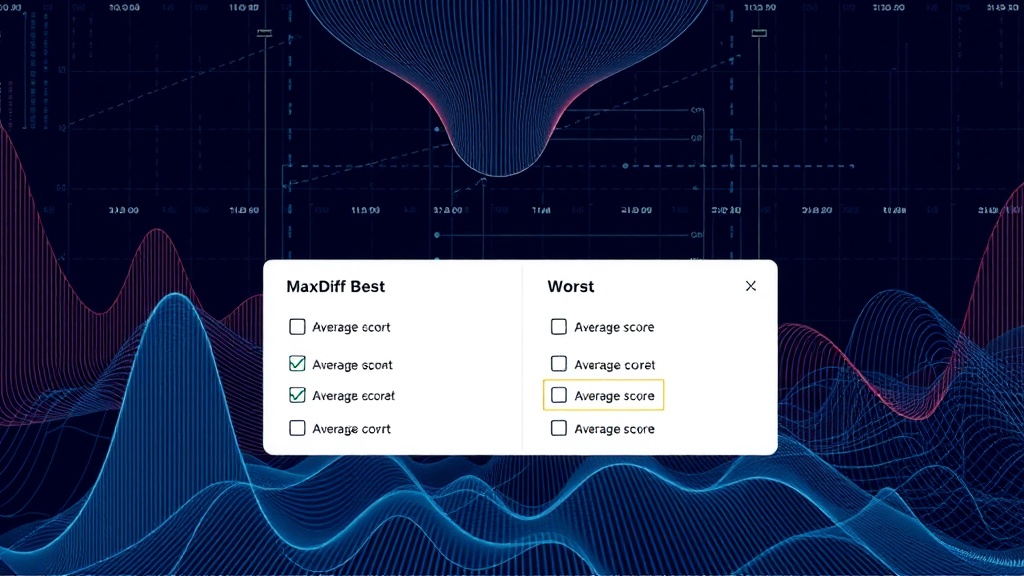
Best-Worst Scaling, often referred to as MaxDiff, is a technique borrowed from market research that can be highly effective for ranking. In this method, raters are presented with a series of sets, and for each set, they identify the best and worst item. For instance, when evaluating agent configurations, a rater might be shown three configurations (A, B, C) and asked to pick the best and worst among them for a specific task. By systematically varying the sets, you can gather data on which configurations are consistently preferred over others.
The underlying principle is that the difference in preference between the best and worst item in a set provides a more robust measure of utility than a simple rating. This method helps to uncover relative preferences more accurately, especially when dealing with a large number of configurations. It forces raters to make comparative judgments, which are often more reliable than absolute ratings. The output of a MaxDiff analysis can be used to derive interval-scale utilities for each configuration, allowing for a more precise ranking.
Plackett-Luce Model
The Plackett-Luce model is a statistical framework used for analyzing paired comparison data, which is exactly what Best-Worst Scaling generates. This model estimates the underlying utility or preference for each item (in this case, agent configurations) based on the observed choices of best and worst items across multiple sets. It assumes that the probability of choosing one item over another depends on their relative utilities.
The model provides a set of parameters, each representing the utility of a specific configuration. These utilities can then be used to rank the configurations. A significant advantage of the Plackett-Luce model is its ability to handle large numbers of items and complex comparison structures. It is particularly useful when dealing with data where direct comparisons between all possible pairs are not feasible or efficient.
Utility Scores for Actionable Insights
By employing Best-Worst Scaling and analyzing the results with the Plackett-Luce model, teams can generate utility scores for each agent configuration. These scores are far more informative than simple averages. They represent a more stable and reliable measure of preference or performance, accounting for the relative strengths and weaknesses across different comparisons. This allows teams to make more confident decisions:
- Ship: Configurations with consistently high utility scores are strong candidates for deployment.
- Prune: Configurations with very low utility scores, or those that are frequently chosen as the worst, can be identified for removal or significant redesign.
- Route Toward Next: Configurations with moderate but promising utility scores, or those that perform exceptionally well in specific types of comparisons (even if not always the absolute best), can be prioritized for further development and iteration.
Moving Beyond Averages for Better AI Development
The landscape of AI agent development is rapidly evolving. As agents become more sophisticated and integral to various applications, the need for rigorous and insightful evaluation methodologies becomes paramount. Relying on simple average scores is akin to navigating a complex city with only a blurry overview map; you miss the details, the one-way streets, and the hidden alleys that can make or break your journey. Best-Worst Scaling and utility scoring provide the detailed, street-level navigation required to build and deploy robust, effective AI agents.
What remains unaddressed is how to dynamically integrate these richer scoring mechanisms into continuous agent development pipelines. Automating the generation of MaxDiff sets and the real-time updating of Plackett-Luce models as new data comes in will be crucial for scaling this approach. The goal is to create a feedback loop that not only ranks configurations but also provides actionable insights for improving them, moving from mere performance measurement to intelligent optimization.