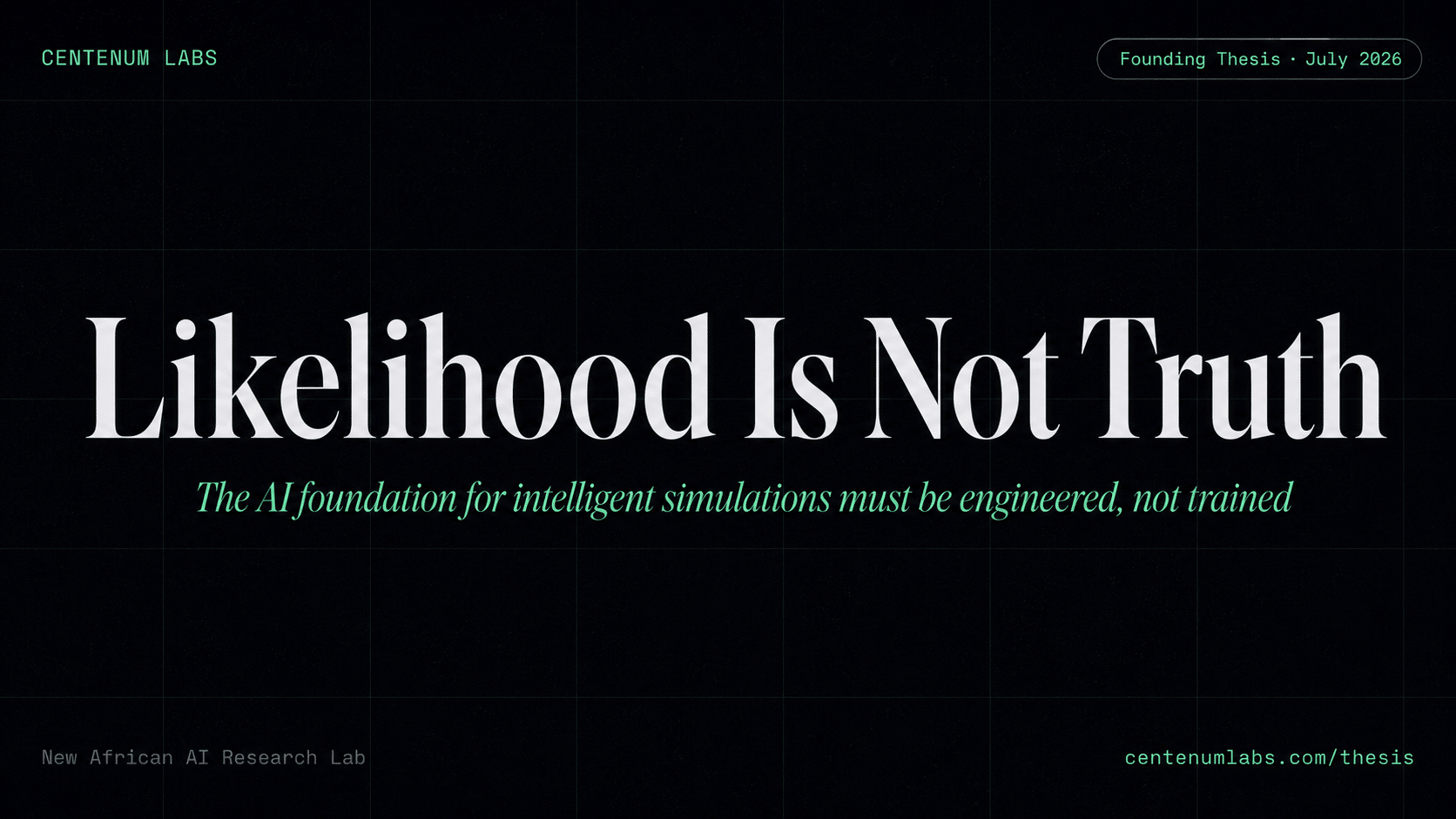
Challenging the Foundation of Modern AI
A nascent African AI research initiative, spearheaded by the newly established Imisi 360, has released a foundational thesis titled "Likelihood Is Not Truth." This document directly confronts a core assumption underpinning most contemporary AI development: that maximizing statistical likelihood in training data equates to producing factual or truthful outputs. The paper argues that this prevailing objective, while effective for certain tasks, leads to AI systems that can generate plausible-sounding misinformation, hallucinations, and biased content, fundamentally misaligning AI's capabilities with genuine human understanding and societal needs.
The thesis posits that the current AI paradigm, heavily reliant on large language models (LLMs) trained on vast internet datasets, is inherently flawed. These models excel at predicting the next token in a sequence based on patterns observed in their training data. This process, often referred to as maximizing likelihood, enables them to generate coherent and contextually relevant text. However, the paper contends that this statistical prowess does not inherently imbue the AI with an understanding of truth, causality, or factual accuracy. The AI is essentially a sophisticated pattern-matcher, not a truth-seeker.
Imisi 360, the research lab behind the thesis, is an African-led initiative focused on developing AI solutions tailored to the continent's unique challenges and opportunities. Their work aims to foster AI research and development that is contextually relevant, ethically sound, and beneficial to African societies. The publication of "Likelihood Is Not Truth" signals their commitment to questioning established norms and proposing alternative trajectories for AI development.
The Problem of Plausibility Over Truth
The core argument is that by optimizing solely for likelihood, AI models become exceptionally good at generating content that *appears* correct, even when it is factually inaccurate or nonsensical. This is particularly problematic in applications where factual correctness is paramount, such as in educational tools, medical diagnostics, or news generation. The paper highlights how LLMs can confidently assert false statements, exhibit biases present in their training data, and even invent information (hallucinate) because these outputs are statistically probable within the context of the data they have processed.
Think of it like a student who has memorized every textbook but never truly understood the concepts. They can recite information perfectly, answer questions with textbook-like precision, but if asked to apply that knowledge to a novel situation or to discern fact from fiction in a complex scenario, they might falter. Modern AI, according to Imisi 360, is this brilliant memorizer, capable of generating highly plausible responses that mimic human language but lack a grounding in verifiable truth. The danger lies in users mistaking this plausibility for accuracy, leading to the amplification of misinformation and erosion of trust in AI systems.

A Call for a New Objective: Truthfulness
The thesis proposes a fundamental shift in AI objective functions. Instead of merely maximizing the likelihood of generated output, future AI development should prioritize truthfulness. This implies developing models that can not only generate coherent text but also ground their outputs in verifiable facts, understand context beyond statistical correlation, and express uncertainty or flag potential inaccuracies. Achieving this requires a departure from current training methodologies and potentially the exploration of new architectures and evaluation metrics.
Achieving truthfulness in AI is not a simple matter of adding a new layer to existing models. It necessitates a deeper exploration of how AI can access, process, and reason with factual knowledge. This could involve integrating knowledge graphs, developing robust fact-checking mechanisms within the models themselves, or exploring novel forms of reasoning that go beyond pattern matching. The paper suggests that this is not merely a technical challenge but also an ethical imperative, especially as AI systems become more integrated into critical aspects of society.
Implications for the Future of AI
The publication of "Likelihood Is Not Truth" raises critical questions for AI researchers, developers, and policymakers worldwide. If the core objective of AI training is flawed, then many of the advancements we've seen, while impressive in their technical execution, may be built on a shaky foundation. This thesis challenges the industry to reconsider its priorities, moving beyond mere performance metrics like perplexity or BLEU scores, and focusing on the actual utility and trustworthiness of AI outputs.
For developers, this means a potential re-evaluation of the tools and techniques they employ. It suggests that simply scaling up current models or datasets might not be enough to overcome the fundamental issue of truthfulness. New research directions could emerge, focusing on methods for incorporating external knowledge, developing robust adversarial training to identify and correct falsehoods, or creating AI systems that can explicitly explain their reasoning and cite their sources. The focus shifts from creating AI that sounds human to creating AI that is reliably informative and truthful.
The thesis also has significant implications for how AI is deployed and regulated. If AI systems are prone to generating plausible falsehoods, then greater scrutiny is needed for applications in sensitive domains. Policymakers may need to consider new standards for AI trustworthiness, moving beyond performance benchmarks to include demonstrable truthfulness and accountability. The onus will be on developers and deployers to ensure their AI systems are not just powerful, but also dependable and aligned with societal values.
An African Perspective on Global AI Challenges
The emergence of this critique from an African research lab is noteworthy. It suggests that diverse perspectives are crucial for shaping the future of AI. As AI is increasingly deployed globally, it is vital that its development is not solely dictated by the priorities and cultural contexts of a few dominant regions. African researchers, facing distinct societal challenges and possessing unique insights, are well-positioned to offer alternative viewpoints and propose solutions that address a broader spectrum of human needs.
This initiative by Imisi 360 is more than just an academic paper; it is a declaration of intent. It signifies a commitment to fostering an AI ecosystem that prioritizes ethical considerations and societal well-being alongside technological advancement. By questioning the very objective of modern AI, they are inviting the global community to pause, reflect, and collectively chart a course for AI that is not only intelligent but also honest and beneficial for all.