The Problem with Black Box AI Analysis
The allure of Artificial Intelligence for data analysis is undeniable. Tools that can ingest raw data and provide insights, forecasts, and anomaly detection promise to democratize data science. However, a significant drawback has emerged: the opacity of the process. When a single Large Language Model (LLM) is responsible for both understanding a user's query and performing the subsequent calculations, the results can be inconsistent and untrustworthy. Sainesh Nakra, the solo developer behind the new open-source project ADA (Automated Data Analyst), experienced this firsthand watching his sister struggle with an LLM. "I watched my sister paste a CSV into on of our LLM overlords and ask a question then reword it and get a different number. That's the problem with letting an LLM both read your question and trust it's math," Nakra explains.
This inconsistency stems from the LLM's inherent nature. While excellent at understanding natural language and generating text, their mathematical and analytical capabilities can be fragile. Slight variations in prompts can lead to different internal reasoning paths, ultimately producing disparate numerical outcomes. This lack of determinism is a non-starter for any serious data analysis, where reproducibility and verifiable results are paramount. ADA directly confronts this challenge by architecting a system that fundamentally separates these two critical functions.
ADA's Architecture: Localized Analysis, Optional LLM Augmentation
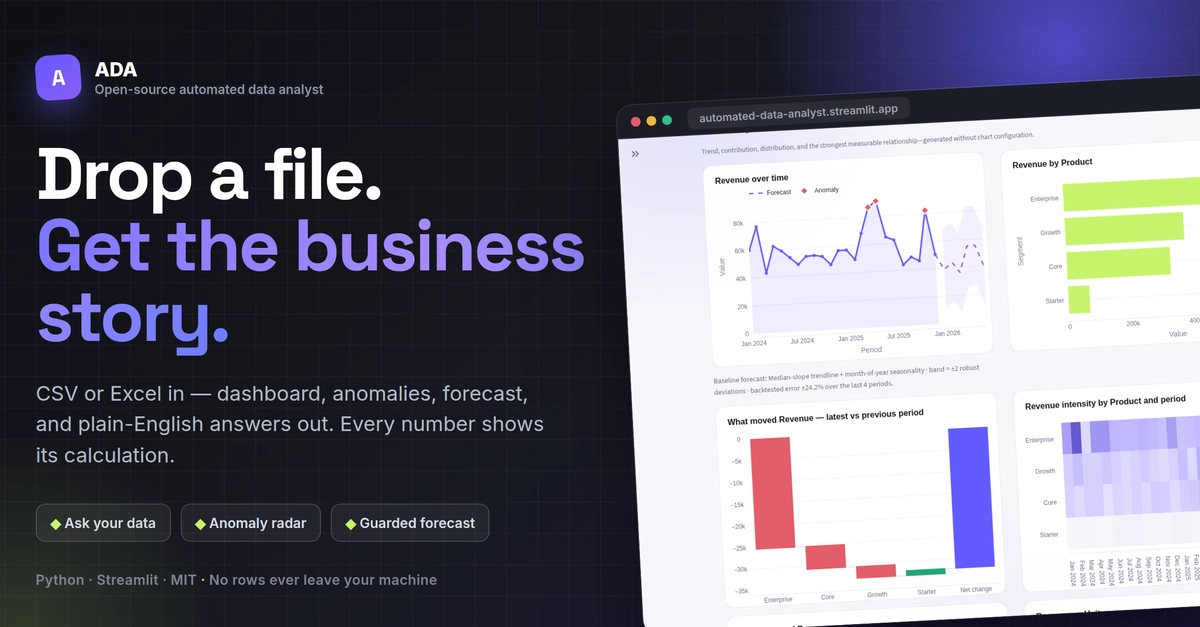
ADA's core innovation lies in its layered approach. The system is designed to process data files—currently supporting CSV and Excel formats—entirely locally. This means that sensitive or proprietary data never leaves the user's server environment to be processed by external AI APIs. Instead, ADA leverages established, deterministic Python libraries, primarily pandas, to perform all calculations. This local processing ensures that the analytical results are consistent and reproducible, regardless of external LLM behavior.
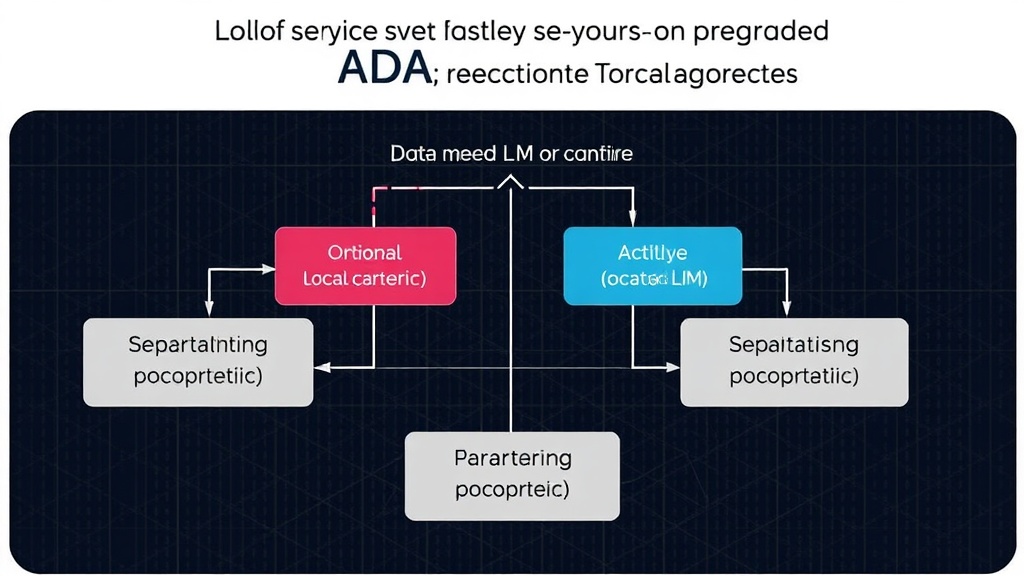
The output from this local analysis is comprehensive. Users can expect to receive a generated dashboard, anomaly detection reports, forecasts, and plain-English explanations of the findings. This multi-faceted output aims to provide a complete picture of the data, catering to both technical and non-technical users. The LLM component, while optional, plays a specific, constrained role. When enabled, the LLM is only used for interpreting the user's natural language queries. Crucially, it never has access to the actual data rows. Instead, it only sees column names and the structure of the data. This separation is key to maintaining data privacy and analytical integrity. The entire system can function without any API keys for the LLM, offering a truly local and private analysis experience if the LLM layer is disabled.
Determinism and Open Source: ADA's Guiding Principles
Nakra's vision for ADA is clear: to make it as LLM-free as possible, prioritizing determinism above all else. This goal is reflected in the project's MIT license, which permits broad use, modification, and distribution. As a solo-built project, ADA is actively seeking contributors to help expand its capabilities and address open issues. The project currently has several open issues, including a desire to further reduce LLM dependency and explore alternative methods for query interpretation that are even more robustly deterministic.
The commitment to determinism sets ADA apart in a rapidly evolving AI landscape. While many tools are racing to integrate LLMs more deeply into every aspect of data processing, ADA takes a contrarian approach. It embraces the power of LLMs for what they do best—understanding and generating human language—while relying on traditional, reliable computational methods for the critical task of data analysis. This hybrid model offers the best of both worlds: the user-friendliness of natural language interfaces combined with the trustworthiness of deterministic computation. The live demo, available at automated-data-analyst.streamlit.app, showcases this functionality, allowing users to interact with the tool and experience its capabilities firsthand.
The Future of Trustworthy AI Data Analysis
ADA's approach tackles a fundamental challenge in the current wave of AI-powered analytics. By isolating the LLM's role to query parsing and ensuring that all calculations are performed locally using libraries like pandas, it provides a transparent and deterministic analysis pipeline. This is particularly important for developers, data scientists, and businesses that require auditable and reproducible results. The open-source nature and permissive MIT license further encourage adoption and contribution, potentially accelerating its development and integration into existing workflows.
The project's future direction, aiming to minimize LLM reliance and maximize determinism, signals a broader trend. As users become more aware of the limitations and potential pitfalls of purely LLM-driven analysis, tools that offer a more controlled and verifiable approach will likely gain traction. ADA is positioned to be a key player in this space, offering a practical solution for anyone seeking AI-assisted data analysis without sacrificing accuracy or trust. The journey from a personal observation about LLM inconsistencies to a fully-fledged open-source project highlights the power of addressing specific pain points in the AI tooling ecosystem.