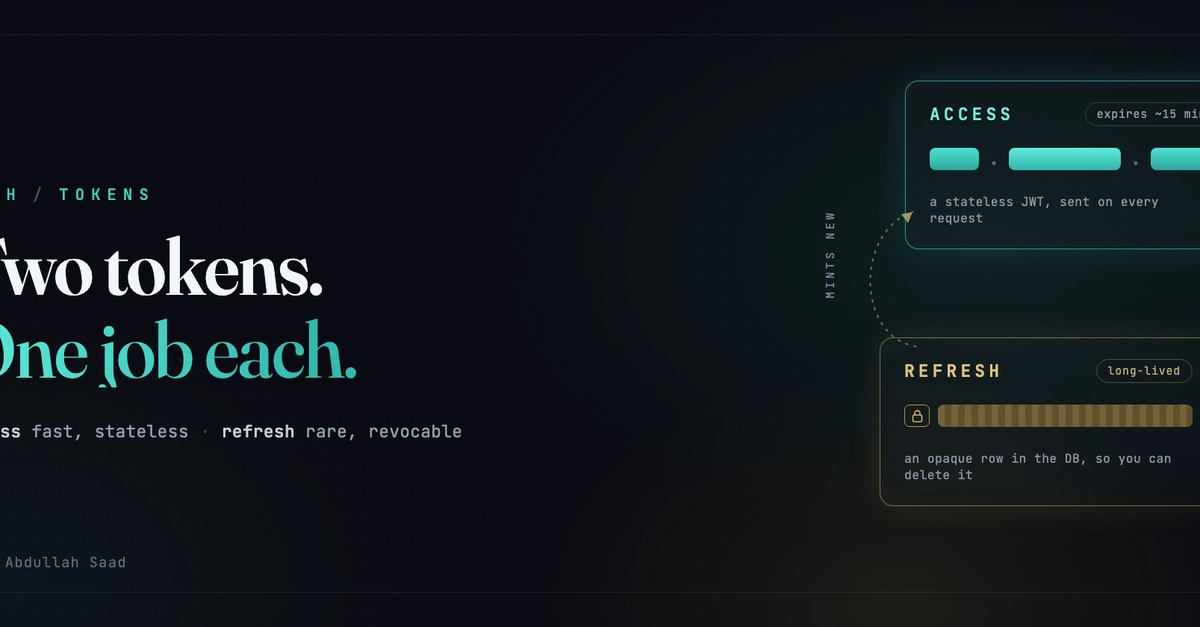
The Mystery of the Second Token
For years, many developers like the one described in a recent Dev.to post relied on a single token for authentication. This approach, while seemingly simpler, overlooks fundamental security and user experience advantages offered by a dual-token system: access tokens and refresh tokens. The confusion often stems from a lack of understanding passed down through generations of developers, where "it's industry standard" becomes the only explanation.
The core of the problem is that a single token, often an access token, is typically short-lived. This is a security feature. If an access token is compromised, the attacker has a limited window to misuse it. However, forcing users to re-authenticate every time this short-lived token expires creates a poor user experience. Imagine having to log in again every 15 minutes. This is where the refresh token steps in, solving the UX problem without sacrificing security.
Understanding the Roles: Access Token vs. Refresh Token
An access token is the credential used to access protected resources. It's typically short-lived, perhaps expiring in 15 minutes to an hour. This token is what the client sends with every API request to prove its identity and authorization. Because it's used frequently and has a short lifespan, it's the primary target for attackers. Limiting its validity is a crucial security measure.
A refresh token, on the other hand, is a long-lived credential used to obtain new access tokens. It's stored more securely and is only sent to a dedicated token endpoint on the authentication server. When an access token expires, the client can present its refresh token to get a new, valid access token without requiring the user to re-enter their username and password. This is the magic that keeps users logged in for extended periods without constant re-authentication.
Think of it like this: the access token is your daily transit pass. It gets you through the turnstile (accessing resources) but expires at the end of the day. You don't need to reapply for a new pass every time you want to ride; you use your monthly pass (refresh token) at the ticket office (token endpoint) to get a new daily pass. The monthly pass is kept in a safer place, and if lost, you'd report it and get a new one, but it's not used for daily entry itself.
The Security Advantage: Mitigating Token Theft
The security implications of this dual-token approach are significant. By making access tokens short-lived, the window of opportunity for an attacker who manages to steal an access token is drastically reduced. If an access token is leaked or intercepted, it becomes useless within minutes or hours, minimizing the damage.
The refresh token, being long-lived, is a more sensitive credential. Therefore, it must be stored and handled with extreme care. Best practices include storing refresh tokens securely on the client-side (e.g., in `HttpOnly` cookies for web applications or secure storage for mobile apps) and ensuring they are only ever sent to the authentication server's token endpoint. If a refresh token is compromised, the security implications are more severe, as it could be used to generate new access tokens indefinitely until revoked. This highlights the need for robust refresh token management, including rotation and revocation mechanisms.
The User Experience Benefit: Seamless Sessions
From a user experience perspective, the refresh token is a game-changer. It allows for persistent sessions without compromising security. Users can browse an application, switch between tabs, or even close and reopen their browser, and remain logged in. This seamless experience is a standard expectation for modern web and mobile applications. Without refresh tokens, developers would be forced to choose between frequent, annoying re-authentication prompts or insecurely long-lived access tokens.
The ability to maintain user sessions without constant interruption is crucial for engagement and conversion. Users are more likely to complete tasks, make purchases, or consume content if the friction of authentication is minimized. The refresh token achieves this balance by abstracting the token renewal process away from the user.
Implementation Considerations
Implementing a dual-token system involves several key considerations:
- Token Generation: Both access and refresh tokens should be cryptographically secure, typically JWTs (JSON Web Tokens) or opaque tokens. Access tokens often contain user identity and authorization claims, while refresh tokens are usually opaque identifiers linked to a user and session in the backend.
- Token Lifespans: Carefully define appropriate lifespans for both tokens. Access tokens might be 15-60 minutes, while refresh tokens could be days, weeks, or even months, depending on the application's security requirements and user expectations.
- Token Storage: Implement secure storage mechanisms on the client. For web apps, `HttpOnly`, `Secure` cookies are a common choice for refresh tokens. For mobile apps, platform-specific secure storage solutions are necessary.
- Token Refresh Flow: Implement a flow where the client automatically requests a new access token using the refresh token when the current access token expires. This process should be transparent to the user.
- Refresh Token Rotation: A critical security practice is to rotate refresh tokens. When a refresh token is used to obtain a new access token, the server can issue a *new* refresh token and invalidate the old one. This helps detect and mitigate refresh token theft. If a stolen refresh token is used, the rotation invalidates it for future use.
- Revocation: Implement mechanisms to revoke refresh tokens server-side. This is essential if a token is suspected of being compromised or if a user logs out from all devices.
The initial confusion described in the Dev.to post highlights a common pitfall: accepting industry standards without understanding the underlying technical rationale. The dual-token system isn't just a convention; it's a well-reasoned approach to balancing security and user experience in modern authentication flows.