The Genesis of ACAI: A Modular Approach
The Adaptive Cognitive AI Architecture (ACAI) project emerges with a clear objective: to build a flexible and extensible AI system through incremental development. Rather than aiming for a monolithic, all-encompassing solution from the outset, ACAI's foundational version focuses on establishing a small, functional core. This approach prioritizes testability and iterative growth, allowing developers to build upon a stable base.
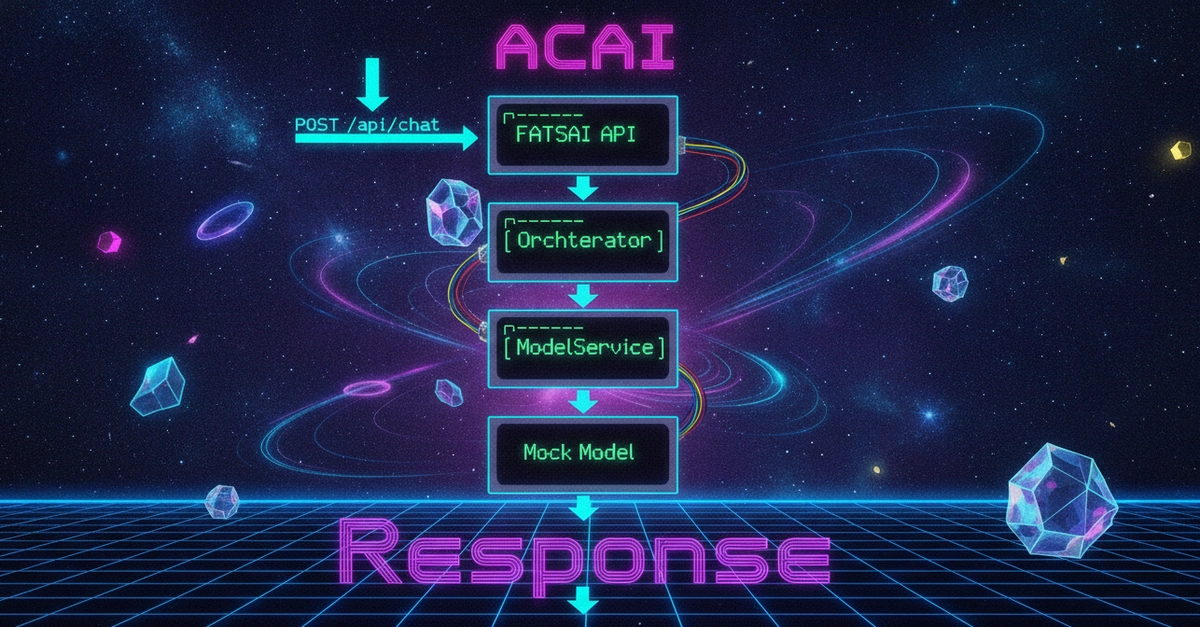
The initial pipeline for ACAI is designed for clarity and simplicity. It begins with a user request, which is handled by FastAPI, a modern web framework for building APIs with Python. FastAPI then passes the request to the ACAI Orchestrator, the central component responsible for managing the flow of information. The Orchestrator communicates with a Model Service, which in turn interacts with an actual AI Model. Finally, the response is returned to the user.

Crucially, the first implementation of ACAI utilizes a Mock Model. This strategic choice sidesteps the immediate need for external API keys or complex model integrations. By employing a mock model, the development team can rigorously test the core infrastructure—FastAPI, the Orchestrator, and the Model Service—ensuring that the data flow and system logic are sound before introducing the complexities of real AI model interactions.
Project Structure and Core Components
The project's organization reflects its modular philosophy. The ACAI repository is structured with a clear separation between backend application logic and testing utilities. The core application resides within the backend/app/ directory, containing essential modules:
__init__.py: Initializes the application package.main.py: The application's entry point, likely setting up the FastAPI instance and defining core routes.config.py: Handles application configuration, managing settings and environment variables.schemas.py: Defines data structures and validation schemas, ensuring consistent data formats for requests and responses.orchestrator.py: Contains the logic for the ACAI Orchestrator, managing the workflow between different services.services/: A subdirectory for service-level logic, including:__init__.py: Initializes the services package.model_service.py: Manages interactions with AI models, abstracting away the specifics of model loading and inference.
The backend/tests/ directory houses testing code, starting with test_api.py, which will be crucial for verifying the functionality of the FastAPI endpoints and the overall system integration.

The Orchestrator: The Brain of ACAI
The ACAI Orchestrator is central to the architecture's adaptive nature. While the initial version focuses on a linear pipeline, the design implies future capabilities for dynamic workflow management. An orchestrator in this context acts as a conductor, determining which AI models or services are best suited for a given task and sequencing their execution. This is a critical step beyond simple request-response patterns, enabling ACAI to potentially handle complex, multi-stage cognitive tasks.
The current implementation, as described, likely routes requests sequentially: User -> FastAPI -> Orchestrator -> Model Service -> Mock Model. However, the naming suggests that future iterations will empower the Orchestrator to make more sophisticated decisions. This could involve selecting from a pool of different AI models based on the input query's characteristics, managing parallel processing of sub-tasks, or even dynamically adjusting parameters for optimal performance. This is akin to a skilled chef not just following a recipe, but understanding the ingredients and adjusting techniques on the fly to create the best possible dish.
Model Service and Future Expansions
The Model Service acts as an intermediary, decoupling the Orchestrator from the specifics of individual AI models. This abstraction is key to ACAI's adaptability. As new AI models emerge or existing ones are updated, only the Model Service needs to be modified to accommodate them, provided they adhere to a common interface. This design allows ACAI to seamlessly integrate diverse AI capabilities, from large language models to computer vision systems.
The use of a Mock Model in Chapter 1 is a pragmatic starting point. It permits the development and testing of the entire request pipeline without the overhead of managing real AI model endpoints, API keys, or computational resources. Once the core infrastructure is validated, the Mock Model can be replaced with actual integrations. The roadmap for ACAI will undoubtedly involve expanding the range of supported AI models and developing more intelligent routing logic within the Orchestrator to truly realize its adaptive cognitive capabilities.
The project's open-source nature invites contributions and suggests a community-driven development path. Future chapters will likely detail the integration of various AI models, the enhancement of the Orchestrator's decision-making logic, and the implementation of feedback mechanisms to further refine the system's cognitive abilities.