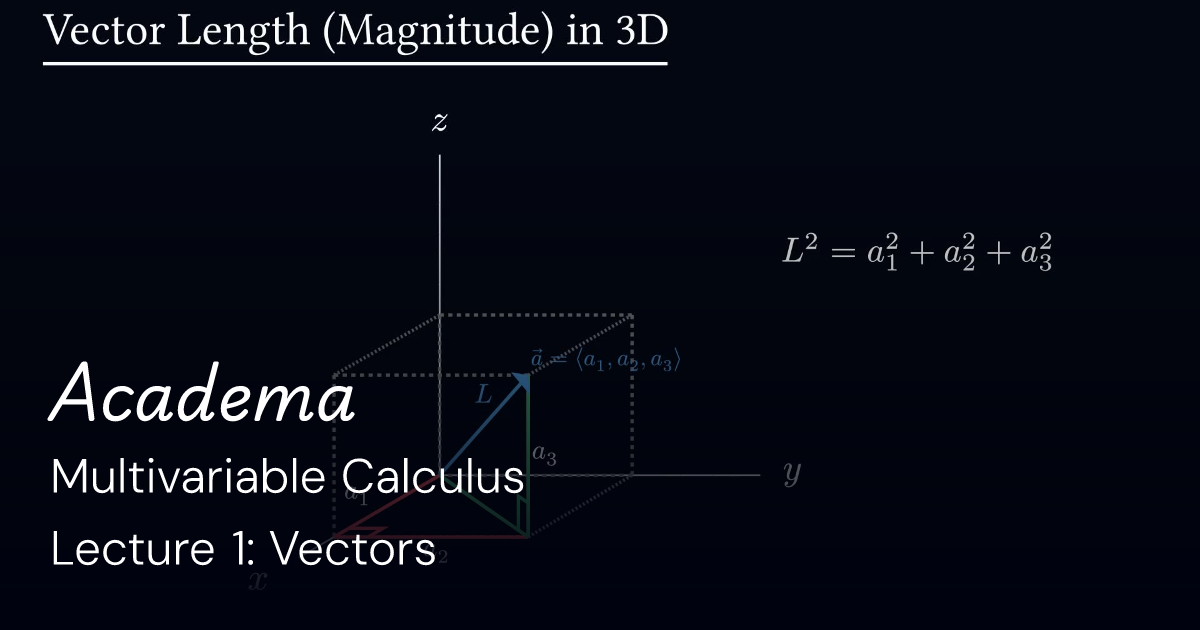
Academa's Innovative Approach to Multivariable Calculus
Academa has launched a new online course in multivariable calculus that integrates Large Language Models (LLMs) to offer a more interactive and personalized learning experience. This initiative aims to address the common challenges students face when grappling with the abstract and computationally intensive nature of advanced calculus, a subject often considered a significant hurdle in STEM education.
Traditional online calculus courses often rely on pre-recorded lectures and automated grading systems that can provide limited feedback. Academa's approach diverges by embedding AI directly into the learning process. Students can ask questions about concepts, receive step-by-step explanations for problems, and get instant feedback on their work, mimicking the benefits of one-on-one tutoring.
The course covers standard multivariable calculus topics, including partial derivatives, multiple integrals, vector calculus, and line and surface integrals. The LLM acts as an intelligent assistant, capable of understanding natural language queries and generating relevant, context-aware responses. This means students are not limited to predefined FAQs or forum posts; they can explore their understanding in real-time, asking 'why' and 'how' as they encounter difficulties.
The Role of LLMs in Calculus Education
The integration of LLMs into calculus education is a nascent but promising field. These models, trained on vast datasets of text and code, can process and generate human-like text, making them adept at explaining complex mathematical ideas. Unlike static textbooks or videos, an LLM can adapt its explanations based on the student's input and demonstrated understanding.
For multivariable calculus, this is particularly impactful. Concepts like divergence, curl, and Green's theorem are notoriously difficult to visualize and understand intuitively. An LLM can provide multiple analogies, break down proofs into smaller steps, or even generate alternative problem formulations to solidify comprehension. This is akin to having a patient teaching assistant available 24/7, ready to re-explain a concept in a different way until it clicks.
Academa emphasizes that the LLM is not intended to replace the instructor entirely but to augment the learning process. The AI handles the immediate, granular questions, freeing up human instructors to focus on higher-level guidance, conceptual discussions, and addressing more nuanced learning difficulties. The system is designed to identify patterns in student errors, potentially flagging common misconceptions for instructors to address in broader class sessions or supplementary materials.
Personalized Learning Pathways
One of the significant advantages of an LLM-integrated system is its ability to foster personalized learning pathways. By analyzing a student's interactions, the AI can infer areas of strength and weakness. This allows the course material to be dynamically adjusted, offering more practice problems in challenging areas or suggesting supplementary resources for specific topics.
For instance, if a student consistently struggles with setting up triple integrals in cylindrical coordinates, the LLM can provide targeted exercises, visual aids, and explanations specifically for that sub-topic. This adaptive approach contrasts sharply with one-size-fits-all online courses, where students might be forced to review material they already understand or move past concepts without true mastery.
The feedback mechanism is another critical component. Instead of just marking an answer as correct or incorrect, the LLM can offer detailed critiques of a student's work, pointing out errors in algebraic manipulation, conceptual misunderstandings, or incorrect application of theorems. This immediate, actionable feedback is crucial for building confidence and correcting mistakes before they become ingrained habits.
Future Implications for STEM Education
The introduction of courses like Academa's signals a broader trend in how AI is being integrated into educational platforms. As LLMs become more sophisticated, their potential applications extend beyond calculus to physics, differential equations, linear algebra, and even introductory programming. The ability to provide scalable, personalized, and interactive learning support at a relatively low cost could democratize access to high-quality STEM education.
However, challenges remain. Ensuring the accuracy of AI-generated explanations, particularly in complex mathematical domains, requires rigorous validation. Ethical considerations around data privacy and the potential for over-reliance on AI also need careful management. Furthermore, the effectiveness of such systems will depend on their ability to foster genuine conceptual understanding rather than mere procedural fluency.
Academa's initiative is a tangible step towards a future where AI acts as a powerful co-pilot for learners navigating challenging academic subjects. It offers a glimpse into how technology can make advanced subjects more accessible and engaging, potentially reshaping the landscape of online STEM education for years to come.