Why Abstraction Matters: Beyond the Textbook Definition
Ask ten beginner developers what abstraction is, and you'll likely hear: "It's hiding implementation details and showing only essential information." Technically, this is correct. But when pressed further – asking why it was invented, how it applies to an inventory system, or how it differs from encapsulation – many candidates falter. This common pitfall stems from rote memorization rather than true comprehension. Experienced software engineers understand abstraction not as a definition, but as a fundamental problem-solving tool that underpins virtually all modern software.
Abstraction exists to manage complexity. Software systems, especially large ones, become unmanageable if every component's intricate workings must be understood by every other component. Imagine trying to drive a car if you needed to understand the precise mechanics of the engine, transmission, and braking system before you could even turn the key. Abstraction allows us to interact with systems at a higher level, focusing on what a component does rather than how it does it. This separation of concerns makes systems easier to design, build, maintain, and evolve.
Abstraction vs. Encapsulation: A Crucial Distinction
A frequent point of confusion is the difference between abstraction and encapsulation. While related, they address different aspects of managing complexity. Encapsulation is about bundling data (attributes) and the methods that operate on that data into a single unit, the class. It also involves controlling access to that data, often through public methods while keeping internal data private. Think of encapsulation as a protective capsule around your data and behavior.
Abstraction, on the other hand, is about simplifying complex reality by modeling classes appropriate to the problem and hiding unnecessary details. It's the concept of presenting a simplified interface. While encapsulation helps achieve abstraction by hiding internal state and implementation, abstraction is the broader principle of focusing on essential features. For instance, a Car class might encapsulate its engine components and fuel level. The abstraction, however, is the driver's interface: the steering wheel, accelerator, and brake pedals. The driver doesn't need to know about spark plugs or fuel injectors to drive; they interact with the car's abstract controls.
Abstraction in Action: The Inventory Management System Example
Consider an Inventory Management System. At a high level, users need to perform actions like addItem, removeItem, checkStock, and updateQuantity. This is the abstract view. A user doesn't need to know if the system uses a relational database, a NoSQL store, or even a simple in-memory array to track items. They don't need to know the specific SQL queries or API calls being made under the hood.
The system's interface exposes these essential operations. Internally, the developers implementing addItem might handle database connections, transaction management, logging, and complex validation rules. These are the implementation details that are hidden. The abstraction is the clean, straightforward API presented to the user or other systems. This allows the inventory management logic to be updated or even rewritten entirely (e.g., migrating from PostgreSQL to MongoDB) without affecting the users who interact with the system through its abstract interface.
Abstraction in C++: Pure Virtual Functions and Abstract Classes
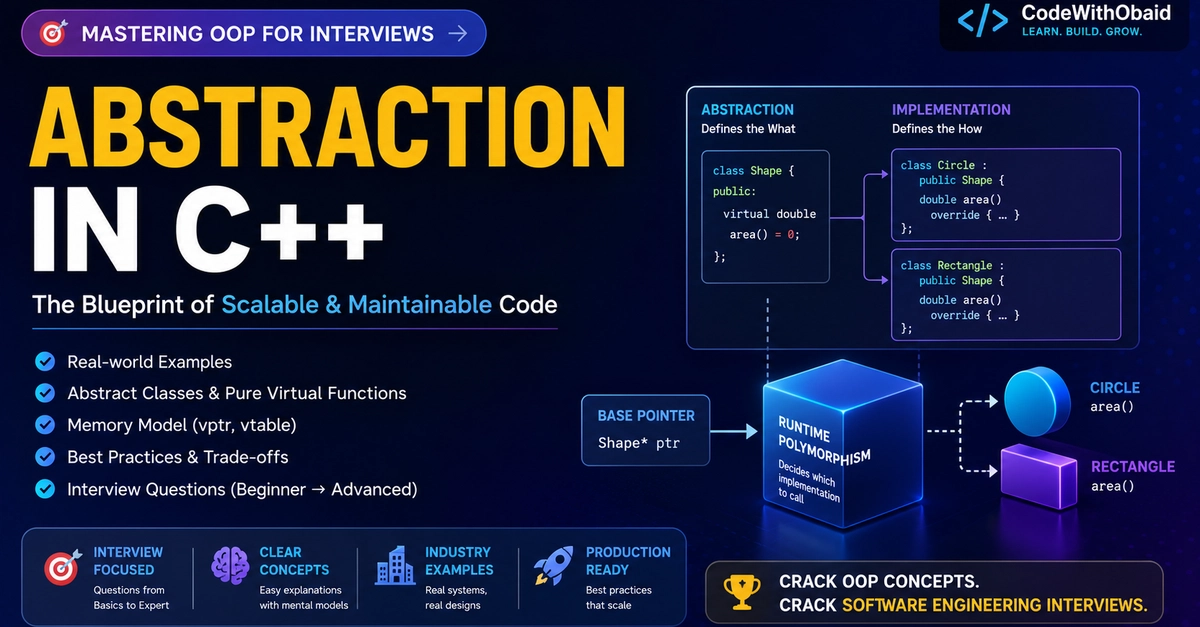
In C++, abstraction is most powerfully represented through abstract classes and pure virtual functions. An abstract class is a class that cannot be instantiated on its own. It serves as a blueprint for other classes. This is achieved by declaring at least one pure virtual function within the class.
A pure virtual function is a virtual function for which no implementation is provided in the base class. It's declared using = 0 after the function signature. For example:
class Shape {
public:
    virtual void draw() = 0; // Pure virtual function
    void commonMethod() { /* Common implementation */ }
};
Any class that inherits from Shape (e.g., Circle, Square) must provide an implementation for draw(). If a derived class fails to implement all pure virtual functions from its base class, it too becomes an abstract class and cannot be instantiated.
This mechanism enforces a contract. Any object of a type derived from Shape is guaranteed to have a draw() method. This allows you to work with a collection of different shapes polymorphically. You can have a std::vector<Shape*> and iterate through it, calling shapePtr->draw() on each element. The correct draw() implementation for the specific derived type (Circle::draw() or Square::draw()) will be called at runtime, demonstrating polymorphism and abstraction working together.
The Benefits: Maintainability, Extensibility, and Testability
Mastering abstraction is crucial for several reasons, particularly in professional software development and interviews:
- Maintainability: When implementation details are hidden, changes within one part of the system are less likely to break other parts. This makes maintenance significantly easier and less risky.
- Extensibility: Abstract designs make it easier to add new features or components. New classes can inherit from abstract base classes, providing specific implementations without altering the existing abstract interface.
- Testability: Abstraction simplifies testing. You can often mock or stub abstract interfaces to test components in isolation, without needing to set up complex dependencies.
- Teamwork: Abstraction allows different team members to work on different parts of the system concurrently. A developer can implement the abstract interface for a service, while another developer can write code that consumes that service, relying only on the agreed-upon interface.
Understanding abstraction at this fundamental level—its purpose, its relationship with encapsulation, and its practical implementation in languages like C++—is what separates candidates who have memorized definitions from those who truly understand object-oriented principles. This deeper understanding is precisely what interviewers look for when assessing a candidate's ability to design robust, scalable, and maintainable software.