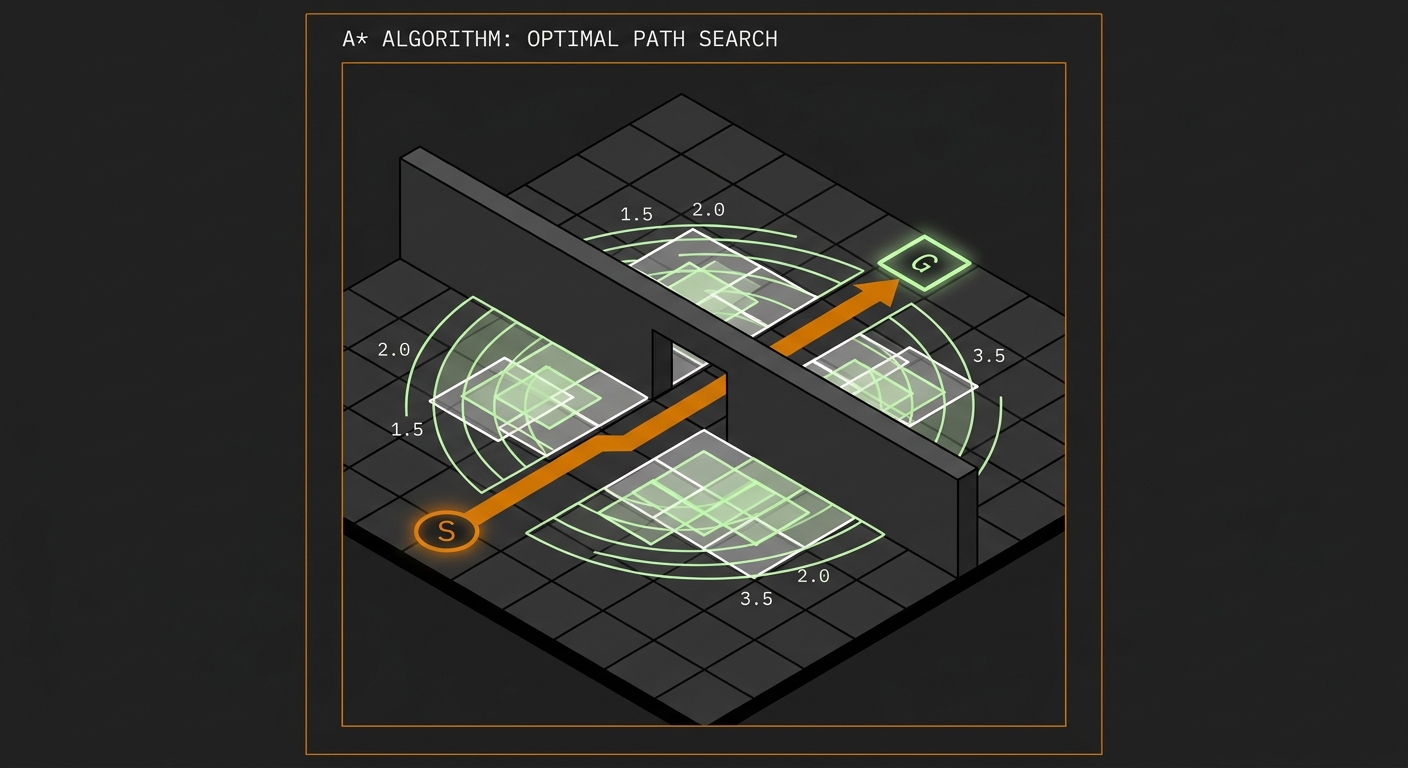
The Problem: Naive Navigation in Games
Imagine a character in a top-down game needs to move from Point A to Point B. The simplest approach might be to tell the character to move directly towards the destination. However, in game environments, this often means walking straight into walls, getting stuck in corners, or exhibiting awkward, robotic movement. This naive approach fails because it doesn't account for the actual traversable space. To overcome this, game developers rely on sophisticated pathfinding algorithms. The A* (A-Star) search algorithm is a cornerstone of efficient and natural-looking character navigation in video games.
A* is a graph traversal and pathfinding algorithm. It's widely used in computing, but its application in video games is particularly critical for creating believable and fluid character movement. Without it, players would constantly encounter characters stuck on geometry, failing to reach objectives, or moving in nonsensical ways. A* provides a way to calculate the most efficient route through a complex, often grid-based, environment.
What is the A* Search Algorithm?
At its core, A* works by evaluating potential paths using a heuristic function. It aims to find the shortest path from a starting node to a goal node in a graph. Unlike simpler algorithms like Dijkstra's, which explore outwards uniformly, A* uses an informed search strategy. This means it prioritizes exploring paths that are more likely to lead to the goal quickly.
The algorithm maintains two key values for each node it considers:
- g(n): The actual cost of moving from the starting node to the current node (n). This represents the distance traveled so far.
- h(n): The estimated cost (heuristic) of moving from the current node (n) to the destination node. This is an educated guess about the remaining distance.
The A* algorithm then calculates an f(n) value for each node: f(n) = g(n) + h(n). This f(n) value represents the total estimated cost of a path going through node n. A* prioritizes exploring nodes with the lowest f(n) value. This combination of actual cost (g) and estimated cost (h) allows A* to be both efficient and optimal.

How A* Works in Practice: The Grid Example
Consider a game world represented as a grid of tiles. Each tile can be either traversable (like a floor) or an obstacle (like a wall). A* operates on this grid:
- Initialization: The algorithm starts with the character's current position as the starting node. Two lists are maintained: an 'open list' (nodes to be evaluated) and a 'closed list' (nodes already evaluated). The starting node is added to the open list.
- Evaluation: While the open list is not empty, the algorithm selects the node with the lowest f(n) value from the open list. This node is removed from the open list and added to the closed list.
- Neighbor Exploration: For each neighbor of the selected node (e.g., adjacent tiles in the grid), the algorithm calculates its g(n) and h(n) values. The g(n) for a neighbor is the g(n) of the current node plus the cost to move to that neighbor. The h(n) is the estimated distance from the neighbor to the goal.
- Path Cost Check: If a neighbor is already in the open list, the algorithm checks if the new path to this neighbor (through the current node) is shorter than the existing path. If it is, the neighbor's parent and g(n) value are updated. If the neighbor is not in the open list, it's added, with its g(n) and h(n) calculated, and its parent set to the current node.
- Goal Check: If the selected node is the destination node, the algorithm has found a path. It reconstructs the path by backtracking from the destination to the start using the parent pointers.
- No Path: If the open list becomes empty and the destination has not been reached, it means no path exists.
The Heuristic: Guiding the Search
The effectiveness of A* heavily relies on the quality of its heuristic function (h(n)). A good heuristic is:
- Admissible: It never overestimates the cost to reach the goal. This guarantees that A* will find the shortest path.
- Consistent (or Monotone): For any node n and its successor n', the cost from start to n plus the estimated cost from n to n' is less than or equal to the estimated cost from start to n'. This property ensures that once a node is moved to the closed list, the path found to it is indeed the shortest.
Common heuristics for grid-based pathfinding include:
- Manhattan Distance: For grids where movement is restricted to horizontal and vertical steps (no diagonals). Calculated as
|x1 - x2| + |y1 - y2|. - Euclidean Distance: The straight-line distance between two points. Calculated as
sqrt((x1 - x2)^2 + (y1 - y2)^2). This is admissible but may not be consistent if diagonal movement has a higher cost than cardinal movement. - Diagonal Distance (or Chebyshev Distance): For grids allowing diagonal movement, considering the cost of diagonal moves.
The choice of heuristic impacts performance. A more accurate heuristic generally leads to fewer nodes being explored, making the search faster. However, calculating a very complex heuristic can also introduce overhead.
Why A* is Superior for Games
Compared to simpler algorithms, A* offers significant advantages for game development:
- Optimality: When using an admissible heuristic, A* is guaranteed to find the shortest path.
- Efficiency: Its informed search strategy means it explores significantly fewer nodes than uninformed algorithms like Breadth-First Search (BFS) or Dijkstra's algorithm, especially in large, complex environments. It's often much faster than Dijkstra's because it prioritizes promising paths.
- Flexibility: A* can be adapted to various grid types, weighted graphs, and movement costs.
The surprising detail here is not the algorithm's complexity, but how a relatively simple formula (f=g+h) can solve such a fundamental and visually critical problem in game design. It's elegant in its execution, balancing known progress with educated guesswork to navigate worlds that would otherwise be impassable for virtual characters.
Implications for Game Development
For game developers, understanding A* is crucial. It's the bedrock upon which complex AI behaviors are built. Beyond simple movement, A* can be used for enemy patrol routes, quest objective navigation, or even determining the best line of sight for characters. Optimizing A* implementations, such as choosing the right data structures for the open list (e.g., a priority queue) and selecting an appropriate heuristic, can significantly impact game performance, especially with many agents needing pathfinding simultaneously.
If you're building a game with any form of character movement in a non-trivial environment, you are likely using A* or a derivative. Its efficiency and optimality make it the go-to choice. The challenge often lies not in implementing A* itself, but in correctly representing the game world as a graph and tuning the heuristic for optimal performance across different scenarios.