The Illusion of Production-Ready AI
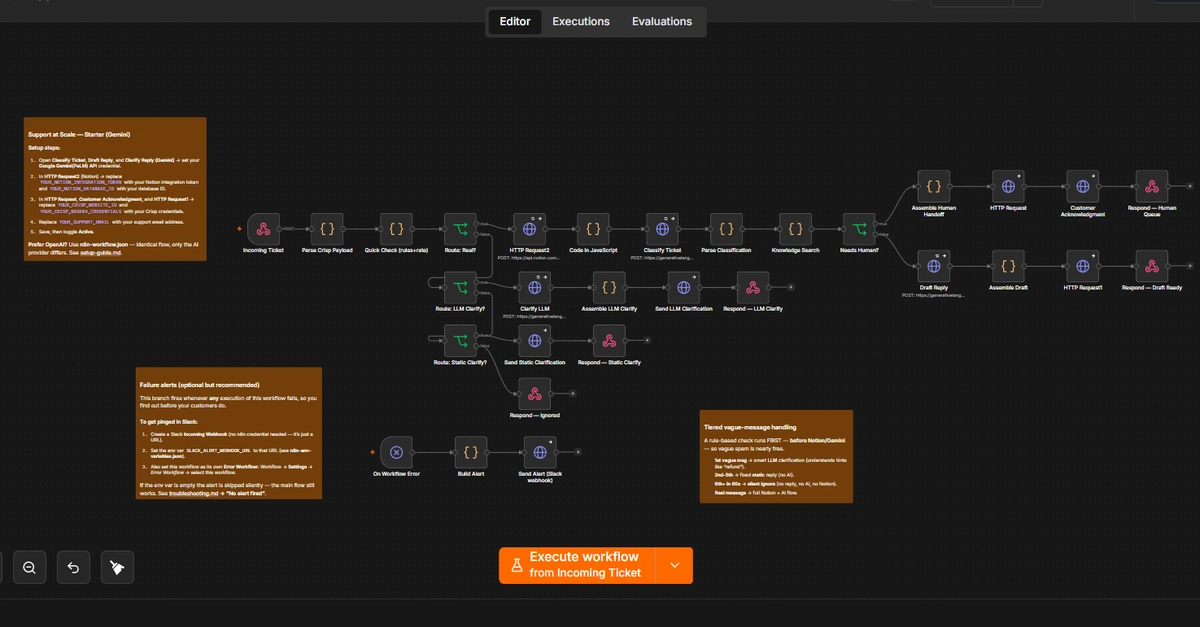
The current landscape of AI development often showcases impressive demos. Connecting tools like OpenAI with automation platforms such as n8n or Make, crafting a compelling prompt, and hitting 'Run' can yield results that appear highly sophisticated. This ease of demonstrating AI capabilities is precisely how many workflows begin, including those developed for projects like AgenticScales. The initial hurdle isn't making the AI perform a task; it's the subsequent, more challenging phase of preparing it for the unpredictable realities of production environments.
The stark reality, as observed by developers building real-world AI workflows, is that approximately 90% of these automations falter when deployed beyond the controlled setting of a demo. This isn't a failure of the AI model itself, but a systemic breakdown in how these systems are architected to handle real-world conditions. The true difficulty lies not in the prompt engineering or the initial integration, but in anticipating and systematically addressing the uncomfortable questions that inevitably arise when an AI workflow interacts with the messy, unpredictable world of users and live data.
Uncomfortable Questions for Production AI
The journey from a working demo to a reliable production system involves confronting a series of critical failure points that are often ignored during the initial development phase. These aren't minor bugs; they are fundamental architectural challenges that, if unaddressed, guarantee failure. Consider the questions that begin to surface once the initial 'wow' factor of a demo wears off:
- API Timeouts and Network Issues: What happens when the external AI service or API fails to respond within an acceptable timeframe due to network latency or server overload? Does the workflow gracefully degrade, retry, or simply crash?
- AI Ignorance and Hallucinations: What happens when the AI model encounters a query outside its training data, or worse, generates plausible but incorrect information (hallucinates)? How does the system handle uncertainty or a lack of knowledge?
- User Edge Cases and Malicious Input: What happens when a customer submits a refund request through an AI-powered support bot, or when a user attempts to spam the system with meaningless or harmful messages? Production systems must be resilient to both legitimate but unusual user actions and deliberate attempts to break them.
- Data Drift and Model Staleness: Over time, the real-world data an AI interacts with can drift from its training data, leading to performance degradation. How is this drift detected, and how is the model updated or retrained to maintain accuracy?
- Integration Failures: AI workflows rarely exist in isolation. They integrate with databases, CRMs, payment gateways, and other services. What happens when these integrations fail, return unexpected data formats, or go offline?
Each of these questions highlights a potential point of failure that moves beyond the core AI model. The more time spent building and iterating on these workflows, the clearer it becomes that production AI is less about crafting the perfect prompt and more about the robust engineering required to handle failure gracefully. The majority of AI automations fail not because the AI model is flawed, but because the surrounding infrastructure and logic are not designed to cope with exceptions.
The Engineering Behind AI Resilience
Building resilient AI systems requires a shift in focus from the 'happy path' to comprehensive error handling and state management. This involves implementing several key engineering practices:
1. Robust Error Handling and Retries
For transient errors like API timeouts or temporary network glitches, implementing intelligent retry mechanisms is crucial. This involves not just simple retries, but exponential backoff strategies to avoid overwhelming a struggling service. Furthermore, defining clear failure thresholds and escalation paths is essential. If an API consistently fails after multiple retries, the system should not halt; instead, it should log the error, notify an operator, and potentially offer a fallback mechanism, such as a human agent review.
2. Uncertainty Management and Fallbacks
AI models are not omniscient. When faced with ambiguous queries or data outside their training scope, they can either refuse to answer or generate incorrect information. Production systems must be designed to detect this uncertainty. This can involve using confidence scores from the AI model, or employing secondary checks. If confidence is low, the system can be programmed to ask clarifying questions, state its limitations explicitly (e.g., "I don't have enough information to answer that precisely"), or escalate to a human. This prevents the system from providing misinformation, which can be more damaging than not providing an answer at all.
3. Input Validation and Sanitization
Protecting against spam, malicious inputs, and malformed data is paramount. Just as web applications sanitize user input to prevent injection attacks, AI workflows must validate and sanitize any data they receive, whether from external APIs or direct user input. This includes checking data types, lengths, formats, and using content moderation techniques to flag or block inappropriate content. Establishing clear rules for what constitutes valid input and how to handle invalid input prevents unexpected behavior and security vulnerabilities.
4. State Management and Idempotency
Complex workflows involve multiple steps, and maintaining the correct state across these steps is vital. If a workflow fails mid-execution, it needs to be able to resume from a consistent state without unintended side effects. This is where idempotency becomes critical: ensuring that performing an operation multiple times has the same effect as performing it once. For example, processing a payment should only happen once, even if the system attempts to process it multiple times due to a retry mechanism. Proper state management ensures that partial failures do not lead to data corruption or duplicate actions.
5. Monitoring, Logging, and Alerting
A comprehensive observability strategy is non-negotiable for production AI. This means implementing detailed logging at every stage of the workflow, from input reception to AI processing to output delivery. Monitoring key performance indicators (KPIs) such as response times, error rates, and successful completion rates allows for proactive identification of issues. Alerting systems should be configured to notify the appropriate teams when predefined thresholds are breached, enabling rapid response to emerging problems before they impact a significant number of users.
The Path Forward: Embracing Failure as a Feature
The 90% failure rate in production AI automations is not an indictment of AI technology itself, but a reflection of the immaturity in engineering practices surrounding its deployment. The focus must shift from solely demonstrating AI's capabilities to building systems that are inherently resilient. This requires developers and organizations to ask the hard questions early, design for failure from the outset, and treat robust error handling, uncertainty management, and input validation not as afterthoughts, but as core features of any production-ready AI workflow. Only by embracing these principles can we move beyond impressive demos to reliable, scalable AI applications.