The Problem: Tutorials vs. Incidents
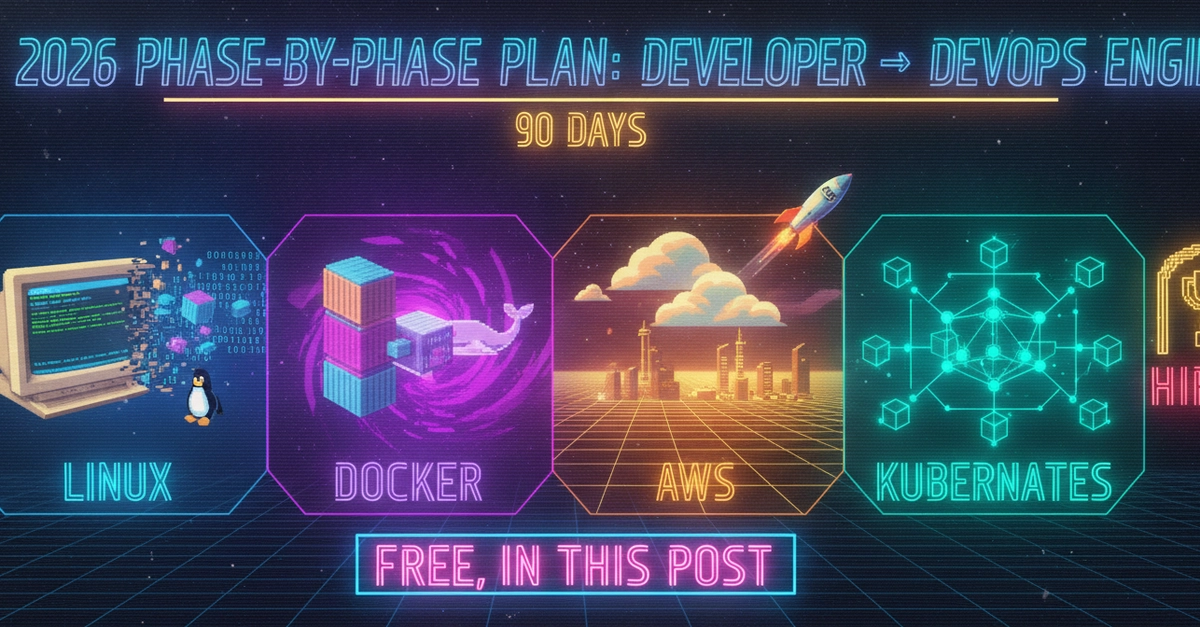
Many aspiring DevOps engineers get stuck. They might breeze through multiple Docker courses, only to freeze when a real container crashes. The issue is simple: tutorials teach commands, but actual incidents teach engineers. This gap is precisely what a new, free 90-day DevOps roadmap aims to close.
Created by a developer who experienced this frustration firsthand, the roadmap is designed to be a comprehensive, day-by-day plan. It guides individuals from writing application code to confidently deploying, debugging, and resolving infrastructure issues. A key differentiator is its accessibility: no signups, no hidden costs, and no external links required to follow the curriculum. The entire plan is laid out within the resource itself.
Why This Order, Why 90 Days
Most existing DevOps roadmaps falter for one of two primary reasons. Either they present an overwhelming, unstructured "skill tree" of hundreds of nodes, leading to scattered learning, or they funnel users into expensive courses. Another common pitfall is teaching tools in the wrong sequence. For instance, diving into Kubernetes before a solid grasp of Linux fundamentals can lead to blindly copy-pasting `kubectl` commands without understanding how to debug them when things go wrong.
The creator settled on a specific ordering principle: each layer of learning must fully build upon the previous one. This ensures a logical progression, preventing the common scenario of learning advanced concepts without foundational knowledge. The 90-day timeframe is structured to allow for practical application and reinforcement of skills, moving beyond theoretical knowledge to hands-on experience.
The roadmap starts with foundational Linux command-line skills. This is critical because many DevOps tools and infrastructure components ultimately rely on a Linux environment. Understanding the operating system at this level is like learning the alphabet before attempting to write a novel. Without it, higher-level concepts become abstract and difficult to troubleshoot.
Following the Linux basics, the curriculum moves to essential scripting and automation. This phase focuses on tools and techniques that allow for the automation of repetitive tasks, a cornerstone of DevOps. Bash scripting is typically the first step, enabling users to chain commands and create simple automation sequences. This is immediately followed by an introduction to version control systems, primarily Git. Mastering Git is non-negotiable in modern software development and operations, as it underpins collaboration, code management, and deployment pipelines.
Building Blocks: From Code to Cloud
The next major phase focuses on containerization. Docker is introduced early on, not just as a tool to run applications, but as a method to package applications and their dependencies consistently. This consistency is vital for eliminating the "it works on my machine" problem. The roadmap likely guides users through building Docker images, running containers, and understanding basic networking within Docker environments.
After containerization, the roadmap pivots to build tools and CI/CD concepts. Tools like Make, Maven, or Gradle (depending on the target language ecosystem) are introduced to manage the build process. This naturally leads into Continuous Integration and Continuous Deployment (CI/CD) pipelines. Understanding how to automate the build, test, and deployment process is central to the DevOps philosophy. This section would likely cover setting up basic pipelines using tools such as Jenkins, GitLab CI, or GitHub Actions, focusing on the principles rather than deep dives into every configuration option.
A significant portion of the roadmap is dedicated to cloud infrastructure. Instead of overwhelming learners with every cloud provider, the roadmap likely focuses on core concepts applicable across major platforms like AWS, Azure, or GCP. This includes understanding core services such as compute (EC2, VMs), storage (S3, Blob Storage), networking (VPCs, subnets), and identity and access management (IAM). The emphasis is on grasping the fundamental building blocks of cloud infrastructure.
The progression then moves to Infrastructure as Code (IaC). Tools like Terraform or Ansible are introduced to manage cloud resources programmatically. This allows for repeatable, version-controlled infrastructure deployments, which is a critical step beyond manual configuration or basic scripting. Learning IaC ensures that infrastructure can be provisioned and managed reliably and at scale.
Orchestration and Monitoring
Kubernetes enters the roadmap after a solid foundation in Linux, containers, and cloud infrastructure has been established. This ordering is crucial. Understanding how containers work, how to build and manage them, and how to provision infrastructure makes learning Kubernetes significantly more manageable. The roadmap likely covers core Kubernetes concepts: Pods, Deployments, Services, and basic cluster management. The focus would be on understanding how Kubernetes orchestrates containerized applications.
Observability becomes a key focus in the later stages. This involves understanding how to monitor systems effectively. The roadmap introduces tools and concepts related to logging, metrics, and tracing. Learners would explore solutions like Elasticsearch, Logstash, and Kibana (ELK stack) for centralized logging, Prometheus and Grafana for metrics collection and visualization, and potentially distributed tracing systems. The goal is to equip engineers with the ability to understand the health and performance of their systems.
Finally, the roadmap culminates in practical incident response and troubleshooting. This is where the learning truly bridges the gap between theory and practice. It involves applying all the previously learned skills to diagnose and resolve issues in a simulated or real-world environment. This phase emphasizes critical thinking, systematic debugging, and effective communication during high-pressure situations. It's the practical application that transforms a learner into an engineer.
The Unanswered Question: Skill Decay
While this 90-day roadmap provides a structured path to acquire essential DevOps skills, a critical question remains unaddressed by most learning resources: how do individuals maintain these skills once acquired? The rapid pace of technological change in DevOps means that tools and best practices evolve quickly. Without continuous learning and practical application, skills can decay rapidly. What mechanisms or ongoing practices should be integrated into a DevOps professional's routine to ensure their knowledge remains current and effective beyond the initial 90-day sprint?
The value of this free, no-signup roadmap lies in its deliberate sequencing and its focus on practical outcomes over theoretical knowledge. It provides a clear, actionable path for individuals looking to transition into or deepen their understanding of DevOps, cutting through the noise of unstructured learning resources and expensive courses.