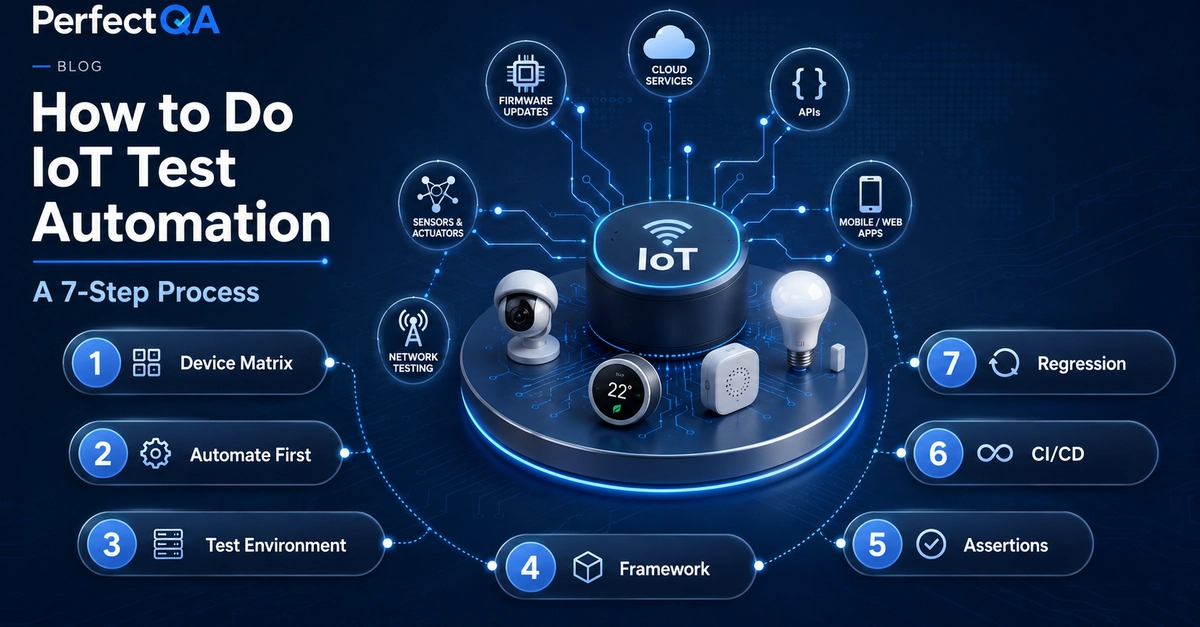
Mapping the IoT Landscape: Device and Firmware Matrix
IoT test automation demands more than just verifying a single device's functionality. Connected products are complex ecosystems where hardware, firmware, networks, cloud services, and applications must interoperate seamlessly. Without a systematic strategy, automation efforts can quickly spiral into unmanageable codebases, failing to capture critical device-specific failures. A practical approach begins with a thorough understanding of the testing landscape.
The first crucial step is to meticulously map the device and firmware matrix. This involves identifying all hardware revisions, firmware versions, and the diverse network conditions under which the product is expected to operate. This detailed mapping provides the team with a clear, comprehensive view of the operational environments the product must reliably support. Neglecting to test a single device or firmware variant can leave significant compatibility issues undetected, leading to costly post-launch defects.

Prioritizing Automation: Deciding What to Automate First
Not every test scenario is an immediate candidate for automation. A strategic decision must be made about where to invest automation efforts first. The most effective approach is to start with stable and repeatable interfaces. This typically includes API contracts and protocol validation, which are foundational elements of connected systems. Automating these core components provides early wins and builds a solid base for more complex testing.
Once the foundational layers are automated and stable, the team can gradually move towards automating more intricate aspects, such as direct device interactions and user interface testing. This phased approach ensures that automation efforts are focused and deliver value incrementally, preventing the team from becoming overwhelmed by the complexity of end-to-end IoT testing.
Designing Testable APIs and Protocols
For effective test automation, APIs and communication protocols must be designed with testability in mind from the outset. This involves ensuring that APIs expose clear contracts and that communication protocols are well-defined and observable. When APIs are designed for testability, it becomes significantly easier to create automated tests that validate their behavior and integration points.
This design principle extends to the underlying protocols. Whether using MQTT, CoAP, HTTP, or custom protocols, ensuring that these are not black boxes is paramount. Automated tests should be able to send commands, receive responses, and monitor data streams to verify correct communication flow and data integrity. This proactive design approach minimizes the effort required for automation later in the development cycle.
Developing a Robust Test Environment
A critical component of IoT test automation is establishing a robust and scalable test environment. This environment must accurately simulate the diverse conditions identified in the device and firmware matrix. This includes simulating various network speeds, latencies, packet loss rates, and even intermittent connectivity.
Virtualization and simulation tools play a key role here. They allow teams to create multiple virtual instances of devices, cloud services, and network conditions without the need for extensive physical hardware. This not only reduces costs but also enables parallel testing and faster feedback loops. The environment should also support the integration of automated test scripts, allowing for seamless execution and reporting.
Implementing Automated Test Cases
With the test environment ready and APIs/protocols designed for testability, the next step is to implement the automated test cases. This involves writing scripts that interact with the device, its APIs, and the simulated network and cloud services. The choice of automation tools and frameworks will depend on the specific technologies used in the IoT product.
Test cases should cover functional testing (e.g., device commands, data reception), performance testing (e.g., response times, throughput), security testing (e.g., authentication, data encryption), and compatibility testing across the defined device and firmware matrix. Maintaining a clear, modular, and well-documented codebase for these test scripts is essential for long-term maintainability.
Executing Tests and Analyzing Results
Automated test execution should be integrated into the continuous integration and continuous delivery (CI/CD) pipeline. This ensures that tests are run frequently, providing rapid feedback on code changes. The execution process should be automated, triggered by code commits or scheduled intervals.
Analyzing the results of these automated tests is as important as running them. Comprehensive reporting mechanisms are needed to clearly present test outcomes, identify failures, and provide actionable insights. This includes detailed logs, error messages, and performance metrics. The analysis should focus on identifying root causes of failures and informing development teams for quick remediation.
Maintaining and Evolving the Automation Framework
The IoT landscape is constantly evolving, with new devices, firmware updates, and service changes. Consequently, the test automation framework must be dynamic and adaptable. Regular maintenance is required to keep test scripts up-to-date with product changes, update dependencies, and optimize test execution speed.
Furthermore, the framework should be designed for extensibility. As new features are added or new devices are introduced, the automation framework should be able to accommodate them with minimal refactoring. This continuous evolution ensures that the automation remains effective and relevant throughout the product lifecycle, providing ongoing confidence in the quality of the IoT solution.