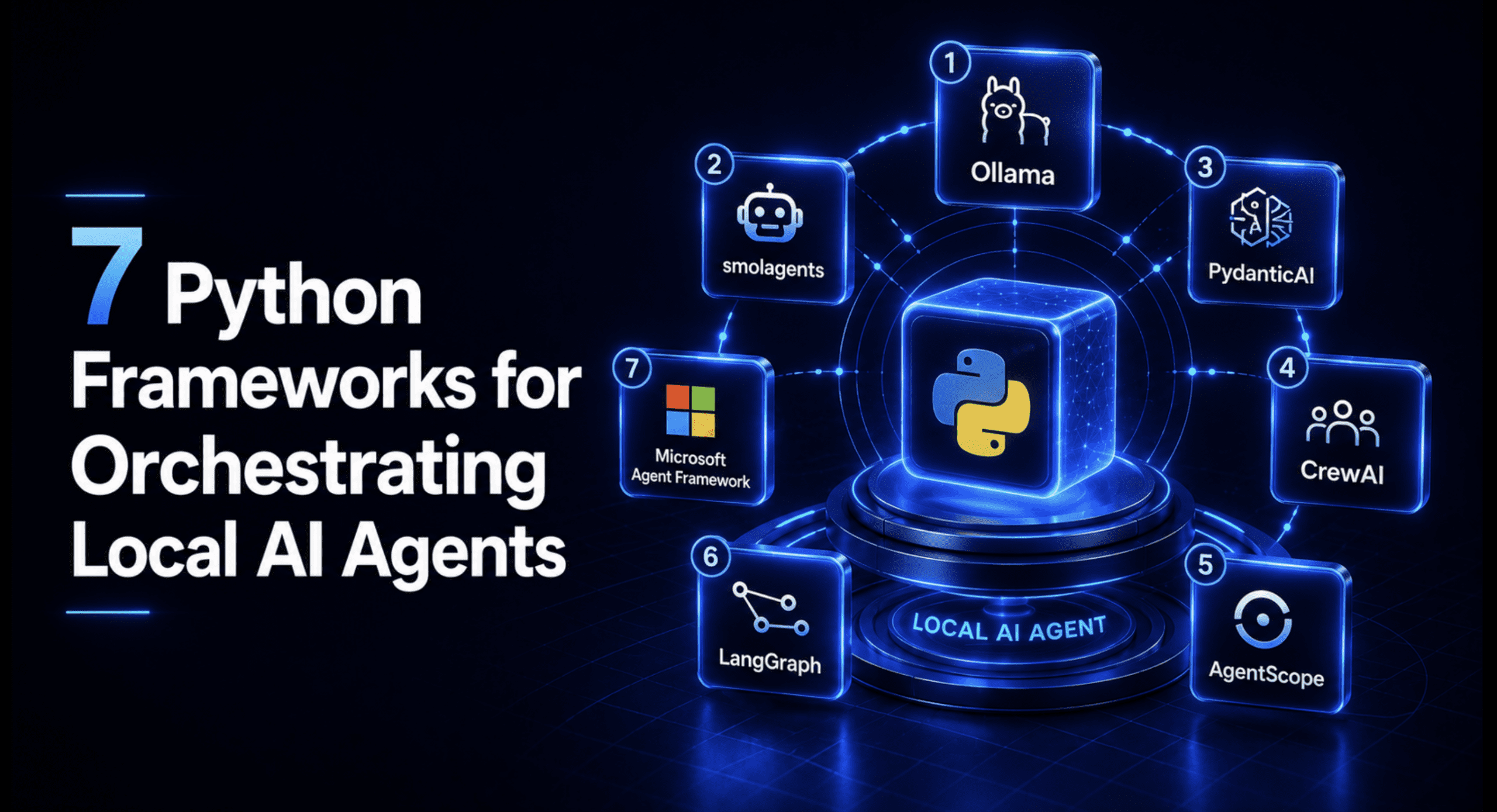
Introduction: The Rise of Local AI Agent Orchestration
The landscape of artificial intelligence is rapidly evolving, with a significant shift towards more accessible and customizable AI agents. While cloud-based solutions offer scalability, a growing number of developers and organizations are prioritizing local AI agent orchestration for enhanced control, security, and cost-efficiency. Running AI agents on local infrastructure allows for greater data privacy, reduced latency, and the ability to fine-tune models without relying on external services. This is particularly crucial for sensitive applications, research environments, and scenarios where consistent performance is paramount. This article explores seven leading Python frameworks that are instrumental in building, coordinating, and deploying these sophisticated local AI agents in 2026.
Orchestrating AI agents involves managing their lifecycle, enabling them to communicate with each other, interact with tools, and execute complex tasks. This requires robust frameworks that can handle agent creation, state management, message passing, and integration with external APIs or local resources. The frameworks discussed here represent a diverse set of approaches, from low-level control to high-level abstractions, catering to different project needs and developer preferences.
1. LangChain
LangChain remains a dominant force in the AI agent orchestration space. Its modular design allows developers to chain together different components, such as language models, data sources, and custom logic, to create complex agentic workflows. LangChain's strength lies in its extensive ecosystem of integrations, supporting numerous LLMs, vector stores, and memory types. For local agent orchestration, LangChain provides the flexibility to connect to local LLM instances (e.g., through Ollama or LM Studio) and manage agent interactions within a controlled environment.
The framework's agent executors and tools are particularly valuable. Agents can be equipped with a variety of tools, from simple calculators to custom Python functions, enabling them to perform actions beyond just text generation. LangChain's memory modules allow agents to maintain context across conversations, crucial for long-running tasks or interactive applications. Its declarative approach to defining agents and their capabilities simplifies the development process, making it a go-to choice for many.
2. LlamaIndex (formerly GPT Index)
While often associated with data indexing for LLMs, LlamaIndex has evolved into a powerful framework for building AI applications, including agent orchestration. Its primary focus on data ingestion, structuring, and retrieval makes it an excellent choice for agents that need to interact with large, complex datasets. LlamaIndex excels at connecting LLMs to private or external data sources, enabling agents to query and reason over specific information.
For local agents, LlamaIndex allows seamless integration with local data stores and LLM endpoints. Its data connectors simplify the process of bringing data into the system, and its query engines provide sophisticated ways to retrieve relevant information. The framework's agent module allows for the creation of agents that can leverage these data capabilities, making them adept at tasks requiring deep domain knowledge or access to proprietary information. Think of it less like a simple data loader and more like an intelligent librarian that can not only find any book but also understand its contents and answer complex questions based on it.
3. AutoGen
Developed by Microsoft, AutoGen offers a novel approach to agent orchestration through its concept of multi-agent conversations. Instead of a single agent performing a task, AutoGen allows for the creation of multiple agents that can converse with each other to solve problems. This conversational paradigm is highly effective for complex tasks that benefit from diverse perspectives and specialized roles.
AutoGen's flexibility in defining agent roles, capabilities, and communication patterns makes it ideal for local development. Developers can define custom agents with specific instructions and allow them to collaborate autonomously. This is particularly powerful when building agents that require complex reasoning, code generation and execution, or even debugging. The framework supports programmatic control over conversations, enabling fine-grained management of agent interactions, which is essential for maintaining control in a local setup.
4. CrewAI
CrewAI is a framework designed for orchestrating autonomous AI agents. It emphasizes collaboration and task delegation, allowing developers to define roles, goals, and tools for each agent within a team. The framework simplifies the creation of sophisticated agent crews that can work together to achieve complex objectives, making it a strong contender for local agent development.
CrewAI's focus on defining agent