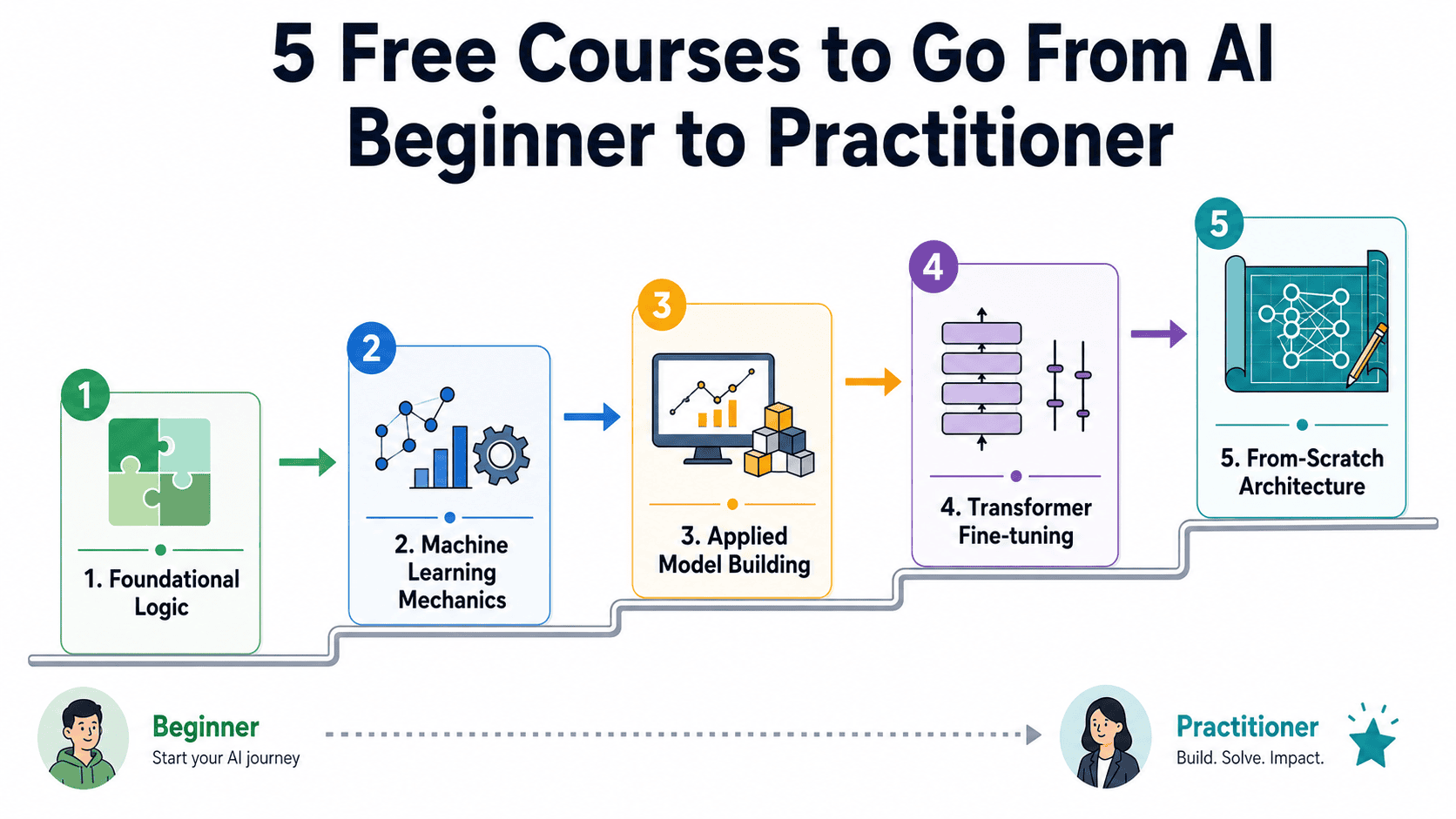
Navigating the vast landscape of Artificial Intelligence can feel overwhelming, especially for newcomers. Fortunately, a structured path exists to transform AI beginners into practitioners without the barrier of tuition fees. A carefully curated five-course roadmap offers a comprehensive journey, starting with foundational concepts and progressing to the complexities of training Large Language Models (LLMs) from scratch. This approach ensures a solid understanding of core principles before diving into advanced techniques.
Foundations of Machine Learning
The initial step in this educational journey focuses on the bedrock of AI: Machine Learning. This foundational course demystifies classical algorithms that power many AI applications. Learners will explore supervised learning techniques such as regression and classification, understanding how models learn from labeled data. Unsupervised learning methods, including clustering and dimensionality reduction, are also covered, providing insights into finding patterns in unlabeled datasets. Key algorithms like Linear Regression, Logistic Regression, Support Vector Machines (SVMs), and K-Means Clustering are typically introduced, along with the mathematical underpinnings that make them work. This phase is critical for developing an intuitive grasp of how machines can learn and make predictions, akin to understanding basic arithmetic before tackling calculus.
Deep Learning Fundamentals
Building upon the machine learning basics, the second course delves into the world of Deep Learning. This field, characterized by artificial neural networks with multiple layers, has driven many recent AI breakthroughs. Students will learn about the architecture of neural networks, including concepts like neurons, activation functions, and backpropagation. The course typically covers different types of neural networks, such as Convolutional Neural Networks (CNNs) for image recognition and Recurrent Neural Networks (RNNs) for sequential data like text and time series. Understanding these architectures is vital for comprehending how AI systems can process complex, unstructured data. Practical implementation using frameworks like TensorFlow or PyTorch is often a core component, allowing students to build and train their first deep learning models.
Natural Language Processing (NLP)
The third course shifts focus to Natural Language Processing, enabling machines to understand, interpret, and generate human language. This area of AI is fundamental to applications like chatbots, translation services, and sentiment analysis. Learners will explore techniques for text preprocessing, feature extraction, and various NLP models. Topics might include word embeddings (like Word2Vec and GloVe), sequence-to-sequence models, and the Transformer architecture, which has become a dominant force in modern NLP. Students will gain hands-on experience in tasks such as text classification, named entity recognition, and machine translation, learning how to represent and process linguistic data effectively.
Computer Vision Essentials
Complementing NLP, the fourth course provides an introduction to Computer Vision. This domain empowers machines to 'see' and interpret visual information from images and videos. The curriculum typically covers image processing techniques, feature detection, and object recognition. Convolutional Neural Networks (CNNs) are central to this field, and students will learn how they are applied to tasks like image classification, object detection, and image segmentation. Understanding how AI systems perceive and analyze visual data is crucial for applications ranging from autonomous vehicles to medical imaging analysis. Practical projects often involve building models that can identify objects in images or analyze video streams.
Training Large Language Models (LLMs) From Scratch
The capstone of this roadmap is an advanced course dedicated to training Large Language Models from the ground up. This is where students apply their accumulated knowledge to one of the most transformative AI technologies today. The course covers the principles behind LLMs, including their underlying architectures (often based on Transformers), the massive datasets required for training, and the computational resources needed. Learners will explore concepts like pre-training, fine-tuning, and prompt engineering. Crucially, the course emphasizes the practicalities of setting up the training environment, managing data pipelines, and evaluating model performance. While training a full-scale LLM from scratch is computationally intensive, this course provides the theoretical framework and practical understanding necessary to comprehend and potentially replicate aspects of this process on a smaller scale, or to effectively utilize and fine-tune existing LLMs.
By completing this five-course sequence, individuals can transition from being AI novices to possessing practical, hands-on skills applicable across a wide range of AI domains. The focus on free, accessible resources democratizes AI education, empowering a broader community to contribute to and benefit from advancements in the field.