
LLM Inference: GPU vs. CPU on a Laptop
Serving large language models (LLMs) often conjures images of powerful server-grade GPUs or high-core count CPUs. However, a recent experiment on a standard laptop reveals a surprising performance disparity. A 4 GB NVIDIA GeForce GTX 1650 Ti (Max-Q) GPU, commonly found in gaming laptops, demonstrably outperforms a 13th Gen Intel Core i7-1360P CPU with 12 cores and 16 threads by a factor of 4.3x when running the Gemma 4 small language model. The test, conducted on a single machine, involved serving the exact same model payload via two distinct hardware paths: CPU-only and leveraging the integrated GPU.
The core of this comparison lies in optimizing inference speed for LLMs, particularly smaller, more accessible models like Gemma. The setup utilized a single laptop, a common piece of developer hardware, equipped with an Intel Core i7-1360P processor (4 Performance-cores with Hyper-Threading and 8 Efficient-cores) and an NVIDIA GTX 1650 Ti Max-Q with 4 GB of VRAM. The experiment focused on the inference performance of Gemma 4, a model known for its efficiency and suitability for edge devices or developer workstations.
The Hardware: A Tale of Two Architectures
The Intel i7-1360P processor presents a modern hybrid architecture, featuring 4 P-cores capable of handling demanding tasks and 8 E-cores optimized for power efficiency and background processes. In total, it offers 12 cores and 16 threads. This CPU configuration was tested in a CPU-only inference mode. The contrasting hardware was the GTX 1650 Ti, a mobile GPU based on the Turing architecture (TU117 chip). This GPU boasts Compute Capability 7.5 and crucially, it lacks dedicated Tensor Cores, which are specialized matrix multiplication units found in newer NVIDIA architectures designed to accelerate deep learning workloads. Despite this limitation, the 4 GB of VRAM on the GTX 1650 Ti proved to be a significant factor.
The comparison was meticulously controlled. The model payload was byte-identical for both CPU and GPU tests, and the only difference in execution was a single flag to direct computation. This rigorous approach ensures that the observed performance difference can be directly attributed to the hardware architecture and its suitability for LLM inference, rather than variations in the model itself or the inference engine configuration. The repository for this experiment, available on GitHub, provides the exact code and setup for replication.
Decoding Performance: Why the GPU Wins
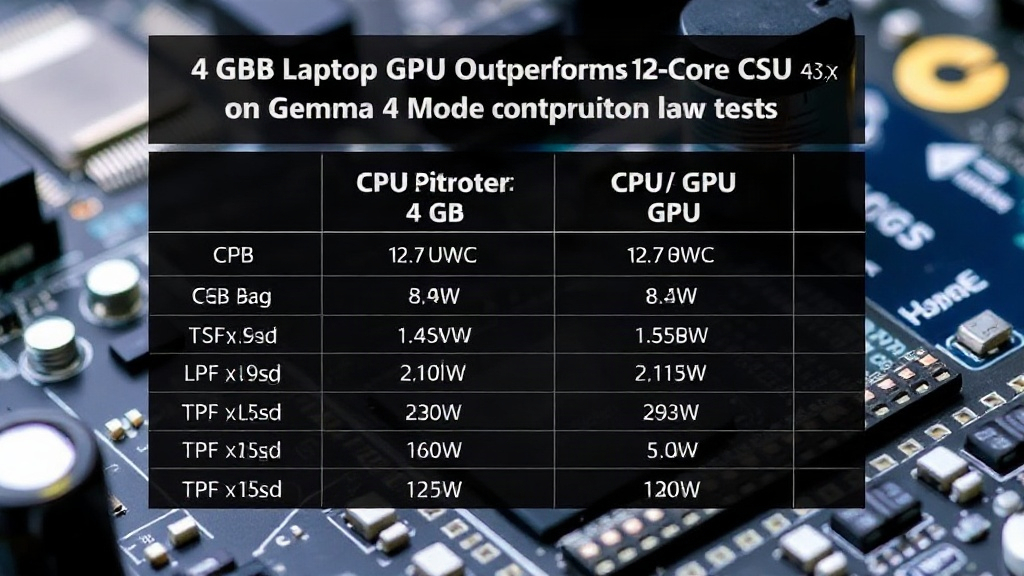
The primary metric for evaluation was inference speed, specifically how quickly the model could generate responses. The results showed the GTX 1650 Ti decoding the Gemma 4 model 4.3 times faster than the 12-core CPU. This outcome is significant because it challenges the conventional wisdom that only high-end, dedicated AI accelerators can provide substantial speedups for LLM inference. Several factors likely contribute to this performance gap.
Firstly, GPUs are inherently designed for massive parallel processing. While the GTX 1650 Ti may not have Tensor Cores, its thousands of CUDA cores are exceptionally adept at performing the matrix multiplications and vector operations that form the backbone of neural network computations. Even without specialized tensor units, the sheer parallel throughput of the GPU architecture can overwhelm a CPU's capabilities for these specific types of tasks. Think of it less like a single, powerful chef (the CPU core) meticulously preparing each dish, and more like an army of line cooks (GPU cores) each performing a small, repetitive part of a much larger recipe simultaneously. For LLM inference, which involves many such repetitive calculations, the army approach proves far more efficient.
Secondly, the dedicated VRAM on the GPU is critical. Loading the entire Gemma 4 model into the GPU's 4 GB of VRAM allows for immediate access to model weights and parameters. In contrast, when running on the CPU, the model weights would likely reside in system RAM and be transferred to CPU caches or registers as needed. This data movement can introduce latency. For models that fit entirely within VRAM, the GPU can perform computations directly on the data without the overhead of memory transfers from main system RAM.
The absence of Tensor Cores on the GTX 1650 Ti is an interesting detail. Newer GPUs offer specialized hardware that can dramatically accelerate mixed-precision matrix multiplications, often leading to even greater speedups. The fact that a GPU without these dedicated units can still achieve such a significant advantage over a modern multi-core CPU suggests that the fundamental parallel processing power of GPUs, combined with dedicated memory, is a powerful advantage for LLM inference, even for models that don't demand the absolute latest in specialized AI hardware.
Implications for Developers and Enthusiasts
This experiment has several key implications for developers, researchers, and anyone looking to run LLMs on consumer-grade hardware. It validates the use of even modest laptop GPUs for accelerating AI workloads. For developers who have laptops with discrete GPUs, even older or lower-end models, it suggests that they can leverage this hardware for faster LLM inference, potentially enabling more complex local development workflows or experimentation with AI models.
The 4 GB VRAM limitation is a crucial factor. While Gemma 4 is a small model and fits within this capacity, larger or more complex models might require more VRAM. This experiment highlights the ongoing trade-off between model size, hardware capabilities, and inference speed. However, it also points towards a future where local LLM development and deployment become increasingly feasible on everyday machines, reducing reliance on expensive cloud infrastructure for certain tasks.
Furthermore, this benchmark provides a concrete data point for hardware selection. When considering a machine for AI development, especially for tasks involving LLM inference, the presence and capability of a discrete GPU, even one with limited VRAM, should be a significant consideration. It suggests that for certain workloads, investing in a system with a capable GPU might offer a better performance-per-dollar ratio than simply opting for a CPU with a higher core count. The question then becomes: how much further can this trend extend as models become more optimized and GPU architectures evolve?