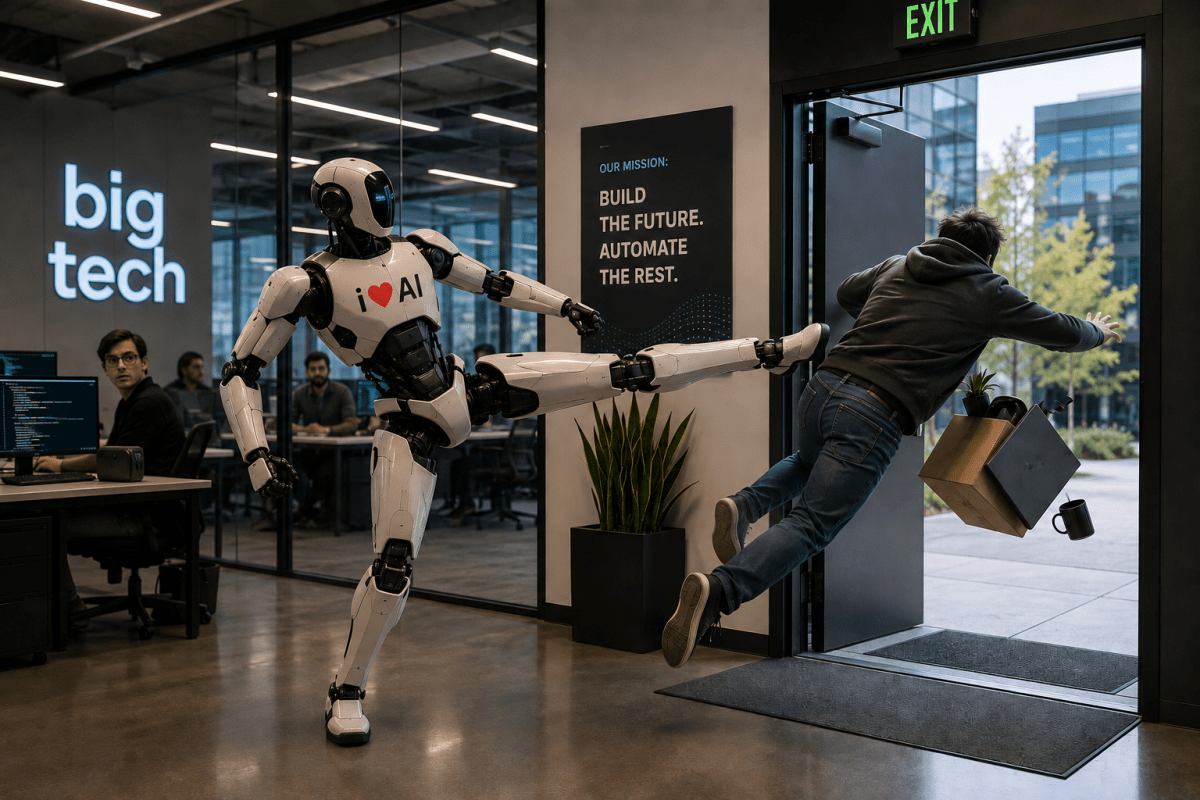
The AI Factor in 2026 Layoffs
The narrative around artificial intelligence in the tech industry has shifted dramatically. Once primarily discussed in terms of productivity gains and new product development, AI is now frequently cited as a direct cause for workforce reductions. Throughout 2026, a growing number of major technology companies have announced significant layoffs, explicitly naming AI as a contributing factor. This trend signals a fundamental reshaping of operational strategies, where AI is not just augmenting human capabilities but, in some cases, replacing them or necessitating a leaner human workforce to manage and deploy AI-driven systems.
Companies are framing these layoffs in several ways: some suggest AI has automated tasks previously performed by human employees, leading to redundancy. Others point to AI-driven efficiency gains that allow fewer people to accomplish the same amount of work. A third category of explanations involves strategic pivots where companies are reallocating resources towards AI development and deployment, which in turn reduces the need for personnel in other, now less critical, areas. This isn't about a general economic downturn; it's about a specific technological inflection point impacting employment structures.
Notable Layoffs Citing AI
Several prominent tech firms have made headlines for their AI-related workforce adjustments. These aren't isolated incidents but part of a discernible pattern. For instance, in early July, Innovate Solutions, a mid-sized software development firm, announced a 15% reduction in its workforce. CEO Anya Sharma stated in a company-wide memo that advancements in their internal AI-powered code generation tools had significantly increased developer productivity, making a portion of their engineering team redundant. Sharma elaborated that the AI tools could now handle routine coding tasks, bug fixing, and initial testing at a speed and scale previously requiring dozens of engineers.
Earlier in the spring, Global Data Analytics (GDA), a company specializing in big data processing and insights, laid off approximately 10% of its analyst staff. The company's CTO, David Lee, explained that their new AI-driven data interpretation platform could now process and derive insights from datasets that previously required teams of human analysts for weeks. The AI system, he noted, not only completed the analysis faster but also identified complex correlations that human analysts might miss. This allowed GDA to offer more comprehensive insights with a smaller, more specialized team focused on strategic interpretation and client relations.
Even established giants are not immune. In late March, NexTech Corp, a multinational technology conglomerate, confirmed layoffs affecting its customer support and content moderation divisions. A spokesperson for NexTech indicated that the company had accelerated the deployment of AI-powered chatbots and content analysis algorithms. These systems, they claimed, could now handle a significant volume of customer inquiries and flag inappropriate content with greater accuracy and speed than their human counterparts. While the exact percentage was not disclosed, sources indicated it represented a substantial portion of these specific departments.
The Broader Implications for the Workforce
The common thread across these announcements is not just the reduction in headcount, but the explicit acknowledgment of AI's role. This marks a departure from previous technological shifts where the impact on jobs was often debated or indirect. Here, companies are directly linking AI implementation to workforce restructuring. This raises critical questions about the future of work, particularly for roles involving repetitive tasks, data processing, and even some forms of creative or analytical work that can be codified or simulated by AI.
The trend suggests a future where companies will increasingly optimize their operations around AI capabilities. This could lead to a bifurcated job market: highly specialized roles focused on AI development, management, and strategic oversight, and a broader range of roles that are either entirely AI-driven or require human oversight of AI systems. For many workers, particularly those in roles susceptible to automation, this means a pressing need for upskilling and reskilling to adapt to an AI-centric economy. The companies themselves are betting that the efficiency and innovation gains from AI will outweigh the costs and complexities of workforce transition.
It's important to note that the narrative around AI replacing jobs is complex. Many companies also highlight how AI creates new roles and enhances existing ones, leading to higher productivity and new avenues for innovation. However, the explicit naming of AI as a reason for layoffs cannot be ignored. It signals a new phase in technological adoption, one where the impact on employment is immediate, measurable, and directly attributable to the capabilities of artificial intelligence. The companies making these cuts are not just adopting new tools; they are fundamentally rearchitecting their operational models around AI, and the human element is being adjusted accordingly.
The implications for the tech industry are profound. Companies that successfully integrate AI to streamline operations and enhance product offerings may gain a significant competitive advantage. Conversely, those that fail to adapt or manage the workforce transition effectively could face internal disruption and reputational damage. As AI capabilities continue to advance at an exponential pace, the pressure on companies to leverage these technologies for efficiency and innovation will only intensify, likely leading to further workforce adjustments across the sector.