The Arithmetic of Self-Hosting
This isn't a post about ideological ownership of data or a defiant stance against Big Cloud. It’s about the cold, hard arithmetic. A £130 fanless x86 board, paired with two hard drives and ZimaOS, has replaced multiple monthly cloud subscriptions. The key takeaway for anyone considering this path isn't just the upfront hardware cost, but the projected cost curve – a factor often overlooked in the self-hosting evangelism.
We'll dissect the actual financials, detail the services running on this modest setup, explore an unusual experiment, and, critically, examine the two significant drawbacks encountered and the single service that remains firmly in the cloud.
Hardware: The Case for Cheap and Slow
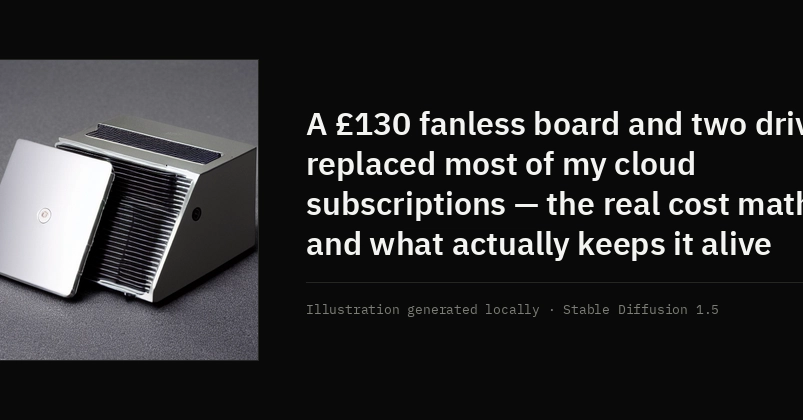
The core of this self-hosting experiment is a low-power x86 mini-PC. The choice of a fanless design is deliberate. It minimizes noise, reduces power consumption, and eliminates a common point of failure. This isn't about raw processing power; it's about sustained, efficient operation for everyday tasks. The specific model chosen is a testament to the shrinking cost of capable, albeit entry-level, computing hardware.
The two hard drives provide the necessary storage. The emphasis here is on capacity and reliability for the services it will host, rather than on lightning-fast SSD speeds. This aligns with the cost-saving objective; larger capacity HDDs are still significantly cheaper per terabyte than SSDs, making them ideal for bulk data storage like media libraries or backups.
ZimaOS, the chosen operating system, is a crucial component. It's designed to simplify the management of self-hosted services, often providing a user-friendly interface and pre-configured applications. This abstracts away much of the complexity typically associated with setting up and maintaining servers, lowering the barrier to entry for users who might not have deep Linux administration experience.
The Services Replaced: What's Actually Running?
The goal was to replace common cloud subscriptions. This typically includes services like cloud storage (e.g., Google Drive, Dropbox), media streaming servers (e.g., Plex, Jellyfin), password managers, personal VPNs, and potentially even small-scale development environments or home automation hubs.
On this £130 board, the author successfully hosts several key services. For file synchronization and backup, a self-hosted solution like Syncthing or Nextcloud can effectively replace services like Dropbox or Google Drive. This provides control over data and eliminates recurring subscription fees. For media consumption, setting up a Plex or Jellyfin server allows users to stream their personal video and music libraries to various devices within their home network and, with proper configuration, even remotely.
A self-hosted password manager, such as Bitwarden (running via Docker), offers a secure and private alternative to cloud-based solutions. Similarly, a personal VPN server, like WireGuard or OpenVPN, can be set up to provide secure internet access when on public Wi-Fi or to bypass geo-restrictions, replacing services like NordVPN or ExpressVPN. Home automation platforms like Home Assistant can also be run locally, consolidating control of smart devices without relying on manufacturer cloud servers.
The performance of these services on the low-power hardware is a critical consideration. While not suitable for heavy-duty tasks, the x86 board with ZimaOS is capable of handling these relatively lightweight, persistent workloads efficiently. The fanless design ensures that the system operates silently in the background, making it ideal for deployment in a home environment.
The Cost Math: Beyond the Initial Purchase
The initial £130 hardware cost is just the beginning. The real savings come from eliminating monthly subscription fees. Let's assume a user pays £10/month for cloud storage, £8/month for a VPN, and £5/month for a password manager. That's £23 per month, or £276 per year. Over three years, this amounts to £828. The £130 initial investment, even after accounting for electricity costs, quickly becomes significantly cheaper.
Electricity consumption is a key variable. A low-power fanless PC typically consumes between 5W and 15W. At 10W, running 24/7, it uses 0.24 kWh per day, or approximately 87.6 kWh per year. At an average UK electricity price of £0.30/kWh (as of late 2023), this equates to roughly £26.28 per year. This is a negligible cost compared to cloud subscription fees.
The cost curve, as the author highlights, is where self-hosting shines. While the upfront cost is higher than a single month's subscription, the long-term savings are substantial. The hardware, once purchased, depreciates slowly, and its operational cost remains low. This contrasts sharply with cloud services, where recurring fees continue indefinitely.
The Unusual Experiment: What Actually Keeps It Alive?
Beyond the standard self-hosting applications, the author experimented with something less conventional. This might involve running a niche service, a custom application, or perhaps leveraging the hardware in a way not typically associated with home servers. For instance, one could explore running a personal AI model for local transcription or summarization, a task that often requires significant cloud compute. Another possibility is experimenting with distributed computing projects or even a small, private blockchain node.
The success of such an experiment on low-power hardware is a testament to either the efficiency of the software or the surprising capabilities of modern entry-level CPUs. It demonstrates that self-hosting can extend beyond basic utility services into more advanced or experimental computing tasks, provided the workload is carefully managed and understood.
The Downsides: Where Self-Hosting Bites Back
No solution is perfect, and self-hosting comes with its own set of challenges. The author identifies two primary ways this setup has caused friction.
The first is maintenance overhead. While ZimaOS and tools like Docker simplify management, they don't eliminate it. Software updates need to be applied regularly to both the OS and individual applications to patch security vulnerabilities and ensure compatibility. This requires proactive attention and can be time-consuming. System failures, though rare with fanless hardware, can occur, necessitating troubleshooting and potentially data recovery efforts. Unlike cloud services, where uptime is largely the provider's responsibility, the burden of keeping the system operational falls entirely on the user.
The second significant drawback is remote access complexity and security. While services can be configured for external access, this introduces security risks. Improperly secured ports or applications can become targets for malicious actors. Setting up reliable and secure remote access often involves configuring dynamic DNS, port forwarding on the router, and potentially setting up a VPN for secure connectivity. This is far more complex than simply logging into a cloud service from anywhere. The author likely encountered issues related to achieving seamless remote access or ensuring its security without compromising performance or introducing vulnerabilities.
The One Service That Remains: The Cloud's Indispensable Role
Despite the success in replacing numerous cloud subscriptions, one service remains firmly in the cloud. This is often a critical component that is either too complex, too resource-intensive, or too vital to reliably self-host. Common candidates include:
- Email Services: Running a reliable, spam-free email server is notoriously difficult and requires constant vigilance against blacklists and security threats. Services like Google Workspace or Microsoft 365 offer robust, managed solutions that are hard to replicate effectively at home.
- High-Availability Services: For mission-critical applications that require near-perfect uptime and redundancy, self-hosting on a single home server is generally not feasible. Cloud providers offer sophisticated infrastructure with built-in failover and disaster recovery.
- Specialized Compute: Tasks requiring massive parallel processing, such as training large AI models or complex scientific simulations, are beyond the scope of a £130 fanless PC and are best left to cloud-based GPU instances or HPC clusters.
- External-Facing APIs with High Traffic: If a service needs to be accessible to a very large number of users globally with low latency, a home internet connection and a single server are unlikely to suffice.
The author's decision to keep one service in the cloud is a pragmatic recognition of the limitations of home-based self-hosting. It highlights that a hybrid approach, leveraging the strengths of both self-hosted and cloud solutions, often provides the most practical and cost-effective outcome.
The Broader Trend: Democratization of Infrastructure
This self-hosting experiment taps into a broader trend: the democratization of infrastructure. As the cost of capable hardware decreases and user-friendly management software like ZimaOS emerges, running sophisticated services locally becomes increasingly viable. This shift is driven by a desire for greater control, enhanced privacy, and, crucially, long-term cost savings. The cloud, while offering unparalleled convenience and scalability, comes with a perpetual cost that can become burdensome. For individuals and small teams, the arithmetic of self-hosting, when carefully considered, presents a compelling alternative, provided the associated complexities and maintenance requirements are understood and accepted.