On-Device AI for Musical Creativity
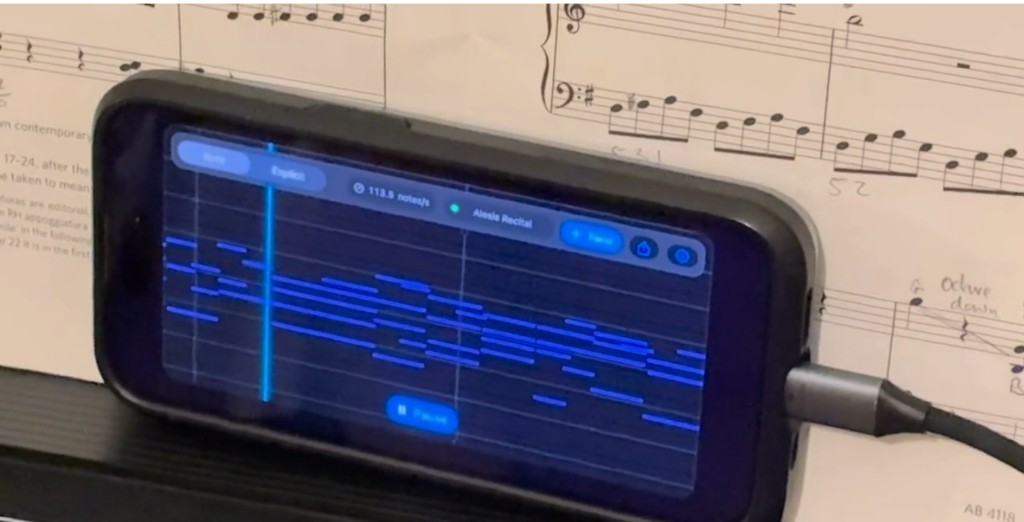
A new demonstration, showcased on Hacker News as "Show HN: I trained a 125M model to autocomplete piano on-device," reveals a significant step forward in making sophisticated AI music generation accessible directly on consumer hardware. The project, developed by user simedw, features a 125 million parameter model trained to predict and generate MIDI sequences for piano music. This allows for real-time musical autocompletion, essentially acting as a creative partner for musicians.
The core innovation lies in the model's ability to run efficiently on-device. This bypasses the need for constant cloud connectivity, reducing latency and enhancing user privacy. For musicians, this means a more responsive and integrated creative tool. Imagine a composer working on a melody, and the AI instantly suggests harmonic progressions or complementary lines, all without a perceptible delay.
Technical Approach and Model Training
The developer details the training process, which involved curating a substantial dataset of MIDI files. These files, representing a wide range of musical styles and complexities, were processed and fed into the model. The 125 million parameter count suggests a balance between model complexity and computational feasibility for on-device deployment. Models of this size can capture intricate musical patterns without requiring the processing power of much larger, cloud-based systems.
Training such a model involves careful consideration of the input and output formats. For MIDI generation, the model learns to predict the next note or sequence of notes based on the preceding musical context. This context can include pitch, duration, velocity (how hard a note is played), and timing. The model likely employs transformer-based architectures, which have proven highly effective in sequential data processing, including natural language and, increasingly, music.
The on-device aspect is particularly challenging. It requires optimizing the model for inference on consumer-grade hardware, often with limited memory and processing capabilities. Techniques such as quantization (reducing the precision of model weights) and efficient attention mechanisms are crucial for achieving real-time performance. The success of this project indicates that these optimization strategies are maturing rapidly.
Implications for Music Creation and Performance
This development has broad implications for music creators. For producers and composers, it offers a powerful new tool for idea generation and arrangement. The ability to receive instant, context-aware suggestions can break through creative blocks and accelerate the songwriting process. It's akin to having an infinitely patient and knowledgeable collaborator always at your fingertips.
For performers, especially those who use electronic instruments or digital audio workstations (DAWs), on-device AI could enable interactive live performances. Imagine a pianist improvising, with the AI generating accompanying parts in real-time that adapt to the performer's choices. This moves beyond pre-programmed backing tracks towards dynamic, AI-assisted improvisation.
The potential for educational tools is also immense. Beginners could use such a system to explore harmonic concepts, practice improvisation, or even learn to compose by observing and interacting with AI-generated musical ideas. The on-device nature makes it accessible without requiring expensive software subscriptions or powerful computers.
The Future of AI in Music
This project is a clear indicator of a trend: AI is moving from the lab and the cloud to the edge. As models become more efficient and hardware more capable, we can expect to see more sophisticated AI applications running directly on our phones, laptops, and even embedded in musical instruments. The challenges ahead involve not just technical optimization but also user interface design and ethical considerations regarding authorship and originality.
The surprising detail here is not the model size itself, but its demonstrated capability for real-time, on-device performance in a domain as complex and nuanced as music. Many might assume that such generative tasks require substantial cloud resources. simedw's work challenges that assumption, showcasing a practical, deployable AI that can augment human creativity in a deeply personal and immediate way. What remains to be seen is how quickly this technology will be integrated into mainstream music production software and hardware, and what new forms of musical expression will emerge as a result.