
Deconstructing t0-alpha: A Novel Transformer for Time Series
Forecasting multivariate time series presents a significant challenge: not only must a model understand how individual variables change over time, but it must also capture the intricate dependencies and interactions between these variables. Traditional approaches often struggle to balance these two crucial aspects, leading to suboptimal performance. Enter t0-alpha, a 101.6 million-parameter foundation model designed specifically to tackle this complexity. Its architecture, detailed by a researcher who worked through its design, introduces a novel approach by bifurcating the core reasoning process into two distinct attention mechanisms: time attention and group attention.
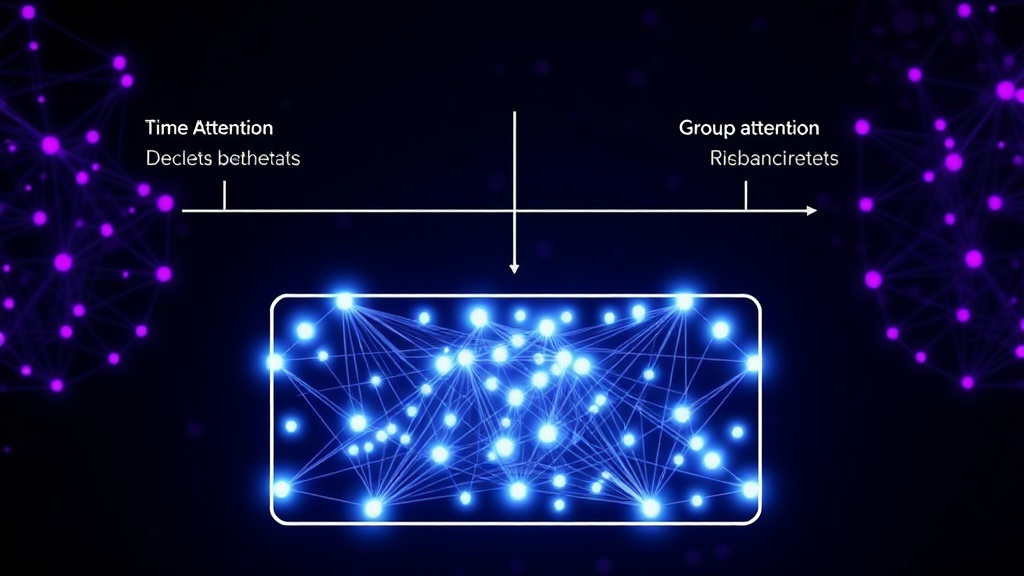
This separation is the cornerstone of t0-alpha's effectiveness. Time attention is dedicated to learning the temporal evolution of each individual variable. It allows the model to discern patterns, trends, and seasonality within a single time series. Think of it as a dedicated historian for each variable, meticulously recording and analyzing its past. In parallel, group attention facilitates the exchange of information between related variables. This mechanism enables the model to understand how changes in one variable might influence or be influenced by changes in others, even if they are not directly correlated in time. This is akin to a network of economists, constantly cross-referencing their findings to paint a holistic picture of the economic landscape.
Architectural Breakdown of t0-alpha
The architecture itself is built upon the robust transformer framework, adapted for the nuances of time series data. The input data is first segmented into patches, each comprising 32 time steps. These patches are then embedded into a 512-dimensional representation, creating a dense numerical fingerprint for each segment. This initial embedding process prepares the data for the sophisticated processing that follows within the transformer blocks.
The core of t0-alpha consists of 24 transformer blocks. Crucially, these blocks are not uniform. The model employs 16 blocks dedicated to time attention, ensuring a deep understanding of individual variable dynamics, and 8 blocks focused on group attention, fostering the ability to model inter-variable relationships. This ratio suggests a prioritization of understanding individual time series evolution, while still dedicating significant capacity to cross-variable interactions.
Beyond the attention mechanisms, t0-alpha incorporates several other advanced components. It utilizes time-aware rotary embeddings, a method that injects positional information into the embeddings in a way that is sensitive to the temporal nature of the data. RMSNorm (Root Mean Square Layer Normalization) is employed for stable and efficient training, and the SwiGLU activation function is chosen for its proven performance in large language models, adapted here for time series.
Probabilistic Forecasting and Context Window
A key feature that distinguishes t0-alpha is its capability for probabilistic forecasting. Instead of merely predicting a single point estimate for future values, the model predicts nine quantiles. This provides a richer understanding of the forecast's uncertainty, enabling users to make more informed decisions by considering the range of potential outcomes. This is particularly valuable in domains where risk assessment is paramount, such as finance or energy demand forecasting.
The model also supports a substantial context window of up to 1,024 time steps. This allows t0-alpha to consider a significant history of the time series when making predictions, enabling it to capture longer-term dependencies and more complex patterns that might be missed by models with shorter context windows. The ability to look back over a larger historical span is critical for accurately forecasting phenomena influenced by factors that unfold over extended periods.
Performance and Implications
The reported aggregate CRPS (Continuous Ranked Probability Score) on the GIFT-Eval benchmark is 0.4941. This score places t0-alpha in a competitive range, comparable to other advanced forecasting models. The CRPS is a metric that evaluates probabilistic forecasts, rewarding models that not only predict accurate values but also assign appropriate probabilities to those values. Achieving a strong CRPS score indicates that t0-alpha's probabilistic outputs are well-calibrated and informative.
The success of t0-alpha highlights a promising direction for multivariate time series forecasting: the explicit separation of temporal and relational reasoning within a transformer architecture. While many models leverage transformers by treating time series as sequences, t0-alpha's design choice to dedicate specific attention mechanisms to different types of relationships offers a more targeted and potentially more effective approach. This architectural innovation could pave the way for more accurate and robust forecasting systems across a wide array of applications, from financial markets and supply chain management to climate modeling and IoT sensor data analysis.
The surprising detail here is not the sheer parameter count, which is substantial but not unprecedented, but the architectural decision to segregate the two primary reasoning tasks. This suggests that for complex multivariate time series, it is not just about having a powerful model, but about designing how that model *thinks* about the data. The question that remains is how this specific split—16 time-attention blocks to 8 group-attention blocks—generalizes across different types of time series datasets and how it scales with even larger models.