The Allure of 100% Test Coverage
The pursuit of 100% test coverage is a siren song for many development teams. It represents an ideal state of software quality, a guarantee that every single line of code has been executed by a test. This metric, often presented as a badge of honor, suggests a mature and rigorous development process. However, like many ideals in software engineering, the reality of achieving and maintaining 100% coverage often falls short of its promise, leading to significant trade-offs.
Consider the task of writing a perfect short story set in the Game of Thrones universe. You must adhere to strict continuity, master the intricate lore, and avoid even a single grammatical error or awkward phrasing. This is incredibly difficult. Software engineers face a similar, albeit more complex, challenge. They are expected to write thousands of lines of code that are not only functional but also demonstrably bug-free, often under tight deadlines. The pressure to achieve 100% test coverage can exacerbate this, pushing teams to focus on the metric itself rather than the underlying quality it's meant to represent.

Diminishing Returns: The Cost of Perfection
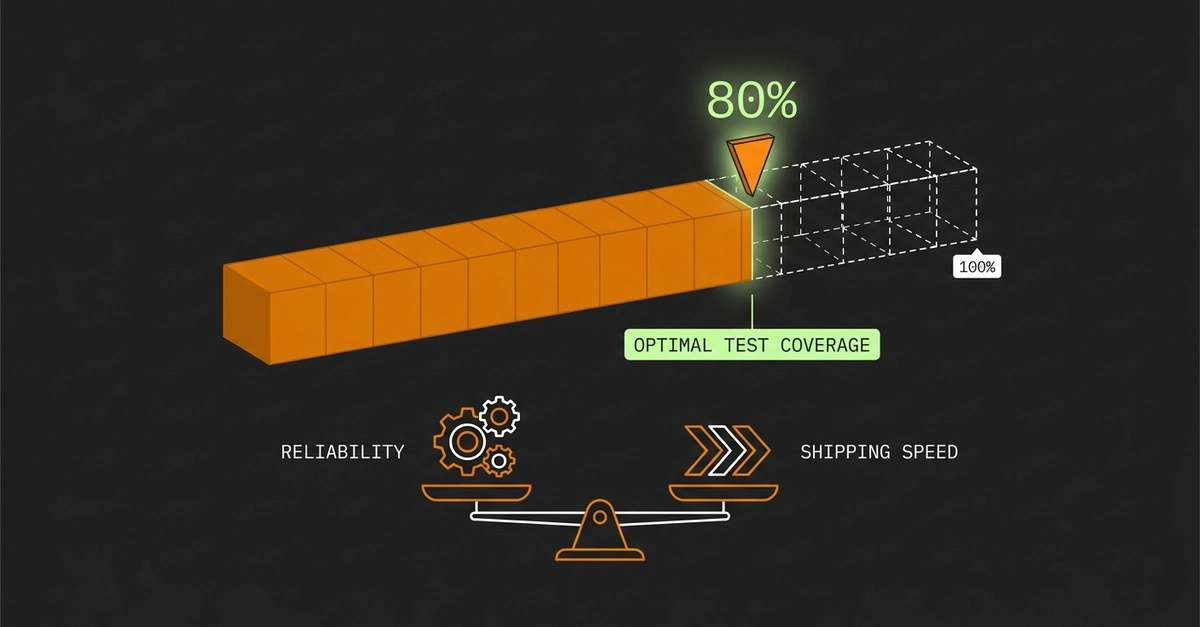
The core issue with aiming for 100% test coverage lies in the principle of diminishing returns. While the initial effort to achieve 70-80% coverage typically yields substantial benefits by validating critical paths, core business logic, and common user scenarios, subsequent efforts to cover the remaining 20-30% become increasingly expensive and less impactful. These edge cases, often obscure or rarely encountered, require disproportionate amounts of development time to test. The code written to achieve this last few percentage points might be brittle, difficult to maintain, and offer minimal practical value in preventing real-world bugs.
For most applications, a coverage target of 70% to 80% represents a sweet spot. This range effectively secures the happy paths and essential business logic without becoming an undue drain on development resources. It allows teams to build confidence in their application's core functionality while retaining agility. The time saved by not chasing the final few percentage points can be reinvested in other crucial areas, such as improving code design, writing better documentation, or developing new features.
When 100% Coverage is Non-Negotiable
There are specific domains where the cost of software failure is astronomically high, and 100% test coverage, or something very close to it, becomes a justifiable, even necessary, goal. These are typically mission-critical systems where even minor bugs can lead to catastrophic consequences. Examples include:
- Aerospace and Aviation Software: Flight control systems, navigation, and avionics demand absolute reliability. A failure here is not an option.
- Medical Devices: Software embedded in pacemakers, insulin pumps, or surgical robots must be flawless. Patient safety is paramount.
- Nuclear Power Plant Controls: Systems managing nuclear reactors require the highest level of assurance against malfunction.
- Financial Trading Systems: High-frequency trading platforms and core banking systems handle vast sums of money and require extreme precision and resilience.
- Safety-Critical Automotive Systems: Software controlling airbags, braking systems, or autonomous driving features must be rigorously tested.
In these high-stakes environments, the investment in achieving near-perfect test coverage is a direct investment in safety, security, and operational integrity. The resources allocated to exhaustive testing are minuscule compared to the potential cost of a single failure.
Defining Realistic Testing Targets
The key to effective testing is not a single, universal metric but a context-aware strategy. Instead of fixating on a coverage percentage, teams should focus on the quality and effectiveness of their tests. This involves asking critical questions:
- Does this test validate a critical business requirement?
- Does this test cover a potential failure point or edge case that could impact users?
- Is this test easy to understand, maintain, and run?
- Does the test provide actionable feedback when it fails?
For many standard web applications, internal tools, or less critical services, a pragmatic approach is to set a target coverage between 70% and 85%. This range generally ensures that the most important code paths are covered. Beyond this, teams should prioritize testing based on risk and impact. High-risk areas, complex logic, and frequently changing code sections warrant more attention than stable, straightforward code.
Furthermore, it is crucial to remember that test coverage is only one facet of software quality. Other essential practices include thorough code reviews, static analysis, integration testing, end-to-end testing, and robust monitoring in production. Relying solely on line coverage can create a false sense of security. A test might execute a line of code without actually verifying its behavior correctly, or it might miss critical integration points between different modules.
The Human Element: Beyond the Numbers
Ultimately, software development is a human endeavor. Developers are not machines programmed to produce error-free code. They are problem-solvers who benefit from clear requirements, effective tools, and realistic expectations. When teams are pressured to achieve an arbitrary 100% coverage target, it can lead to burnout, demotivation, and a culture of gaming the metrics rather than genuinely improving quality. Focusing on meaningful tests that provide real value, coupled with a pragmatic coverage goal, fosters a healthier and more productive development environment. The goal should be robust, reliable software, not just a high number on a dashboard.