The Problem: Express's Lack of Built-in Validation
Express, by default, offers minimal built-in request validation. When a request hits your Express application, the req.body, req.query, and req.params objects are essentially raw data. This means you might receive strings where you expect numbers, missing fields that your business logic assumes are present, or data with entirely unexpected shapes. These inconsistencies can lead to runtime errors deep within your application, making debugging difficult and introducing instability.
Without a robust validation layer at the HTTP boundary, your application's core logic becomes responsible for handling malformed input. This is inefficient and error-prone. Imagine a scenario where a user expects to input their age as a number, but instead, they send a string like "twenty-five". If your backend code isn't prepared for this, it might crash or produce incorrect results. This is precisely the problem Zod aims to solve.
Introducing Zod: Type-Safe Schemas
Zod is a TypeScript-first schema declaration and validation library. Its primary strength lies in its ability to define data shapes once and then infer TypeScript types directly from those definitions. This eliminates the common problem of maintaining separate type definitions and validation logic, ensuring that your types and your runtime data validation are always in sync.
With Zod, you construct schemas that describe the expected structure and types of your data. For instance, you can define a schema for a user object that includes properties like name (a string), age (a number), and email (a valid email format). Zod then provides methods to parse incoming data against these schemas. If the data conforms to the schema, it's considered valid. If it doesn't, Zod throws a validation error, allowing you to intercept and handle it gracefully.
Leveraging Zod with Express Middleware
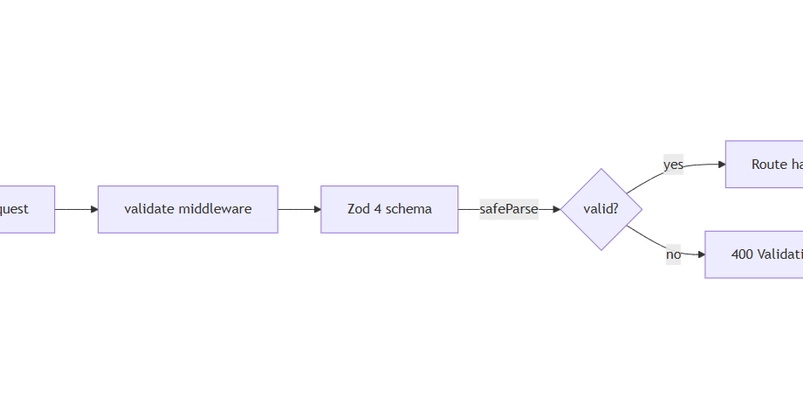
The most effective way to integrate Zod into an Express application is by creating custom middleware. This middleware will intercept incoming requests before they reach your route handlers, performing the necessary validation. This ensures that by the time a request handler receives data, it is already guaranteed to be valid according to your defined schemas.
Here’s a breakdown of how you can implement this:
Defining Zod Schemas
First, you need to define your Zod schemas. For example, to validate a request body for creating a new user, you might define a schema like this:
import { z } from 'zod';

const createUserSchema = z.object({
  name: z.string().min(1, { message: 'Name cannot be empty' }),
  age: z.coerce.number().positive({
    message: 'Age must be a positive number',
  }),
  email: z.string().email({ message: 'Invalid email address' }),
  uuid: z.string().uuid({ message: 'Invalid UUID format' }),
});

export type CreateUserSchema = z.infer<typeof createUserSchema>;
Key Zod features demonstrated here include:
z.object({...}): Defines the structure of an object.z.string(),z.coerce.number(): Specifies the expected data type.z.coerceis particularly useful as it attempts to convert input to the target type (e.g., a string \"123\" to the number 123)..min(),.positive(),.email(),.uuid(): These are refinement methods that add specific validation rules.z.infer<typeof schema>: This powerful utility generates a TypeScript type based on your Zod schema, ensuring type safety throughout your application.
Creating the Validation Middleware
Next, you create an Express middleware function that uses your Zod schema to validate the request. This middleware will typically target req.body, but can be adapted for req.query or req.params.
import { RequestHandler } from 'express';
import { ZodError } from 'zod';

const validateRequest = (
  schema: any // In a real app, use a more specific Zod type
): RequestHandler => (
  req,
  res,
  next
) => {
  try {
    schema.parse(req.body);
    next();
  } catch (error) {
    if (error instanceof ZodError) {
      // Format Zod's error into something more user-friendly
      const formattedErrors = error.errors.map((err) => ({
        path: err.path.join('.'),
        message: err.message,
      }));
      return res.status(400).json({ errors: formattedErrors });
    }
    // Handle other potential errors
    next(error);
  }
};

export default validateRequest;
This middleware:
- Accepts a Zod schema as an argument.
- Uses
schema.parse(req.body)to validate the request body. - If validation passes, it calls
next()to proceed to the next middleware or route handler. - If validation fails (throws a
ZodError), it catches the error, formats it for a better client response (including the specific field and error message), and sends a 400 Bad Request response.
Integrating Middleware into Express Routes
Finally, you integrate this middleware into your Express routes. You can apply it directly to a specific route or to a group of routes.
import express from 'express';
import validateRequest from './validationMiddleware'; // Assuming you saved the middleware in this file
import { createUserSchema } from './schemas'; // Assuming your schema is defined here

const app = express();
app.use(express.json()); // Middleware to parse JSON bodies

app.post(
  '/users',
  validateRequest(createUserSchema), // Apply the validation middleware
  (req, res) => {
    // If we reach here, req.body is guaranteed to be valid according to createUserSchema
    const userData = req.body as CreateUserSchema; // Type assertion using Zod's inferred type
    // Proceed with creating the user...
    res.status(201).json({ message: 'User created successfully', data: userData });
  }
);

// Example for query parameters validation
const getUserSchema = z.object({
  id: z.string().uuid(),
});

app.get(
  '/users/:id',
  validateRequest(getUserSchema.partial()), // Use .partial() if only some params are validated, or adapt middleware
  (req, res) => {
    // req.params.id is guaranteed to be a UUID string here
    res.send(`Getting user with ID: ${req.params.id}`);
  }
);

const PORT = process.env.PORT || 3000;
app.listen(PORT, () => {
  console.log(`Server running on port ${PORT}`);
});
Notice how req.body inside the route handler is now safely typed as CreateUserSchema, thanks to Zod's type inference and the middleware's validation. This eliminates the need for manual type checks or assertions within your handler logic.
Common Pitfalls and Best Practices
While Zod and Express integration is straightforward, a few points are worth considering:
- Error Formatting: Zod's default error messages can be quite verbose. Customizing the error formatting within your middleware, as shown above, provides a cleaner API response for clients.
- Coercion vs. Strictness: Use
z.coercejudiciously. While helpful for converting incoming string numbers, it can mask issues if strict type enforcement is critical. Sometimes, a directz.number()that fails on non-numeric input is preferred. - Validation Targets: Remember to apply validation middleware not just to
req.bodybut also toreq.queryandreq.paramswhere appropriate. You might need to adapt your middleware or create specific ones for different request parts. For instance, you could passreq.queryorreq.paramsto theschema.parse()method, or have your middleware extract the correct part of the request. - Schema Organization: For larger applications, organize your Zod schemas into separate files (e.g.,
src/schemas/userSchemas.ts,src/schemas/productSchemas.ts) to maintain clarity and reusability. - Global vs. Route-Specific Middleware: Decide whether validation should be global (applying to all routes) or specific to certain routes. Global middleware might be too broad, while route-specific middleware requires more configuration. A common pattern is to group routes by their validation needs.
Conclusion: A More Resilient API
Integrating Zod for request validation in Express transforms your API from a potential source of runtime errors into a robust, predictable system. By defining your data contracts once with Zod and enforcing them at the HTTP boundary via middleware, you ensure that your route handlers receive clean, validated data. This not only simplifies your application code but also significantly enhances its reliability and maintainability. Developers can focus on business logic, confident that the input they receive has already passed rigorous checks.