The Challenge of Private Image Data
Digital images are ubiquitous, but their content often contains sensitive personal information. Sharing, editing, or compressing these images typically requires revealing their full content to third-party services. This poses significant privacy risks, especially when dealing with medical records, personal photographs, or proprietary visual data. Current solutions often rely on trust in service providers or employ heavy encryption that can hinder usability and computational efficiency.
The introduction of ZK-JPEG marks a significant step towards addressing this fundamental privacy concern in image processing. It leverages the power of zero-knowledge proofs (ZKPs) to allow users to perform complex operations on images—including editing and compression—without ever exposing the raw image data itself to the party verifying the operations. This paradigm shift promises to unlock new possibilities for secure cloud-based image services and private data analysis.
ZK-JPEG: A Zero-Knowledge Approach
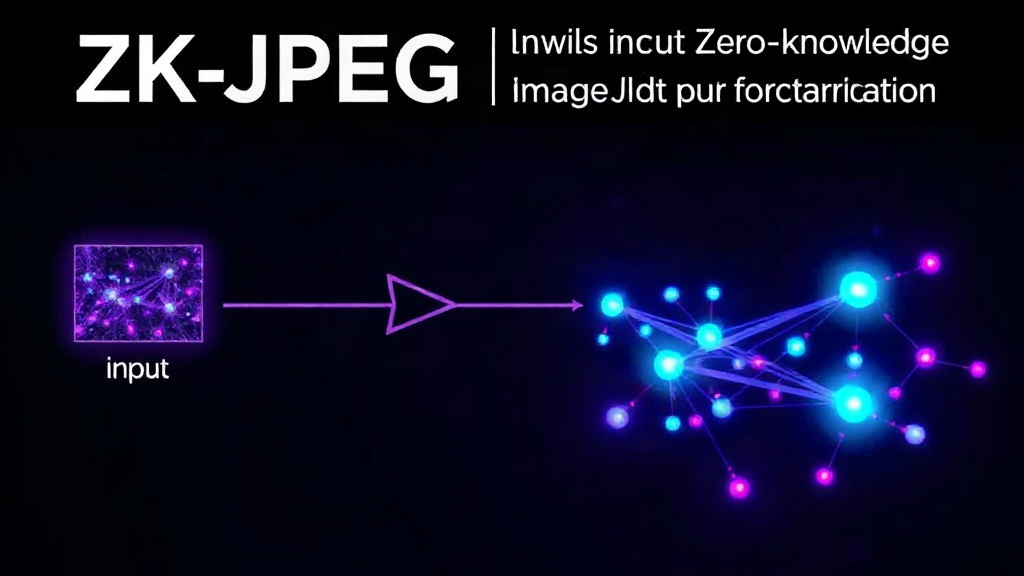
ZK-JPEG is a cryptographic protocol designed to perform image editing and compression tasks while maintaining the privacy of the original image data. At its core, the system uses ZKPs to prove that specific operations have been performed correctly on an image, without the verifier ever seeing the image itself. This is achieved by constructing a computational environment where the image is represented in a way that can be processed by ZKP circuits.
The process involves converting the image into a format suitable for ZKP computations. This often means representing pixel values as elements within a finite field. Then, a ZKP circuit is designed to encapsulate the desired image operation. For instance, an editing operation like cropping or color adjustment would be translated into a series of arithmetic gates within the ZKP circuit. The prover (the user with the image) generates a proof that these operations were executed correctly on the secret image data. A verifier can then check this proof efficiently, confirming the validity of the operation without learning anything about the image content.
Key Features and Capabilities
ZK-JPEG's innovative approach enables several critical functionalities:
- Zero-Knowledge Image Editing: Users can perform edits such as cropping, resizing, color correction, and even applying filters. The ZKP ensures that these edits are applied as specified, but the content of the edited image remains private. This is particularly useful for scenarios where images must be shared with specific metadata or dimensions for analysis, but the visual content is sensitive.
- Private Image Compression: The protocol also supports image compression. A compressed version of the image can be generated, and a ZKP can attest to the fact that the compressed data is a valid representation of the original, private image, according to a defined compression standard. This allows for efficient storage and transmission of visual data without compromising its secrecy.
- Verifiable Operations: The core promise of ZK-JPEG is verifiability. Anyone can verify that the claimed operations were performed correctly on the image data, but they gain no information about the image itself. This builds trust in services that handle image data.
Technical Underpinnings and Challenges
The implementation of ZK-JPEG relies on advanced cryptographic primitives, primarily focusing on succinct non-interactive arguments of knowledge (SNARKs) or similar ZKP schemes. These schemes allow for the generation of small proofs that can be verified quickly, making them practical for real-world applications. However, constructing efficient ZKP circuits for complex image processing tasks is computationally intensive and requires significant expertise.
One of the primary challenges is the overhead associated with generating ZKPs. Converting images into a suitable format and then running the ZKP generation process can be time-consuming and resource-heavy. The size of the image directly impacts the complexity of the ZKP circuit and the time required to generate a proof. Researchers are actively working on optimizing these circuits and exploring more efficient ZKP systems to make ZK-JPEG more accessible and performant.
Another significant hurdle is the compatibility with existing image formats and standards. ZK-JPEG needs to be designed to integrate seamlessly with widely used formats like JPEG, PNG, and others, while also potentially defining new standards for zero-knowledge image data. The research paper proposes a specific approach for JPEG compression, indicating a path towards practical deployment.
Potential Applications and Future Directions
The implications of ZK-JPEG are far-reaching. In healthcare, it could enable secure sharing of medical images for remote diagnosis or research without exposing patient identities. For businesses, it could allow for private analysis of visual marketing data or product images. Social media platforms could offer enhanced privacy controls for user-uploaded images, allowing for edits or compression before public sharing.
The research also opens avenues for further exploration. Future work could focus on expanding the range of supported image operations, improving the efficiency of proof generation and verification, and developing user-friendly tools and libraries that abstract away the cryptographic complexity. The ultimate goal is to make private image processing as seamless as current, non-private methods.
What remains to be seen is how ZK-JPEG will fare against the computational demands of high-resolution images and real-time editing applications. The current research provides a strong theoretical and practical foundation, but scaling these solutions to meet the performance expectations of mainstream users will be the next critical phase.