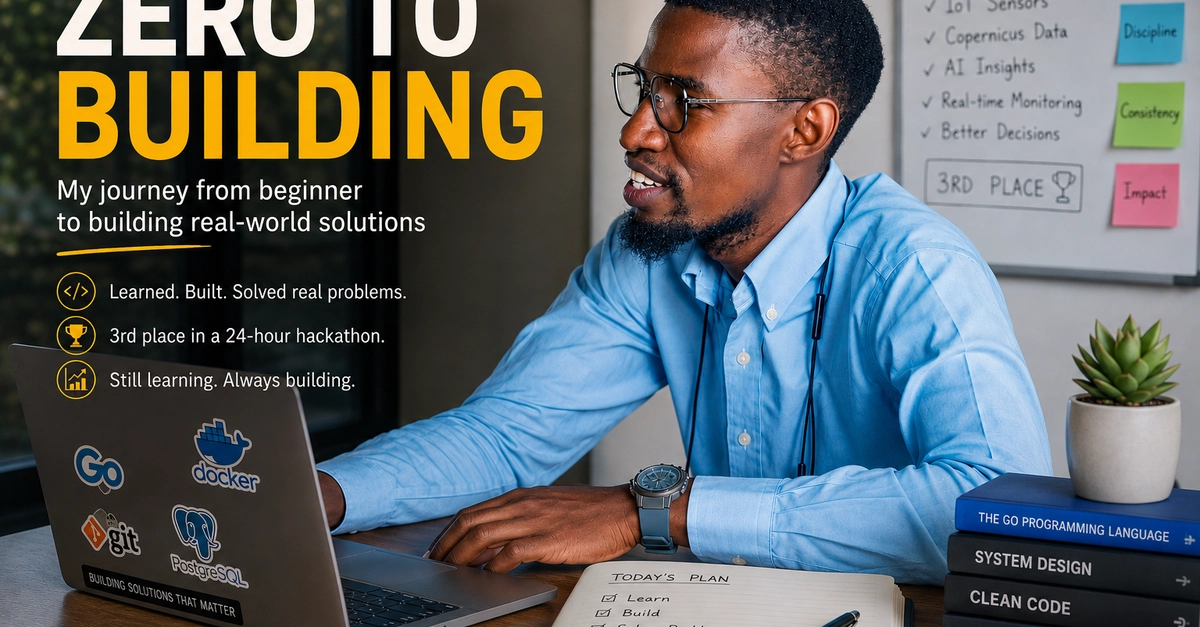
From Novice to Full-Stack in 60 Days
Two months ago, the concept of a programming variable was a foreign language. Today, I'm writing backend Go code, integrating APIs, managing PostgreSQL databases, and deploying with Docker and Git. This rapid transformation wasn't a smooth, linear path; it was a messy, intense journey culminating in a 48-hour build of a solution addressing a real environmental and economic challenge.
My entry into Zone01 Kisumu was as a complete beginner. The initial learning curve was steep, forcing me to grapple with concepts many developers consider fundamental. Questions like 'What is Git?', 'What does git push actually do?', and 'Why isn't my code compiling?' were daily hurdles. Understanding the difference between compile-time and runtime errors, the function of APIs, and the common pitfalls of connecting applications to databases like PostgreSQL felt like deciphering ancient hieroglyphs. The classic 'it works on my machine' problem was a recurring source of frustration, highlighting the disconnect between local development and deployed environments.
The Messy Middle: Debugging and Discovery
The first weeks were a blur of debugging. I'd spend hours staring at error messages, trying to piece together the logic behind my code's failures. Simple tasks, like setting up a local development environment with PostgreSQL and Docker, became significant undertakings. The process often involved a cycle of trial, error, and extensive searching for answers. Stack Overflow became a lifeline, but synthesizing the information and applying it to my specific problem was the real challenge. It wasn't just about finding a solution; it was about understanding why it was a solution.
This period underscored the importance of version control. Initially, Git felt like an unnecessary complication. However, the ability to track changes, revert to previous states, and collaborate (even with myself on different branches) quickly proved indispensable. Docker, too, initially seemed like overkill for a beginner. But the promise of a consistent, reproducible environment – the antithesis of the 'works on my machine' syndrome – was a powerful motivator. Learning to containerize my Go application and its PostgreSQL database simplified deployment immensely, abstracting away many of the underlying system dependencies.
Working with APIs, both consuming and understanding how to build them, opened up new possibilities. The concept of stateless communication, request-response cycles, and data serialization (like JSON) became clearer through practical application. Building the backend for the environmental solution required defining clear API endpoints, handling incoming requests, validating data, and interacting with the database to store and retrieve information. This involved choosing appropriate Go web frameworks and understanding how to structure a backend application logically.
The Environmental Solution: From Concept to Code
The project that truly solidified my learning was a solution designed to tackle a specific environmental and economic problem. The core issue involved [specific problem related to waste management or resource allocation, e.g., inefficient tracking of recyclable materials leading to economic loss and environmental pollution]. The existing methods were either too manual, too expensive, or lacked the real-time data needed for effective intervention.
My proposed solution aimed to create a streamlined, data-driven system. This involved developing a backend service using Go that would handle data input from various sources (potentially sensors or manual entry points), process this data to identify inefficiencies or areas of concern, and provide actionable insights. The database (PostgreSQL) was crucial for storing historical data, tracking key metrics, and enabling trend analysis. The API layer facilitated communication between the backend and any potential frontend interface or other integrated systems.
The 48-hour build was an intense sprint. It demanded rapid prototyping, quick decision-making, and a willingness to push through challenges. The goal was not perfection, but a functional Minimum Viable Product (MVP) that demonstrated the core capabilities of the system. This involved writing code for data validation, database interactions, and the primary logic for generating the required insights. Debugging became more focused, as the objective was clear: get the core functionality working. This intense period of focused development, building upon the foundational knowledge acquired over the previous weeks, allowed me to see the tangible impact of my learning.
The success of this project wasn't just in the code written, but in the realization that I could take a complex problem, break it down, and build a technical solution. It shifted my perspective from being a student of programming to being a builder. The messy journey, filled with errors and frustrations, was precisely what forged the understanding required to complete the task. It proved that with dedication and the right environment, significant progress is possible in a short timeframe.
Looking Ahead: The Developer's Path
This experience has fundamentally changed my view of technology and my place within it. The initial fear of complex codebases and abstract concepts has been replaced by a curiosity and a drive to learn more. The tools and languages learned – Go, Docker, PostgreSQL, Git – are now building blocks for future projects. The immediate next steps involve refining the environmental solution, exploring its potential for broader application, and continuing to deepen my understanding of backend development principles. The journey from knowing nothing about variables to shipping a real-world solution in two months is a testament to the power of hands-on learning and the accessibility of modern development tools.