The Pain of YouTube Summaries
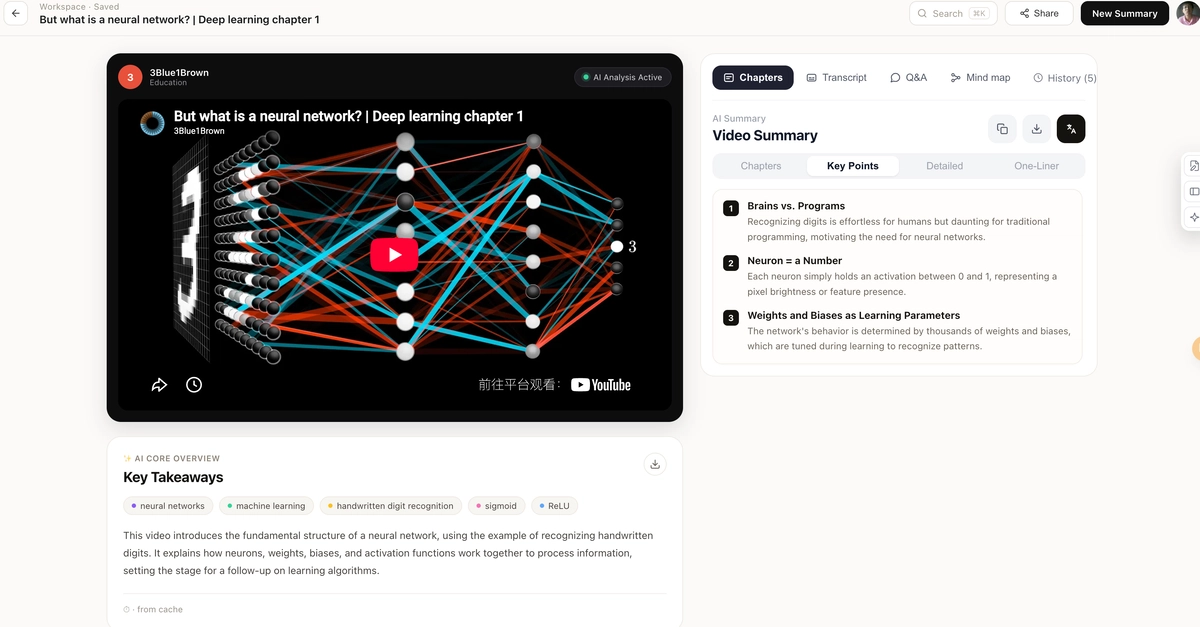
The premise is simple: a user pastes a YouTube link and wants a concise summary of a lengthy video, perhaps a 45-minute conference talk where the key insights are buried somewhere in the middle. The demand is for distilled information, not a time commitment. This is the problem developer Alex Stojanovic set out to solve with SummarizeVideoToText, a tool designed to provide a full transcript, an AI-generated summary, timestamped chapters, a mind map, and an interactive Q&A panel that can interrogate the video's content. The initial pitch is straightforward, but the journey to building a robust tool revealed significant, unexpected challenges.
Caption Retrieval: A Fallback Chain, Not an API Call
Stojanovic’s first attempt at retrieving video transcripts was optimistically simple: call a single endpoint and expect a transcript. This proved to be a naive assumption. YouTube’s internal systems are not designed for direct, programmatic access to captions in a predictable way. The primary endpoint, which one might expect to yield a transcript, fails frequently. Reasons for failure are varied: YouTube frequently rotates its internal APIs, some videos require a specific ‘proof-of-origin’ token to access their associated data, and sometimes, caption tracks exist but are not available in the language the user or the tool requested.
The reality of getting reliable captions from YouTube is far more complex. It requires a fallback strategy, a chain of providers where each layer attempts to fetch the data and, if it fails, passes the request to the next. This multi-stage approach acknowledges that no single method is foolproof. The tool must be prepared to try different techniques, different data sources, and different language handling mechanisms to eventually retrieve usable text data. This is less like a direct API call and more like navigating a series of increasingly fragile bridges, hoping one of them holds.

AI Model Integration and Context Window Limits
Once the transcript is secured, the next hurdle is processing it with AI. Summarizing lengthy videos and enabling a Q&A function requires feeding substantial amounts of text into a language model. Large language models (LLMs) have context window limitations – a finite amount of text they can process at once. A 45-minute video can easily generate a transcript that exceeds these limits, even for advanced models. This means the transcript cannot simply be pasted into the AI in one go.
To overcome this, Stojanovic had to implement chunking strategies. The transcript is broken down into smaller, manageable segments. These segments are then processed individually or in overlapping batches. For summarization, this might involve summarizing each chunk and then summarizing the summaries. For the Q&A feature, the system needs to intelligently select relevant chunks to feed to the LLM based on the user's question, a process that requires sophisticated embedding and retrieval mechanisms. This isn't just about sending text; it's about intelligently managing and querying vast amounts of text data that far exceed typical input sizes for many AI applications. The challenge is akin to trying to read an entire library by only being able to look at one book at a time, and needing to recall information across multiple volumes simultaneously.
Cost Management for AI Inference
The third significant challenge is the operational cost. Running AI models, particularly for tasks like summarizing long texts or performing complex Q&A on extensive transcripts, is computationally expensive. Each inference request to an AI API or a self-hosted model incurs a cost. For a tool that aims to be accessible and potentially free for initial use, managing these costs is paramount. A single user interrogating a long video transcript could trigger numerous API calls, quickly escalating expenses.
Stojanovic had to implement several cost-saving measures. This includes optimizing the AI prompts, choosing the most cost-effective models for different tasks (e.g., a cheaper model for initial summarization, a more powerful one for nuanced Q&A), and potentially rate-limiting or imposing usage caps on free tiers. Caching is also crucial: if multiple users query the same video, the results should ideally be reused. The economic viability of such a tool hinges on balancing powerful AI capabilities with the need to keep operational expenses low. It’s a constant tightrope walk between providing a rich user experience and preventing the service from becoming prohibitively expensive to run.
Beyond the Code: What Users Want
The development of SummarizeVideoToText highlights that building a useful tool involves more than just writing code. It requires anticipating and solving complex infrastructure problems, understanding the nuances of third-party APIs, and navigating the practical constraints of AI technologies. For users, the hope is that these behind-the-scenes challenges are ironed out, delivering a seamless experience that makes consuming long-form video content significantly more efficient.