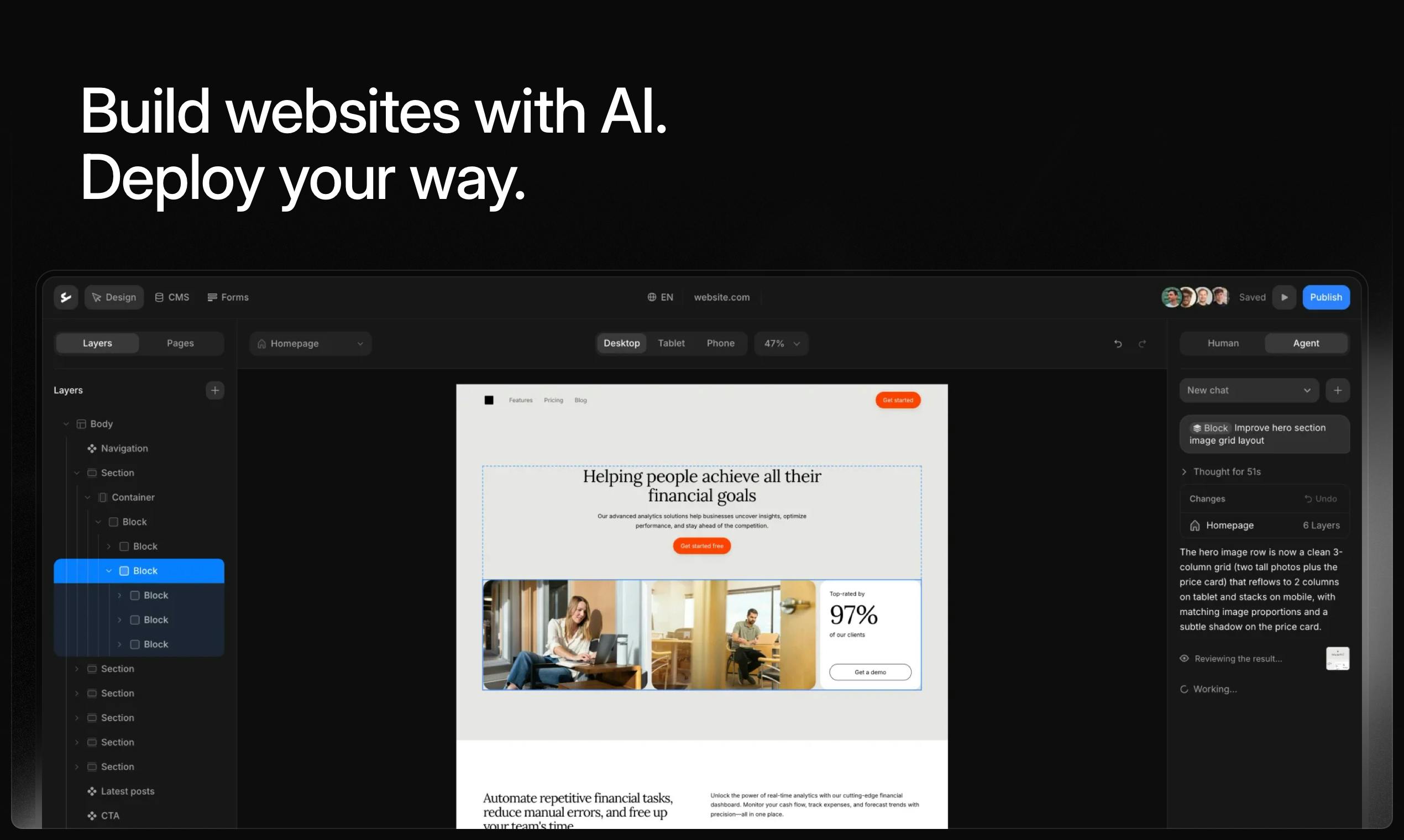
Ycode AI Agents: Building Websites with Natural Language
The landscape of web development is undergoing a significant shift with the introduction of Ycode AI Agents. This new platform aims to empower individuals and businesses to create functional websites using only natural language prompts. Instead of requiring deep technical expertise in coding, design, and deployment, users can describe their desired website, and Ycode's AI agents will handle the heavy lifting.
This move represents a broader trend in the AI space, where complex tasks are being abstracted away into intuitive, human-readable interfaces. Think of Ycode less like a traditional website builder and more like a digital architect who understands your vision from a conversation. The promise is a dramatically reduced barrier to entry for anyone needing an online presence, from small businesses and freelancers to individuals testing out new ideas.
The core functionality of Ycode AI Agents revolves around its ability to interpret user input and translate it into a complete website. This includes not only the visual design and layout but also the underlying structure, content integration, and potentially even basic interactive elements. Users are expected to provide descriptions that cover the purpose of the site, target audience, desired aesthetic, and any specific features or content sections they envision. The AI then synthesizes this information to generate a draft website.
How Ycode AI Agents Work
While the exact technical architecture remains proprietary, the process is designed to be straightforward for the end-user. A user initiates the process by providing a prompt. This prompt can be as simple as 'I need a website for my local bakery, featuring our menu, location, and contact form' or more detailed, specifying color schemes, font preferences, and calls to action.
Ycode's AI agents then parse this input, breaking down the request into constituent parts: content requirements, structural needs, and design parameters. It draws upon a vast knowledge base of web design best practices, UI/UX principles, and common website patterns. This allows it to make informed decisions about layout, navigation, and user flow. The output is not just a static design but a functional website that can be previewed, iterated upon, and eventually published.
The platform likely employs a combination of large language models (LLMs) for understanding user intent and generative AI models for producing code and design elements. This could involve generating HTML, CSS, and JavaScript, or potentially utilizing a proprietary framework that the AI can generate and manage. The iterative nature of AI development suggests that users will be able to provide feedback on the generated site, allowing the AI to refine its output through subsequent prompts.

Implications for Web Development and Business
The advent of tools like Ycode AI Agents has significant implications for both professional developers and the broader business community. For individuals and small businesses that previously found website creation too costly or technically challenging, this offers a viable path to establishing an online presence. It democratizes the ability to launch a digital storefront, portfolio, or informational site, potentially leveling the playing field against larger, more established competitors.
For professional web developers, the impact is more nuanced. While Ycode might automate the creation of simpler websites, it also presents an opportunity to focus on more complex, custom projects that require human creativity, strategic thinking, and advanced problem-solving. Developers may find themselves working alongside AI agents, using them as powerful assistants to accelerate the initial stages of development or to handle repetitive tasks. The demand for AI prompt engineering skills in web development is also likely to rise.
The competitive landscape for website builders and design platforms is intensely crowded. Ycode AI Agents enters this market by offering a fundamentally different approach, moving beyond drag-and-drop interfaces to a generative AI model. This could force established players to accelerate their own AI integrations or risk being outpaced by more agile, AI-native solutions. The success of Ycode will hinge on the quality of its AI output, the intuitiveness of its user experience, and its ability to handle a diverse range of website needs.
What remains to be seen is how Ycode handles the nuances of branding and unique user experiences. While AI can replicate common patterns and styles, creating a truly distinctive brand identity often requires a human touch. The platform's ability to go beyond generic templates and truly capture a unique brand voice will be a key differentiator.
The Future of AI-Powered Web Creation
Ycode AI Agents represents a significant step forward in the application of AI to creative and technical fields. By abstracting the complexities of web development, it opens up new possibilities for entrepreneurship and digital expression. As AI continues to evolve, we can expect even more sophisticated tools that blur the lines between human intention and machine execution.
The immediate future will likely involve further refinement of Ycode's AI capabilities, enabling it to generate more complex websites with greater customization options. Integration with other AI tools, such as content generation AI or SEO optimization AI, could further enhance the platform's utility. The ultimate goal for such platforms is to make the process of bringing an idea online as simple as describing it.
The broader impact on the digital economy is substantial. Lowering the cost and complexity of website creation can spur innovation, enable more individuals to become entrepreneurs, and increase the overall digital footprint of businesses and organizations worldwide. Ycode AI Agents is not just a new tool; it's a potential catalyst for a new era of accessible web development.