The Challenge of Sentence Segmentation
Sentence segmentation, the process of dividing text into individual sentences, is a fundamental yet surprisingly complex task in Natural Language Processing (NLP). While it appears straightforward, real-world text is rife with challenges that can confound even sophisticated systems. Abbreviations like ".", URLs, ellipses ("...", "..."), and intricate punctuation patterns present significant hurdles for rule-based approaches. These edge cases, if mishandled, can lead to catastrophic downstream errors in NLP pipelines, affecting everything from information extraction to sentiment analysis.
spaCy, a widely-used open-source library for advanced NLP, includes a built-in component called the Sentencizer. Designed for speed and efficiency, it's a lightweight, rule-based tool intended to offer a quick solution for sentence splitting. However, this focus on speed and simplicity comes at a cost: accuracy on complex or unusual sentence structures. For many production applications where precision is paramount, the trade-off made by spaCy's Sentencizer proves insufficient, leading to a significant drop in performance on challenging datasets.
Introducing yasbd: A More Accurate Alternative
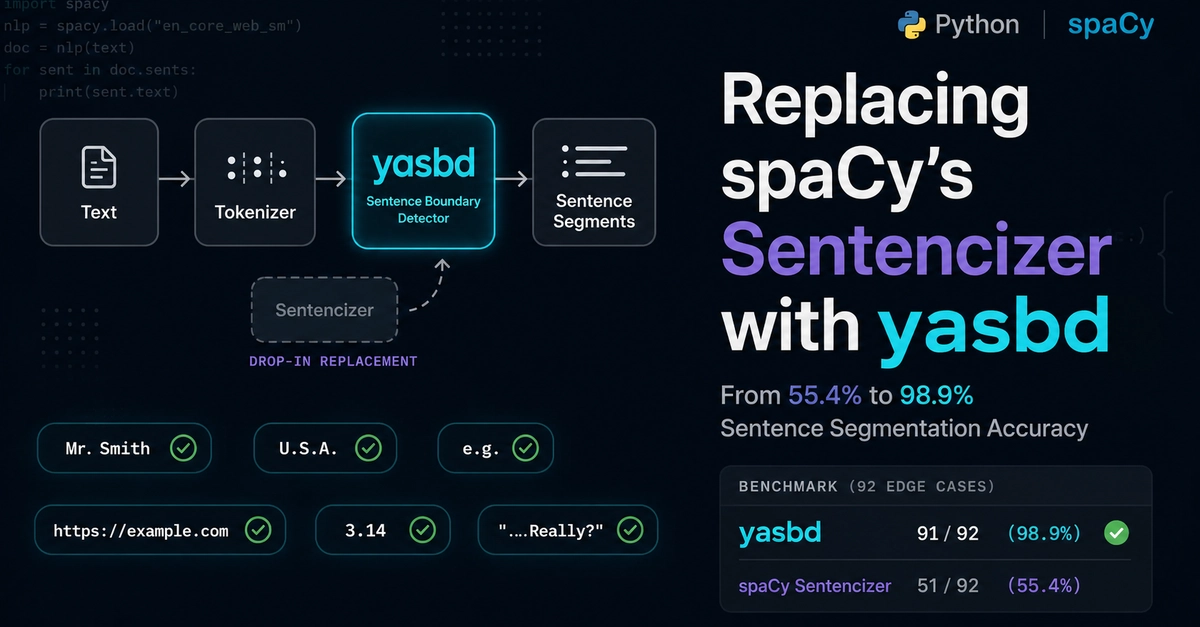
Enter yasbd (Yet Another Sentence Boundary Detector). This pure-Python, rule-based sentence boundary detector (SBD) is designed to be a direct, drop-in replacement for spaCy's Sentencizer. The critical differentiator for yasbd is its significantly higher accuracy. On a challenging English golden benchmark, yasbd achieves an impressive 98.9% accuracy. This stands in stark contrast to spaCy's Sentencizer, which scores a mere 55.4% on the same benchmark. This leap in performance means that applications relying on accurate sentence segmentation can see a dramatic improvement in their overall reliability and effectiveness.
The development of yasbd addresses a key limitation in many existing NLP workflows. While spaCy's ecosystem is robust and comprehensive, its default sentence segmentation component is a known bottleneck for tasks requiring high precision. Developers often face a choice: accept lower accuracy for speed, or implement more complex, custom solutions. yasbd offers a compelling third option: high accuracy with minimal integration effort. Its pure-Python nature also makes it accessible and easy to integrate into various environments without heavy dependencies.
Why spaCy's Sentencizer Falls Short
spaCy's Sentencizer operates on a set of predefined rules designed to be efficient. These rules generally work well for standard English prose. However, they tend to falter when encountering patterns that deviate from the norm. For example, a sentence ending with an abbreviation like "." (e.g., "Dr. Smith arrived.") can be incorrectly split, or a URL containing periods (e.g., "example.com") might be misinterpreted as a sentence terminator. Similarly, complex punctuation like multiple ellipses or quoted sentences within sentences can also pose problems.
The underlying issue is that rule-based systems, by definition, struggle with ambiguity and context that isn't explicitly encoded. spaCy's Sentencizer prioritizes speed by making quick decisions based on these rules. This means it doesn't engage in deeper linguistic analysis that might be required to correctly disambiguate a period following an abbreviation from a period ending a sentence. For developers, this means that if their text data contains a high proportion of such edge cases—common in domains like legal documents, scientific literature, or user-generated content—the Sentencizer's accuracy will plummet, rendering its output unreliable for critical tasks.
Integration and Usage of yasbd
Integrating yasbd into an existing spaCy pipeline is designed to be straightforward. As a drop-in component, it can replace the default Sentencizer with minimal code changes. Typically, this involves initializing yasbd and adding it to the spaCy processing pipeline, often after components that might benefit from accurate sentence boundaries (like Named Entity Recognition or dependency parsing, though sentence segmentation is usually an early step). The library's pure-Python implementation ensures compatibility and ease of use across different operating systems and Python environments.
The key benefit of using yasbd is not just the improved accuracy but also the potential to simplify development workflows. Instead of spending time creating custom regex patterns or complex logic to handle sentence boundary ambiguities, developers can leverage yasbd's pre-built, highly accurate solution. This allows teams to focus on higher-level NLP tasks rather than getting bogged down in the intricacies of sentence splitting. The direct replacement capability means that existing spaCy pipelines can be upgraded with yasbd to immediately benefit from the accuracy gains, often with only a few lines of code modification.
Implications for NLP Pipelines
The discrepancy in accuracy between spaCy's Sentencizer and yasbd has significant implications for the reliability and effectiveness of NLP applications. For tasks like document summarization, question answering, or machine translation, accurate sentence segmentation is critical. An incorrectly segmented sentence can lead to nonsensical inputs for these models, degrading their performance. For instance, if a sentence containing an abbreviation is split incorrectly, the subsequent analysis might treat the parts as separate sentences, potentially losing context or misinterpreting entities.
Consider a system designed to extract key information from financial reports. If a sentence like "The company reported a net profit of $1.2M. This marks a significant increase." is split into three parts due to misinterpretation of the period after "M.", the extraction of the profit figure and its associated commentary would be severely compromised. This is precisely the type of error yasbd aims to prevent. By achieving nearly perfect accuracy, yasbd ensures that the foundational layer of sentence understanding is robust, allowing downstream NLP models to perform at their best.
The existence of yasbd also highlights a broader trend in the NLP community: the continuous effort to refine and improve core NLP components. While libraries like spaCy provide excellent general-purpose tools, the demand for specialized, high-performance components for specific tasks like sentence segmentation continues to grow. This allows developers to build more robust and accurate NLP systems by selecting the best-in-class tools for each stage of their pipeline. The success of yasbd suggests that there is a clear market for specialized, highly accurate NLP building blocks that can integrate seamlessly with established frameworks.
The Future of Sentence Boundary Detection
The significant performance gap demonstrated by yasbd raises questions about the future of sentence boundary detection. While spaCy's Sentencizer prioritizes a balance of speed and simplicity, the clear demand for higher accuracy, especially in specialized domains, suggests that SBD components will continue to evolve. It remains to be seen whether spaCy itself will incorporate more advanced SBD techniques into its core offering or if the community will continue to rely on external libraries like yasbd for maximum precision.
For developers and data scientists working with text data, the choice of an SBD component is no longer a trivial one. The leap from 55.4% to 98.9% accuracy is substantial and can directly impact the quality of insights derived from NLP models. Adopting yasbd offers a tangible path to improving the robustness of sentence segmentation, thereby enhancing the overall performance of NLP pipelines. This upgrade is not just a minor tweak; it's a fundamental improvement to how text is understood at its most basic level, paving the way for more reliable and accurate language processing applications.