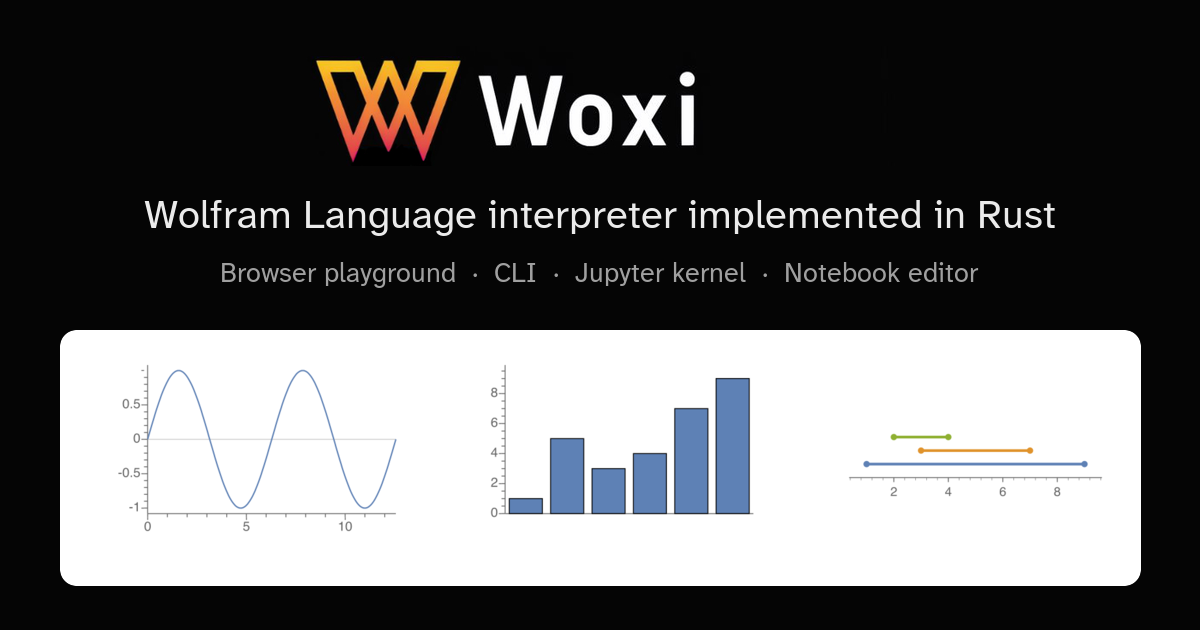
The Ambition: Recreating a Computational Ecosystem
A new project, Woxi, has emerged on Hacker News with the explicit goal of reimplementing Mathematica and its underlying Wolfram Language. This ambitious undertaking seeks to create an open-source alternative to a proprietary, decades-old computational system that powers everything from scientific research to complex data analysis.
Mathematica, developed by Wolfram Research, is a powerful symbolic computation program. Its integrated system allows for symbolic manipulation, visualization, and programming. For decades, it has been the go-to tool for mathematicians, scientists, engineers, and data analysts who require its unique blend of symbolic reasoning and numerical computation. However, its proprietary nature and associated licensing costs have always presented a barrier for many individuals and institutions.
Woxi aims to dismantle that barrier. The project's creators have embarked on the monumental task of reverse-engineering and rebuilding the core functionalities of Wolfram Language. This is not merely about creating a similar syntax; it involves understanding and replicating the deep symbolic manipulation capabilities, the vast curated knowledge base, and the sophisticated computational engine that defines Mathematica.
The Wolfram Language is known for its declarative programming style and its ability to handle complex mathematical operations symbolically. This means it can manipulate mathematical expressions as abstract structures rather than just numbers. For instance, it can perform algebraic simplification, solve equations analytically, and work with abstract mathematical concepts like functions and sets without needing concrete numerical values. This symbolic approach is fundamental to many advanced fields of research and development.
Technical Challenges and Approach
Reimplementing a system as complex as Mathematica is a formidable technical challenge. The Wolfram Language's strength lies in its intricate algorithms for symbolic integration, differentiation, equation solving, and matrix manipulation, among many other areas. Each of these requires deep algorithmic understanding and precise implementation.
The Woxi project will likely need to tackle several key areas:
- Symbolic Manipulation Engine: The core of any Mathematica alternative. This involves developing algorithms that can represent, transform, and evaluate mathematical expressions symbolically. This is akin to building a sophisticated theorem prover and algebraic manipulation system from scratch.
- Knowledge Base Integration: Mathematica is renowned for its vast curated knowledge base, which includes data on physics, chemistry, mathematics, geography, and more. Integrating and making this knowledge accessible through the language is a significant undertaking.
- Programming Language Semantics: Replicating the unique functional and symbolic programming paradigm of Wolfram Language, including its pattern matching, rule-based transformations, and dynamic evaluation.
- Interoperability and Ecosystem: A successful reimplementation would also need to consider how it interacts with other tools and languages, and how it can foster its own community and package ecosystem, much like Mathematica has over the years.
The developers behind Woxi are essentially reverse-engineering a proprietary system. This means they must deduce the underlying principles and algorithms from observing Mathematica's behavior and outputs, or by referring to publicly available documentation and research papers that describe aspects of its functionality. This process is painstaking and requires a deep understanding of computer science, mathematics, and programming language design.
The open-source nature of Woxi is its most significant differentiator. It invites collaboration from a global community of developers and mathematicians. This distributed effort can potentially accelerate development and uncover novel approaches to problems that might be intractable for a single company. Furthermore, an open-source implementation means users are not beholden to licensing agreements or vendor lock-in, fostering greater academic and commercial freedom.
Think of this project less like building a clone and more like rebuilding a renowned scientific instrument with entirely new materials and blueprints, guided by the original’s capabilities. The goal isn't just to match functionality, but to ensure the underlying principles are sound and the system is extensible and transparent.
Community Reaction and Future Implications
The announcement on Hacker News has generated immediate interest. Early comments reflect both excitement and healthy skepticism regarding the sheer scale of the project. Many users shared their reliance on Mathematica and the potential impact of a viable open-source alternative.
The path forward for Woxi will be long and arduous. Successfully replicating even a fraction of Mathematica's capabilities would be a major achievement. The project’s success will depend on its ability to attract and retain a dedicated community of contributors, its technical execution in building a robust symbolic engine, and its capacity to provide a user experience that, while perhaps initially less polished, offers genuine computational power.
If Woxi can mature into a functional and stable reimplementation, it could democratize access to advanced computational tools. This would empower students, researchers in resource-constrained environments, and startups to leverage powerful symbolic computation without prohibitive costs. It also presents an opportunity for innovation, as an open-source project can evolve in directions dictated by user needs rather than commercial roadmaps.
What remains to be seen is the long-term viability and the depth of functionality Woxi can achieve. Replicating the vast, integrated knowledge base and the highly optimized, proprietary algorithms of Mathematica is a Herculean task. However, the open-source community has a track record of achieving the seemingly impossible through collective effort and persistent innovation.
For developers and researchers accustomed to Mathematica, Woxi represents a beacon of hope for a more accessible future in computational mathematics. Its journey will be one to watch closely.