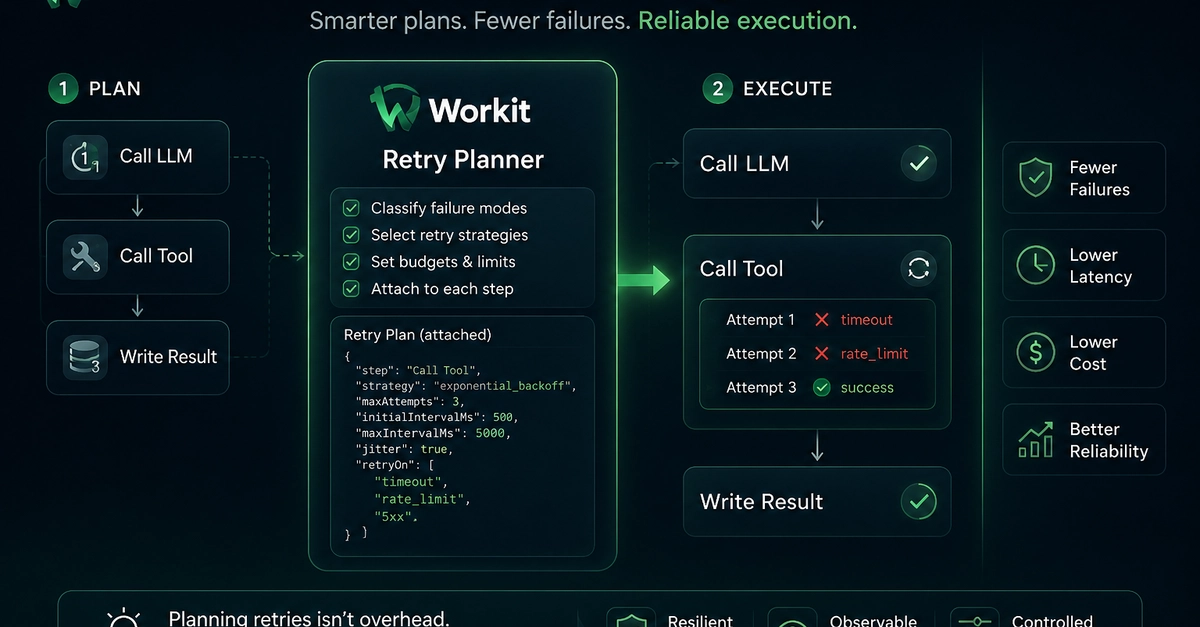
The Problem with Reactive Retries
Many applications rely on retrying failed operations. This is a standard pattern to handle transient network issues or temporary service unavailability. However, a common pitfall is implementing retry logic reactively, without considering the overall time budget of the operation. A retry policy, which might seem reasonable in isolation, can become impossible to fulfill within the constraints of the originating request. This leads to unexpected timeouts and failures that are difficult to debug because the individual retry attempts themselves are valid, but their cumulative duration exceeds the allotted time.
Consider a scenario where a single provider attempt takes 800 milliseconds. The system is configured to allow four attempts with an increasing backoff strategy. Meanwhile, the entire request has a strict two-second (2000 milliseconds) deadline. Individually, 800ms per attempt and a few retries seem manageable. But when you sum them up – the first attempt (800ms), a potential second attempt (800ms + backoff), and so on – the total time quickly exceeds the 2000ms limit. The request fails not because any single step was too slow, but because the sequence of retries, even with delays, fundamentally cannot fit within the allocated window.
This is akin to planning a road trip. You might have enough fuel for each individual leg of the journey, and your car can technically make the distance. But if you haven't factored in the total driving time, rest stops, and potential traffic delays against your overall arrival deadline, you might find yourself stranded or late, even though each component seemed fine on its own.
Introducing @workit/core/time-policy
To address this critical gap, the team behind Workit has introduced @workit/core/time-policy. This library provides a proactive approach to managing retry logic. Instead of simply defining a number of retries and a backoff strategy, it allows developers to plan the execution shape of these retries before any task actually runs. The core function, planTimePolicy, evaluates the feasibility of a given time policy against a defined total duration.
The library takes a structured input, including the retry type (e.g., exponential backoff), the maximum number of attempts, and the initial delay. It also considers the estimated duration of the operation itself. By processing these parameters, planTimePolicy can determine if the proposed retry schedule can realistically complete within the overall request deadline. This pre-execution analysis prevents the runtime surprises that plague many distributed systems.
The output of planTimePolicy is not just a boolean indicating success or failure, but a detailed breakdown of the planned execution. This includes the total estimated time the policy would consume, the number of attempts that can actually be made within the deadline, and the specific delays between each attempt. This level of transparency is invaluable for developers trying to design robust and predictable systems.
How it Works: The Planning Phase
The process begins with defining the time policy. This typically involves:
- Operation Duration: An estimate of how long a single successful execution of the task takes.
- Max Attempts: The maximum number of times the operation should be retried.
- Backoff Strategy: How the delay between retries increases. Common strategies include linear, exponential, or fixed backoff.
- Total Duration: The absolute deadline for the entire operation, including all retries.
The planTimePolicy function then simulates the execution. For an exponential backoff strategy, it might calculate the first attempt's duration, add the initial delay, then calculate the second attempt's duration plus an exponentially increased delay, and so on. It continuously sums these durations and delays. If at any point the cumulative time exceeds the totalDuration, the planning stops. The function then returns the maximum number of attempts that could be completed within the budget, along with the precise timings for each step.
This is fundamentally different from simply setting a timeout on the entire request and hoping for the best. It allows developers to make informed decisions about their retry strategies. For instance, if planTimePolicy indicates that only two out of five intended retries can fit within the two-second window, a developer might need to:
- Reduce the estimated operation duration (if possible).
- Shorten the backoff delays.
- Increase the overall request deadline (if system architecture permits).
- Re-evaluate the necessity of so many retries for this specific operation.
The library's design prioritizes clarity and predictability. By making the temporal implications of retry logic explicit, it shifts the burden of temporal management from runtime guesswork to pre-execution design.
Implications for System Design
The introduction of proactive retry planning has significant implications for building resilient distributed systems. Developers can now integrate this planning step directly into their workflow, ensuring that retry mechanisms are not just functional but also practical within real-world system constraints.
For teams building critical services, this means fewer unexpected timeouts and a more robust user experience. Instead of a request failing silently or with a generic timeout error, systems can potentially provide more specific feedback or gracefully degrade functionality when retries are infeasible. It encourages a mindset where temporal budgets are treated as first-class citizens in system design, much like error handling or data validation.
What remains to be seen is how widely this proactive approach will be adopted. Developers are accustomed to configuring retries and timeouts, but the explicit planning step requires a shift in perspective. Will this become a standard practice, or will it remain a niche tool for highly critical systems? The success of @workit/core/time-policy will likely depend on its ease of integration and the clear demonstration of its value in preventing costly production incidents.