
Bridging the Gap: Wireless AI Performance
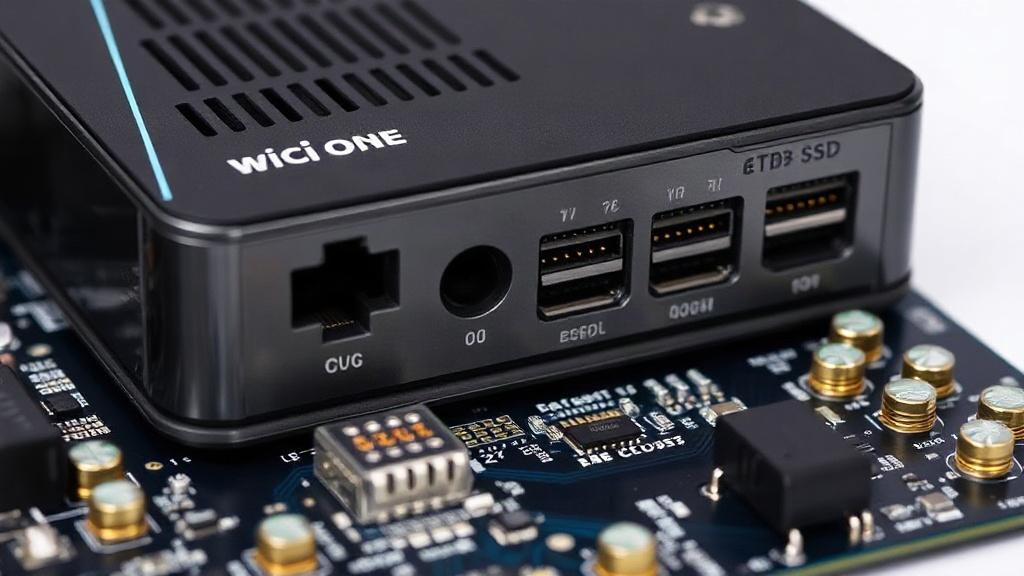
The race to democratize powerful AI processing is heating up, and WiCi One has entered the fray with an ambitious product: a wireless external GPU (eGPU) box equipped with a substantial 4TB SSD. Priced at $1,999, this device aims to deliver desktop-grade AI performance to laptops and other machines that lack powerful onboard graphics or extensive storage. The core innovation lies in its utilization of Wi-Fi 7, promising high bandwidth and low latency connectivity that could make a remote GPU feel as responsive as a local one.
For years, the dream of offloading intensive computational tasks, particularly for AI and machine learning, to external hardware has been hampered by the limitations of connectivity. Traditional eGPU solutions rely on Thunderbolt, which, while fast, is still a wired connection. This new offering from WiCi One seeks to liberate users from cables, presenting a scenario where a powerful GPU, paired with significant local storage for datasets and models, can be accessed wirelessly. This is particularly relevant for developers, data scientists, and creators who need substantial GPU compute and storage but prefer the portability of a laptop.
The inclusion of a 4TB SSD is a critical component. AI workloads are notoriously storage-intensive, requiring vast amounts of data for training and rapid access to large models. By integrating this much storage directly into the eGPU enclosure, WiCi One addresses a common bottleneck. Users can store their datasets and models locally on the SSD, minimizing the need to transfer large files over the network, even when the GPU itself is accessed wirelessly. This setup positions the WiCi One box not just as a graphics accelerator, but as a self-contained AI workstation accessory.
Wi-Fi 7 as the Backbone
The standout technology enabling this wireless approach is Wi-Fi 7 (802.11be). This latest Wi-Fi standard offers theoretical peak speeds of up to 46 Gbps, a significant leap from Wi-Fi 6/6E's 9.6 Gbps. More importantly for demanding applications like AI, Wi-Fi 7 introduces features such as Multi-Link Operation (MLO), which allows devices to connect simultaneously across different frequency bands (2.4 GHz, 5 GHz, and 6 GHz), and improved channel utilization, leading to lower latency and increased reliability. These advancements are crucial for an eGPU solution where the latency introduced by wireless transmission can significantly degrade performance.
WiCi One's strategy is to present the remote GPU and its local SSD as if they were directly attached to the host machine. This implies a sophisticated software layer that manages the connection and abstracts the hardware. The success of this product will hinge on how effectively it can mask the wireless connection's overhead, making the user experience seamless. If the latency and bandwidth provided by Wi-Fi 7 are sufficient, it could unlock new possibilities for flexible and powerful computing setups.
Performance Expectations and Use Cases
While the exact GPU configuration within the WiCi One box is not specified in the initial announcement, the promise of desktop-class AI performance suggests it will house a powerful, modern graphics card. Users can anticipate being able to run more complex AI models, train larger neural networks, and perform inference tasks with significantly reduced wait times compared to relying solely on integrated graphics or lower-end discrete GPUs. The 4TB SSD further enhances this by allowing for larger datasets and more extensive model libraries to be kept readily accessible.
Potential use cases are varied. For developers, it means a portable laptop can be transformed into a potent machine for AI model development and experimentation without being tethered to a powerful desktop. Data scientists can leverage it for faster iteration cycles on training models. For content creators, particularly those working with AI-assisted tools for video editing, 3D rendering, or complex image manipulation, the wireless eGPU could offer a significant boost in productivity.
The $1,999 price point places this device in the premium segment. It competes not only with traditional wired eGPU enclosures but also with compact AI workstations or even entry-level servers. The key differentiator is the wireless convenience, which could justify the cost for users who prioritize flexibility and a clutter-free workspace. However, the ultimate performance and user experience will depend on the synergy between the Wi-Fi 7 implementation, the chosen GPU, and the host machine's compatibility.
The Unanswered Question: Software and Compatibility
What remains to be seen is the robustness of WiCi One's software stack and its compatibility across different operating systems and hardware configurations. Delivering a seamless experience where a remote GPU feels local requires more than just fast wireless. It demands intelligent driver management, efficient data serialization, and potentially custom software solutions to optimize performance. The company needs to ensure that its solution doesn't introduce unexpected compatibility issues or performance quirks that undermine the benefits of Wi-Fi 7. For developers who rely on specific libraries or frameworks, ensuring that the wireless GPU setup doesn't interfere with their existing workflows will be paramount.
The market for external GPUs has seen ups and downs, often hindered by the cost-benefit analysis compared to simply upgrading the entire system. WiCi One's approach, by integrating high-capacity storage and leveraging the latest wireless standard, attempts to carve out a unique niche. If successful, it could redefine how users approach portable AI computing, offering a compelling blend of power, capacity, and wireless freedom.