
The Unsexy Problem Solving the AI Hardware Boom
It might seem like a trivial pursuit, but the humble act of folding laundry has become a magnet for venture capital and a proving ground for the next generation of robotics startups. While headlines often focus on autonomous vehicles or advanced manufacturing, a significant chunk of the billions pouring into robotics is being directed toward solving this surprisingly complex domestic chore. Companies like FoldiMate, Laundroid (now defunct), and Swyft are not just building gadgets; they are attempting to crack a problem that requires sophisticated AI, advanced manipulation, and a deep understanding of human-scale interaction – all for a task that most people find tedious, but which has proven exceptionally difficult for machines.
The allure of laundry folding for robotics startups isn't about convenience alone. It represents a confluence of challenges that, if solved, unlock a vast market and demonstrate mastery over critical AI and robotics capabilities. These include precise object recognition (distinguishing between different types of garments), dexterous manipulation (handling soft, deformable fabrics without damaging them), and adaptive learning (adjusting to wrinkles, sizes, and fabric types). Success in this domain signals a significant leap forward in general-purpose robotics, making these startups attractive to investors looking for the next big thing beyond specialized industrial applications.
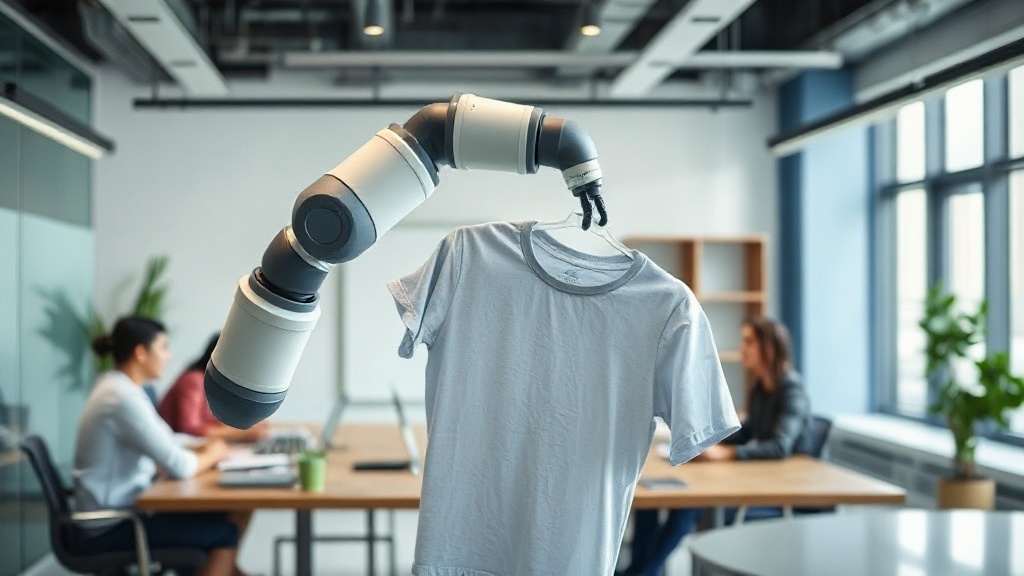
Think of it less like programming a factory robot to assemble car parts – where objects are rigid and environments are controlled – and more like teaching a person to sort and fold a chaotic pile of laundry. Fabrics are soft, they deform, they wrinkle, and they don't have fixed shapes. A robot needs to be able to grasp a sock, identify its orientation, and then maneuver it into a neat fold, all while dealing with the inherent unpredictability of textiles. This requires advanced computer vision to understand the 3D shape and state of the fabric, and delicate robotic grippers that can apply just the right amount of pressure. The sheer variety of clothing types, sizes, and materials further complicates the problem, demanding a level of adaptability that current industrial robots often lack.
Why Now? The Convergence of AI and Investment
Several factors are converging to make this the opportune moment for laundry-folding robots. Firstly, advancements in AI, particularly in machine learning and computer vision, have reached a point where machines can better interpret the complex visual data associated with fabrics. Deep learning models can now be trained on massive datasets of clothing images and folding sequences, enabling them to recognize and manipulate garments with greater accuracy. Secondly, the cost of sensors, processors, and actuators has decreased, making sophisticated robotic systems more economically viable for consumer applications.
The market potential is undeniable. Every household has laundry. While early iterations of these robots are likely to be expensive and targeted at early adopters or commercial laundromats, the long-term vision is a ubiquitous appliance that frees up significant human time. For investors, the prospect of capturing a piece of this massive consumer market, estimated to be worth billions globally, is a powerful draw. Furthermore, the successful development of a general-purpose fabric manipulation system could have spillover effects into other industries, such as logistics (package handling), agriculture (fruit picking), and even healthcare (handling delicate medical textiles).
The Technical Hurdles and the Road Ahead
Despite the investment and technological progress, the path to a perfect laundry-folding robot is fraught with challenges. The primary hurdle remains the delicate and unpredictable nature of fabric. Unlike rigid objects, clothes lack defined edges and can easily slip from grippers or become tangled. Developing end-effectors (the robotic equivalent of hands) that can grip and manipulate soft materials without tearing or bunching them is a significant engineering feat. Researchers are exploring various approaches, from suction-based grippers to multi-fingered manipulators with tactile feedback, each with its own set of trade-offs.
Another critical aspect is the speed and efficiency of the folding process. Consumers expect laundry to be folded relatively quickly. Early prototypes often take several minutes to fold a single item, which is not practical for everyday use. Startups are working on optimizing algorithms and hardware to increase throughput, aiming for a speed comparable to human folding. The cost of these robots is also a major consideration. For a consumer product to achieve mass adoption, it needs to be affordable. This means driving down the cost of complex components and manufacturing processes.
What nobody has fully addressed yet is the long-term maintenance and repairability of these complex consumer robots. When a sophisticated AI-powered appliance breaks down, who fixes it, and at what cost? The current model often relies on expensive, specialized technicians, which could become a significant barrier to widespread adoption for a product that will inevitably require servicing.
Beyond the Laundry Room: A Foundation for General Robotics
The obsession with laundry folding is, in essence, a strategic choice. It’s a way for robotics companies to tackle a real-world, high-value problem that requires a broad set of advanced capabilities. Solving fabric manipulation is a proxy for solving general-purpose robotics. The companies that succeed here will likely develop platforms that can be adapted to a wide range of other tasks, from sorting packages in warehouses to assisting with elder care. The lessons learned in handling soft, deformable objects and integrating complex AI for real-time decision-making will be invaluable.
The billions being invested in laundry-folding robots are not just about cleaner closets. They represent a bet on the future of robotics – a future where machines can perform complex, nuanced tasks in unstructured, human environments. If these startups can successfully automate the folding of clothes, they will have demonstrated a level of dexterity and intelligence that paves the way for robots to become integral parts of our homes and workplaces in ways we are only beginning to imagine.