The Challenge: Bridging Serverless and GPU Compute
Running a demanding AI model like Whisper, which requires significant GPU resources and potentially long processing times, within the constraints of a Cloudflare Worker presents a fundamental architectural puzzle. Workers are designed for ephemeral, short-lived tasks, typically handling requests in milliseconds. They cannot sustain multi-minute GPU computations, nor can they directly establish the gRPC connections that Modal's Python SDK uses for its spawn() functionality. This inherent mismatch means the conventional approach of directly invoking Modal from the Worker is a non-starter.
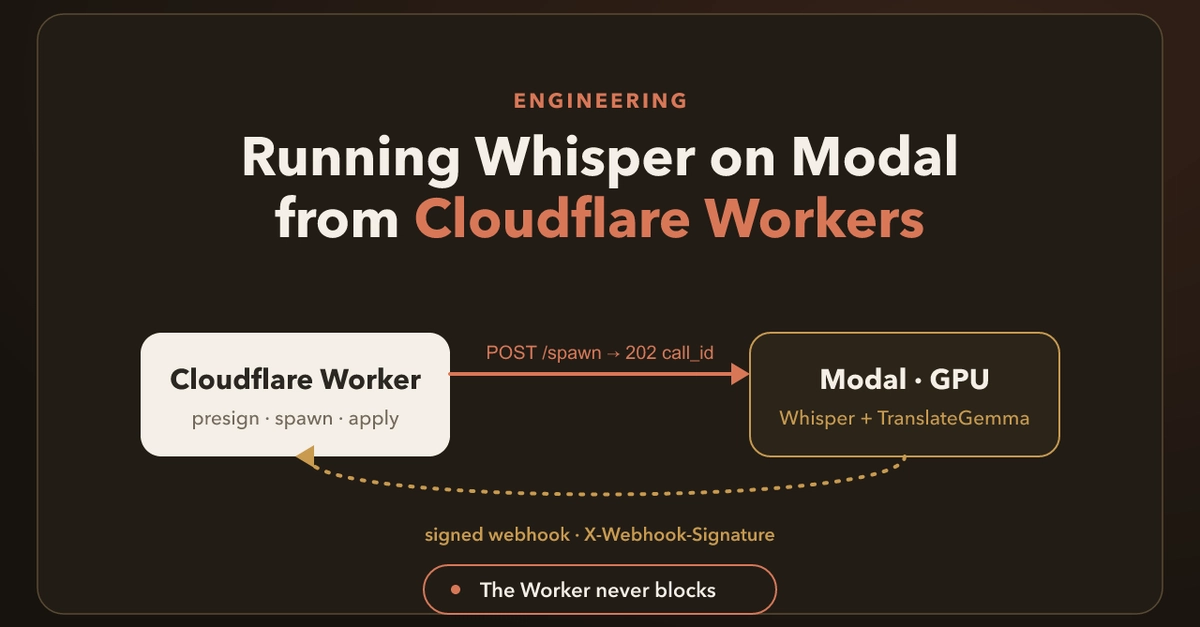
The solution, as implemented by ScribeToAny, is to reframe the interaction. Instead of treating Modal as an SDK to be called directly, it's treated as a remote HTTP endpoint. The Worker initiates a job on Modal, and Modal, upon completion, signals back to the Worker via a signed webhook. This asynchronous, fire-and-forget pattern allows the Worker to remain responsive while the heavy lifting occurs on Modal's GPU infrastructure. The entire web application resides on Cloudflare Workers, while Whisper processing, including optional translation, is offloaded to Modal's GPUs. This architecture successfully marries two runtimes with diametrically opposed operational characteristics.
Decoupling Workloads for Scalability
The core principle is workload decoupling. Cloudflare Workers excel at handling user-facing requests, authentication, routing, and orchestrating external services. They provide a globally distributed, low-latency frontend. However, their compute budget is strictly limited, making them unsuitable for intensive tasks like audio transcription or complex model inference. Modal, on the other hand, provides on-demand GPU compute, allowing developers to run Python code that requires substantial processing power without managing underlying infrastructure.
The interaction design pivots on an HTTP POST request from the Worker to Modal. This request carries the necessary data for transcription – typically the audio file or a reference to it. Modal then queues this job, spins up the appropriate GPU environment, and executes the Whisper model. The critical innovation here is the webhook callback. Once Whisper completes its task, Modal sends an HTTP POST request back to a pre-defined, authenticated endpoint on the Worker. This callback carries the transcription results.
Implementing the Webhook Callback Mechanism
Securing this callback is paramount. A signed webhook ensures that the incoming request genuinely originates from Modal and has not been tampered with. This involves Modal generating a signature for each callback, typically using a shared secret or a cryptographic key. The Worker then verifies this signature upon receipt. This verification process is straightforward within a Worker's environment, as it involves standard HTTP request handling and cryptographic operations.
The data flow looks like this: A user uploads an audio file via the ScribeToAny web app. The Worker receives the file, potentially stores it temporarily in a service like R2, and then sends an HTTP request to Modal's API to initiate a transcription job. This request includes a payload containing the audio file's location and any specific parameters for Whisper (e.g., language, task). Modal acknowledges the request and begins processing. While the Worker is free to handle other incoming requests, it also sets up an endpoint to listen for the Modal callback. Upon receiving the signed webhook from Modal with the transcription results, the Worker processes this data, perhaps storing it in a database or returning it to the user's session.
Handling Asynchronous Operations in Workers
Workers are inherently stateless and event-driven. Managing long-running, asynchronous processes requires careful design. In this scenario, the Worker doesn't wait for Whisper to finish. Instead, it immediately returns a response to the user, indicating that the transcription is in progress. The user might then poll for results, or receive a notification when the transcription is complete. The webhook mechanism provides the push notification from Modal to the Worker, which then updates the application's state.
This approach effectively sidesteps the Worker's execution time limits. The Worker's job is to orchestrate the request and handle the final result delivery, not to perform the computation itself. Modal handles the compute-intensive part. This separation allows each service to operate within its strengths. The Worker remains fast and scalable for user interactions, while Modal provides the necessary heavy-duty processing power for AI tasks.
The Surprising Simplicity of the HTTP Abstraction
The most surprising detail here is not the technical complexity of bridging these two disparate platforms, but the elegance and relative simplicity of abstracting Modal away from its SDK. Developers accustomed to direct SDK integration might find this indirect, HTTP-centric approach initially counterintuitive. However, it unlocks powerful cross-platform integrations where one environment is fundamentally unsuited for the other's primary workload. Treating Modal as a remote API endpoint, rather than a library to be imported, is the key insight that makes this architecture feasible. It transforms a seemingly impossible integration into a manageable system.
Future Implications and Alternatives
This pattern of using serverless functions as orchestrators for specialized, on-demand compute services is likely to become more common. As serverless platforms mature, their role will increasingly shift towards managing and coordinating distributed workloads rather than executing them entirely. For developers building AI-powered applications, this offers a flexible way to leverage powerful GPU resources without the overhead of managing dedicated infrastructure. While Modal is a compelling option, similar patterns could be applied with other GPU compute providers accessible via APIs, provided they offer robust callback or webhook mechanisms.